I Went Looking for the Real Book of Revelation. There's No There There.
Tracing the most feared book in the Bible back to its source, where I found forgeries, a fabricated apocalypse, and the blueprint for psychological warfare.
The Apocalypse is nightmare fuel when taken literally. Is the Book of Revelation real, or shaped by historical manipulation and Biblical forgery? Join Chance Garton and Dylan Saccoccio on Inner Whirled for a decode of the Revelation Mind War and the origins of the Textus Receptus.
Watch the free half of this podcast on Youtube
BECOME A PAID MEMBER TO UNLOCK THE FULL VIDEO EPISODE AND DETAILED SHOW NOTES WITH SLIDES - SCROLL DOWN TO VIEW
🔓 Support the podcast and get access to double length episodes by becoming an InnerVerse Plus+ member.
The Apocalypse is nightmare fuel when taken literally. Is the Book of Revelation real, or shaped by historical manipulation and Biblical forgery? Join Chance Garton and Dylan Saccoccio on Inner Whirled for a decode of the Revelation Mind War and the origins of the Textus Receptus.
The Plus+ Extension is where things get interesting:
Jesus is Lucifer and Lucifer is Venus and Venus is Mary
The Father/Mother/Son androgyne
Which of the Johns wrote Revelation anyway?
What the historical record contains about Rome’s persecution of Christians
The allegory of the Whore of Babylon, 1st Century Rome and “antichrist” Nero
Codex Siniaticus & Vaticanus, and the oldest Bibles
In the last episode, we discussed St. John’s Revelation or Apocalypse and how it was significantly altered if not entirely composed in the early 16th century. We need to do a clarification around this, because the way that I spoke about it was misleading when I said, “one guy basically made it up.” The situation is more nuanced than that statement makes it seem, although I still think the odds that Revelation was authentically written by John the Apostle are the same odds as any of the other Gospels of the New Testament having been written by Matthew, Mark or Luke—in other words, there’s zero chance of that being true.
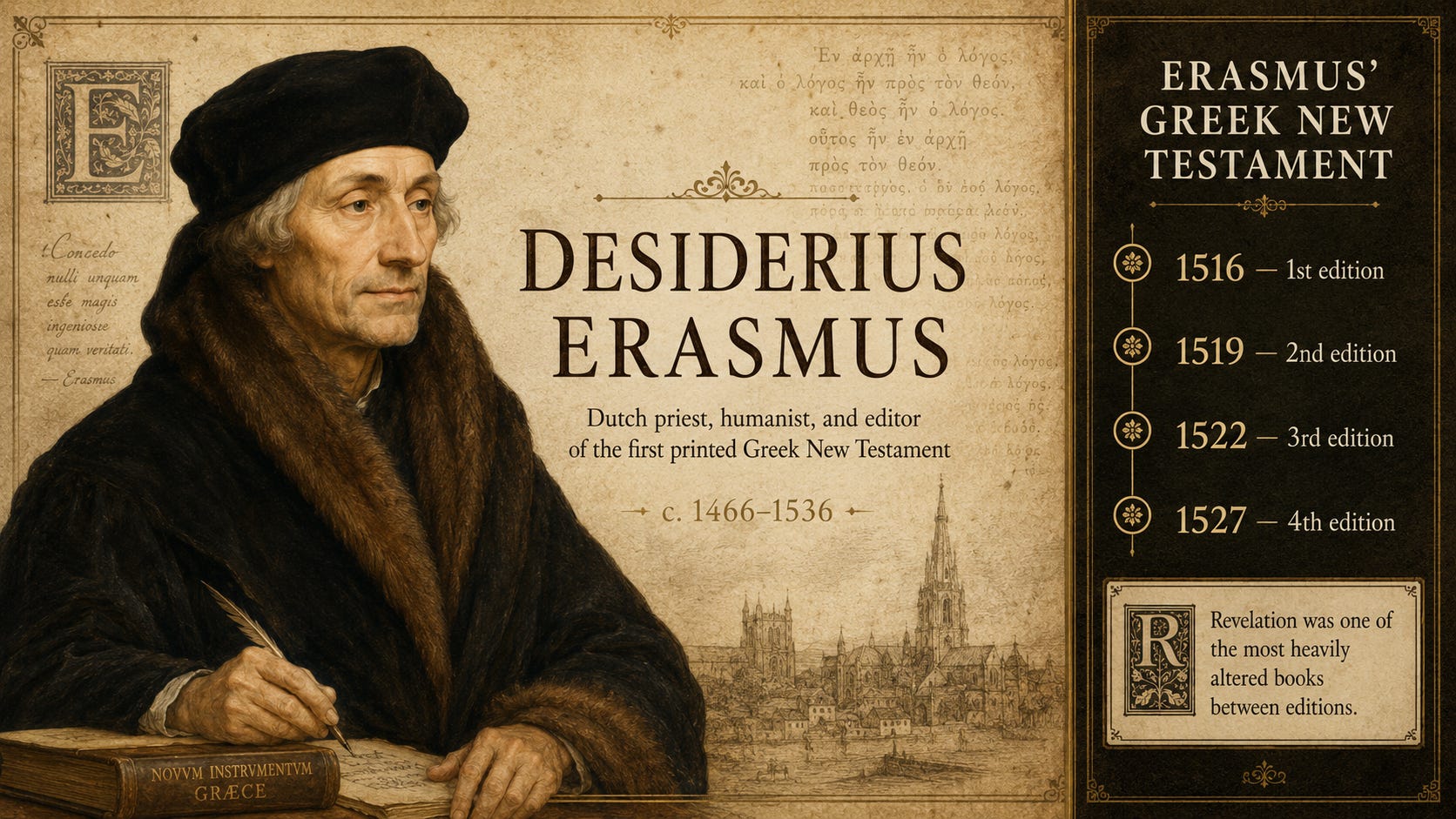
The Dutch priest and humanist Erasmus wrote in a letter to Luigi Marliano from the 16th century, “I know that sometimes it is a good man’s duty to conceal the truth, and not to publish it regardless of times and places, before every audience and by every method, and everywhere complete.” In another letter to Justus Jonas he criticized Martin Luther, founder of Protestantism, for “making everything public and giving even cobblers a share in what is normally handled by scholars as mysteries reserved for the initiated.” Keep in mind that the “Apocalypse” was the standard technical term initiates used across all the Mediterranean mystery schools to describe the reception of Gnosis. The Latin “Revelare” means “to unveil,” making it equivalent to Apocalypse.
This Erasmus is the very same who doctored the scriptures in his lifetime, and especially Revelation, as 90 percent of the alterations he made to the Bible were in this book, as Rev. Robert Taylor wrote: “Dr. John Mill computes that the fourth edition of Erasmus’s Greek Testament differed from his third edition in no less than one hundred and six, or one hundred and thirteen places—ninety of which were alterations made exclusively in the Book of Revelation.” But there is actually an even better documented case of fabricated scripture in the Erasmus story, the Comma Johanneum.
1 John 5:7 in the King James Bible famously reads, “For there are three that bear record in heaven, the Father, the Word, and the Holy Ghost: and these three are one.” While there are many instances of Father/Son/Holy Ghost being mentioned together, which are interpreted to mean three-in-one, 1 John 5:7 is the only verse that explicitly states the doctrine of the trinity. Erasmus omitted this verse from his first two editions of the Greek New Testament because he could not find it in any Greek manuscript he examined, only in “later” Latin Vulgate copies. After being savagely attacked by Stunica and the Archbishop of York for this omission, tradition holds that he responded by promising to include the verse if anyone could produce a single Greek manuscript that contained it.
A previously unknown manuscript conveniently appeared in Britain, now known as the Codex Montfortianus, and scholarly consensus is overwhelmingly in favor that this manuscript was forged specifically to win the argument and force Erasmus to include the doctrine of the trinity in the printed Bible. This is not an exceptional case, only an exceptionally well documented case. This tendency of church fathers to “discover” ancient documents that happen to support their preferred dogma, and thus to create a perception of ancient precedence for their interpretations, this tendency was the rule, not the exception.
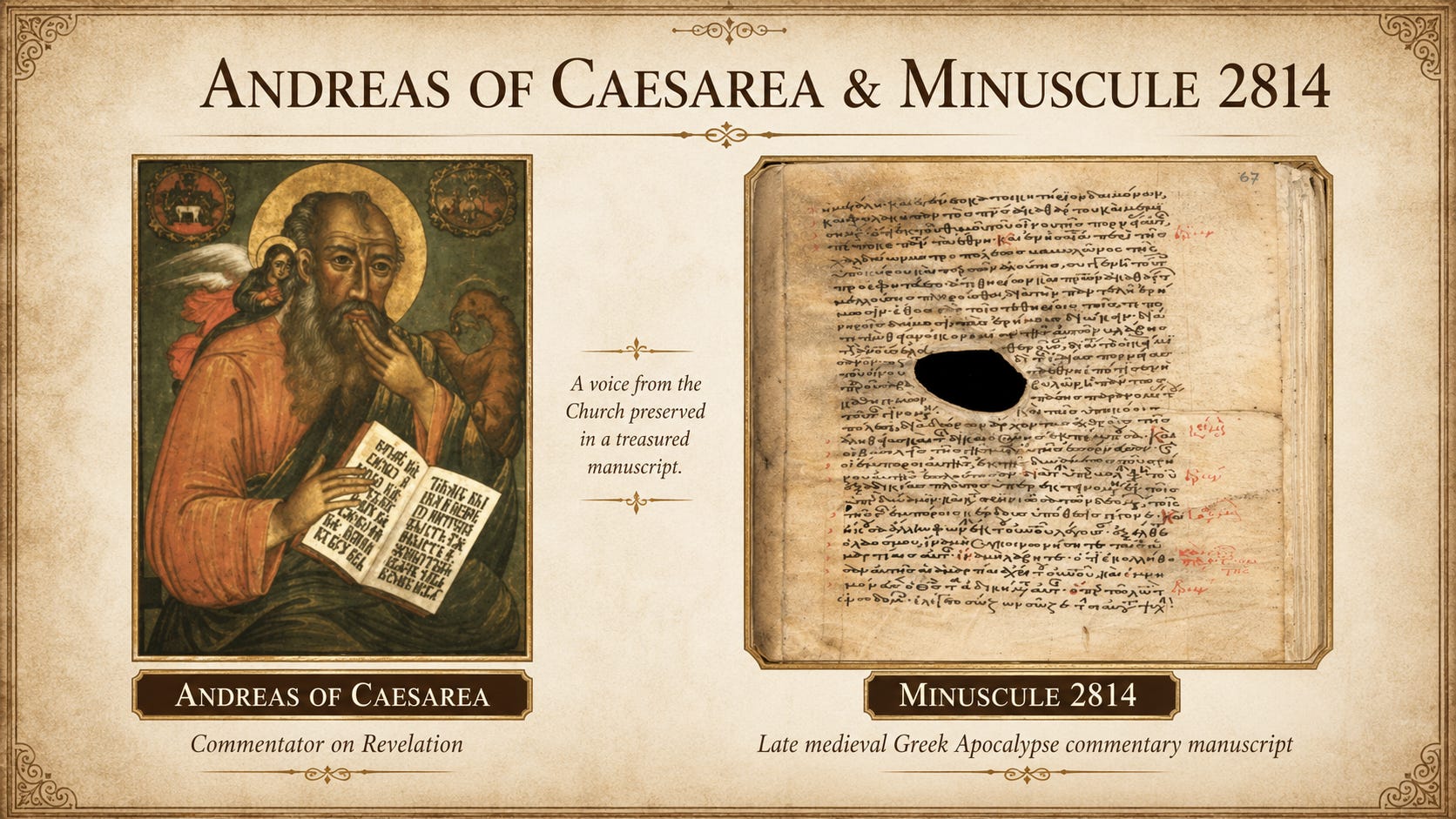
Erasmus’ version of the Apocalypse was translated from one Greek manuscript, now known as minuscule 2814, which has been dated paleographically to the 12th century. The KJV Revelation (that Christians and little season theorists rely on as the base of their belief system around a second coming of Christ) has for its origin one late medieval Greek commentary manuscript.
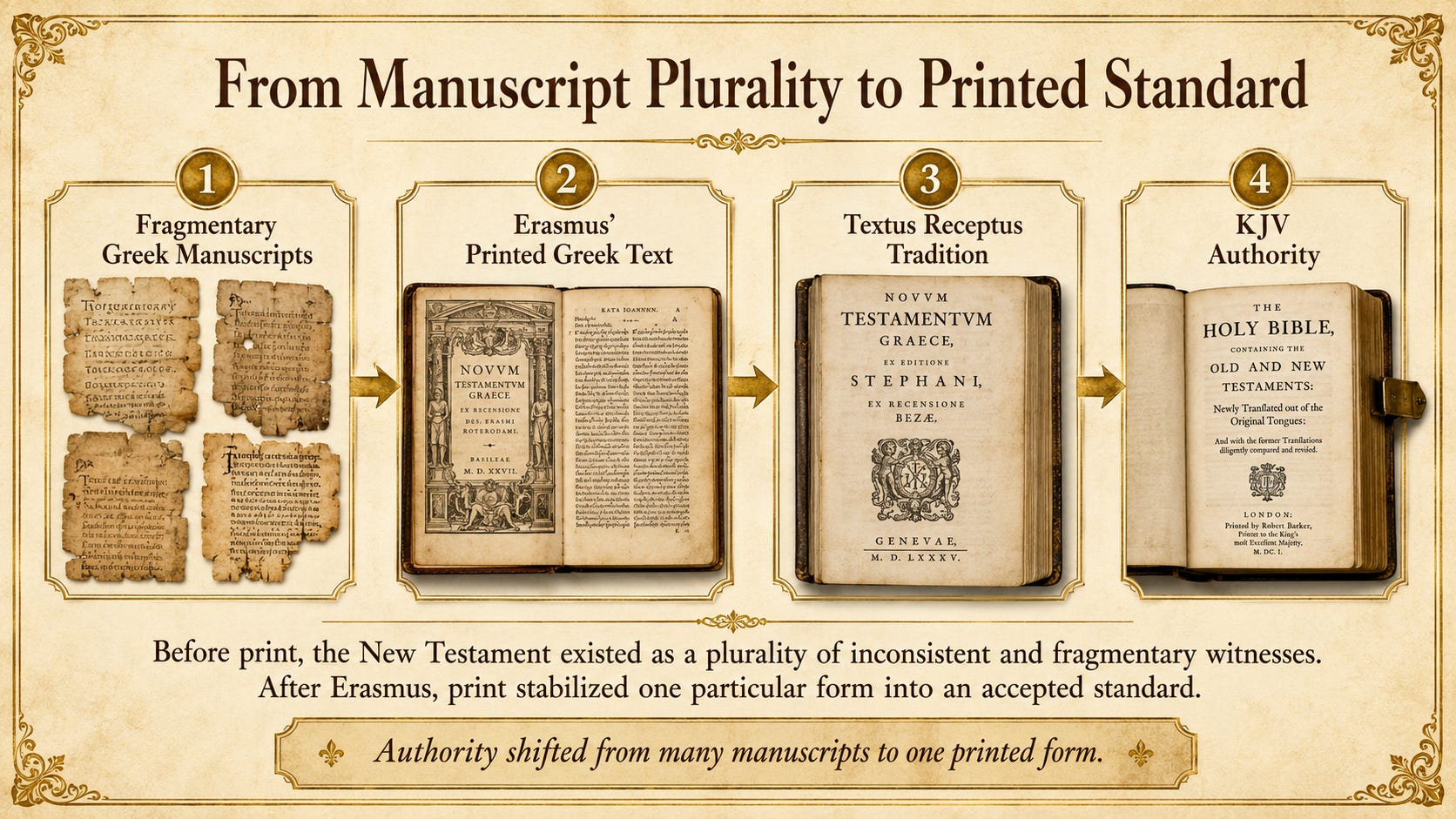
Before the printing press, the alleged original Greek language New Testament existed as a plurality of inconsistent and fragmentary manuscripts. After Erasmus, a printed Greek text began to standardize one particular form. Later Protestant tradition treated that printed form as it were simply “the preserved Greek original.” The perceived authority of the later KJV derives not from a single unbroken transmission from the time of Christ to the modern day, but from the printing press stabilizing a fragmented, medieval manuscript tradition into a single accepted version.
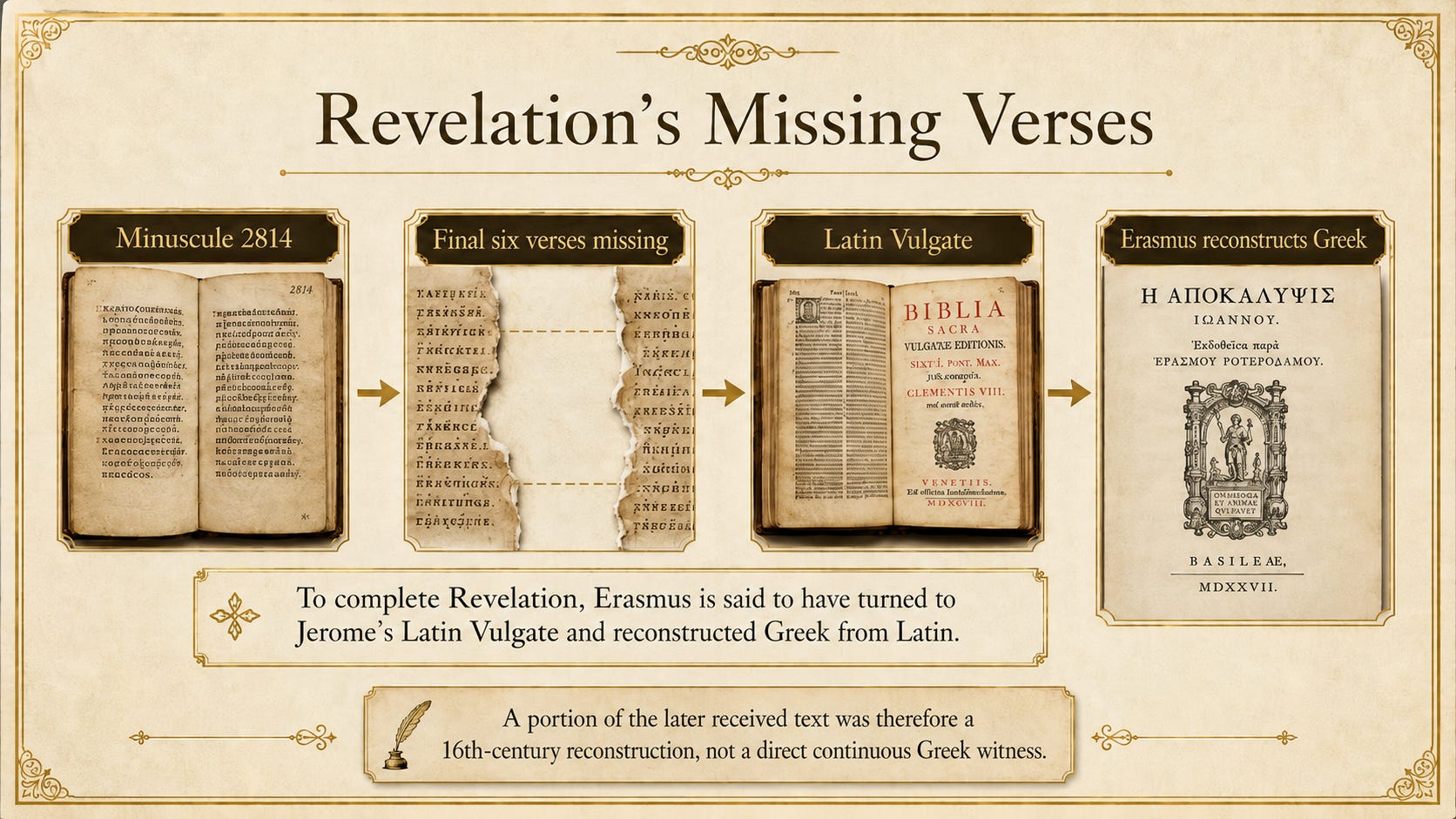
Erasmus had to turn to the 4th century Latin Vulgate, “translated” by Jerome, to fill in the final six verses of Revelation, which were missing from minuscule 2814. This means that at least a portion of the text that millions of Christians regard as the original and literal word of God was actually a 16th century Dutch priest’s reconstruction of Greek from a Latin original. Knowing what we do about the penchant for priests to fabricate documents, and the literal army of monkish scribes at their disposal during the medieval era, we should be seriously asking ourselves: was Jerome’s Vulgate the original Bible?
The old argument is that Greek was the lingua franca of the Roman empire during the Apostles’ lifetime, and they wanted their gospels to reach as wide of an audience as possible. That argument makes sense to modern, literate people, who’d have expected Matthew, Mark, Luke and John to have written their goat songs in English, even if they were from Palestine. Scholarly reckoning estimates 3% to 10% literacy rates in the 1st century. Does the “lingua franca” argument really hold up against that statistic? Is it more likely that the early Church fathers wrote their own scriptures alongside their “original” Greek manuscript counterparts?
The average religious person, and even many pastors, have no concept of this history, believing the dogma that the Bible is the word of God and has been preserved by God perfectly. The manuscript evidence, if taken at face value, shows that the text of the Bible evolved through monkish scribes, back and forth translations, commentary manuscripts, editorial choices to fill in missing pieces, until reaching a printed standard. Erasmus himself, working from minuscule 2814 which was missing the final six verses of Revelation, is said to have turned to the Latin Vulgate version to complete his edition of the book.
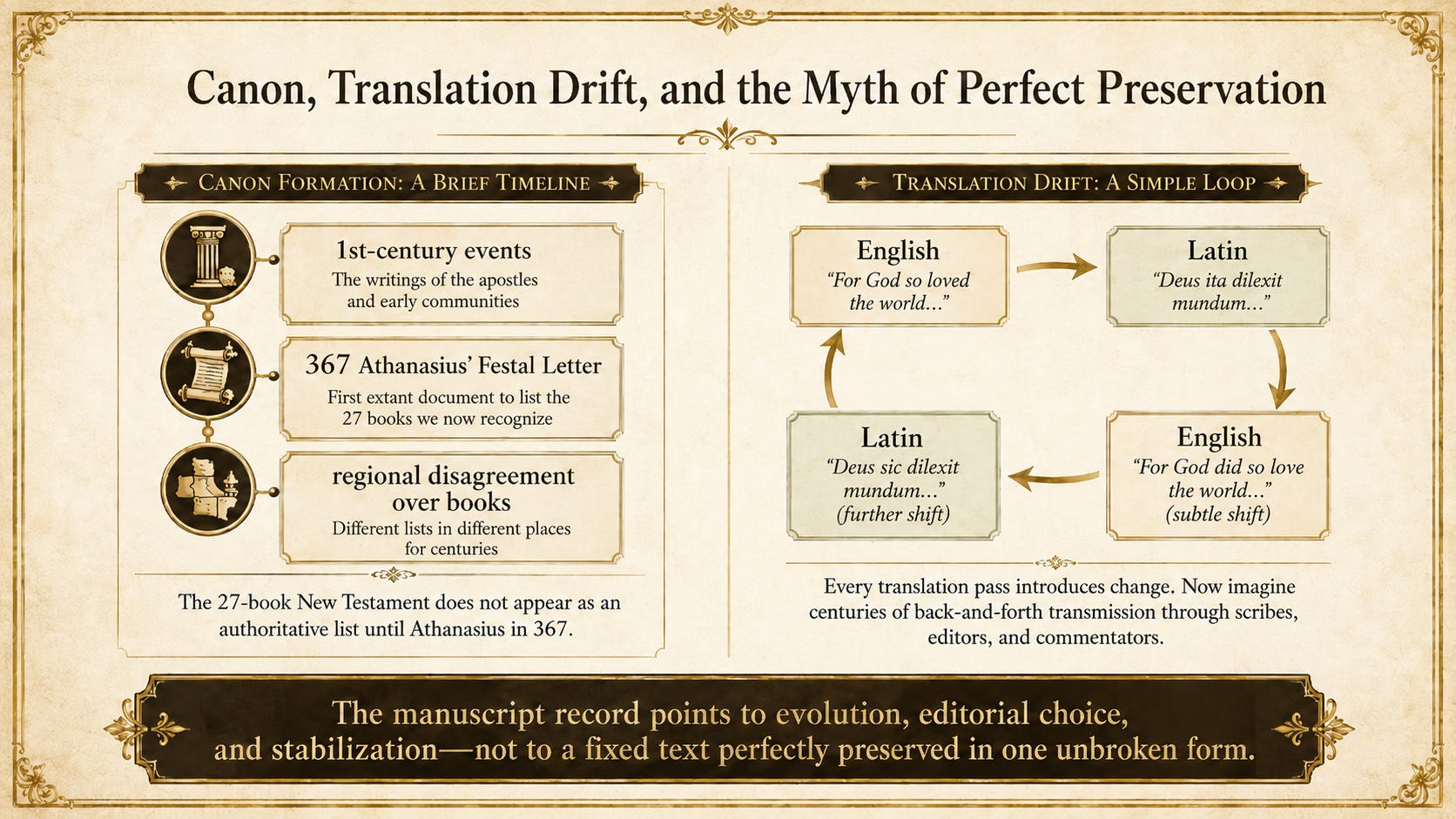
The 27-book New Testament as we have it today does not appear as an authoritative list until 367, in the 39th Festal Letter of Athanasius of Alexandria (Egypt). Of course, these letters do not appear in a complete form in the historical record until they are “rediscovered” in 1842, with fragments no older than the 9th or 10th century. Apart from the familiar books of the Old and New Testament as we know them today, “Athanasius reckons the Book of Wisdom, Sirach, the Book of Esther, Judith, the Book of Tobit, the Teaching of the Apostles, and the Shepherd of Hermas… as books ‘appointed by the Fathers to be read by those who newly join us, and who wish for instruction in the word of godliness” (Wikipedia), and in other works refers to these extra-biblical texts as “Holy Scripture.” He speaks of other books to be rejected, “calling them apocypha, and describes them as ‘an invention of heretics, who write them when they choose, bestowing upon them their approbation, and assigning them a date, that so using them as ancient writings, they may find occasion to lead astray the simple.” And thus in the very letters Biblical historians use as a chronological anchor for the “received text” of the Bible, the very same Alexandrian admits to the regularity of forgeries passed off as ancient writings. The notion of a fixed and divinely preserved set of New Testament books does not reckon well with the historical record. Not only were there 3 centuries between the supposed events of the Gospels and the moment when the church got around to deciding what counts and what was “an invention of heretics,” the answer to that question changed depending on which regional council was giving it.
An interesting side note about this particular letter of Athanasius is that it begins with “They have fabricated books which they call books of tables (inferred from the Coptic to mean astrological charts), in which they shew stars, to which they give the names of Saints. And therein of a truth they have inflicted on themselves a double reproach: those who have written such books, because they have perfected themselves in a lying and contemptible science; and as to the ignorant and simple, they have led them astray by evil thoughts concerning the right faith established in all truth and upright in the presence of God.” Athanasius was Bishop of Alexandria, one of the most significant locations in the ancient world for the study of astronomy. I have very few doubts about whether or not he knew that scriptures were astrological, and here he is evidently lying through his teeth (or quill I suppose). This isn’t esoteric in the philosophical sense, it’s plain deception and hypocrisy.
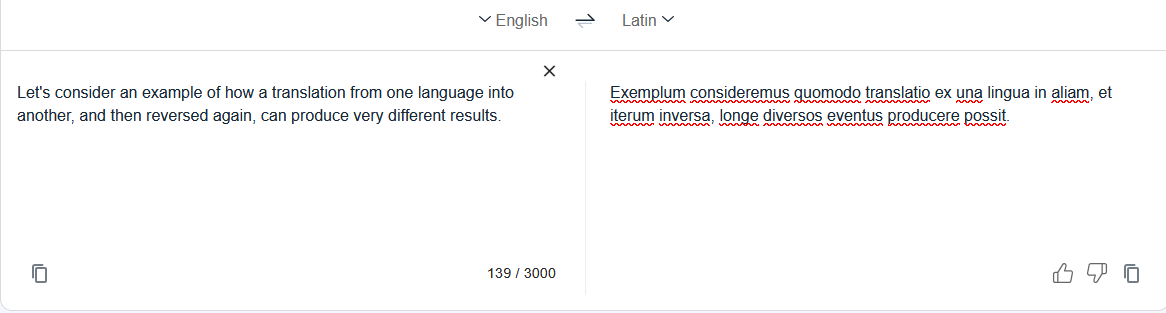
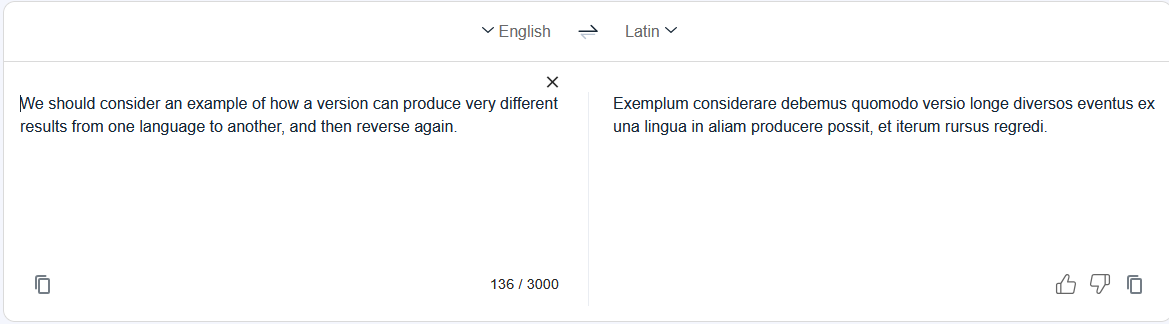
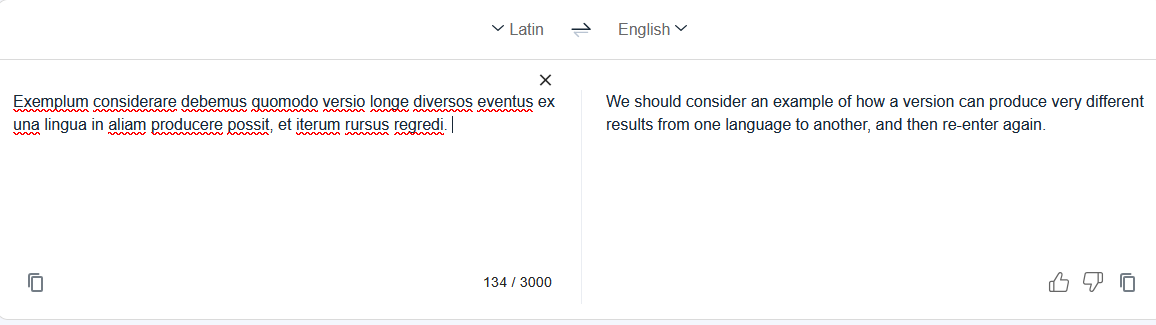
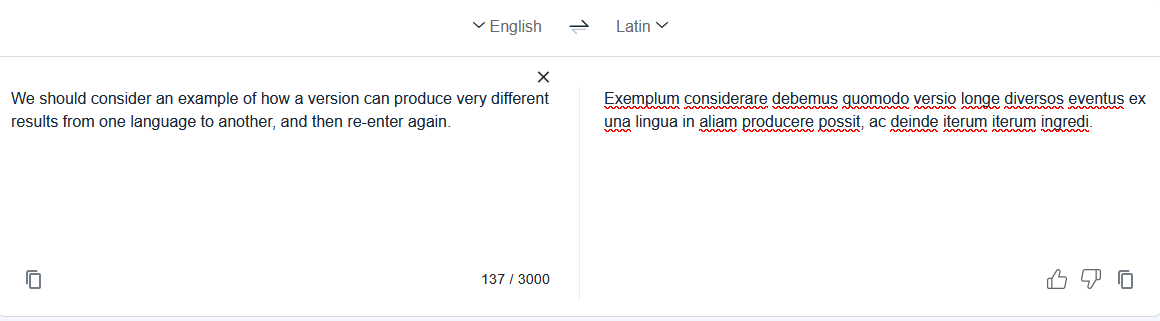
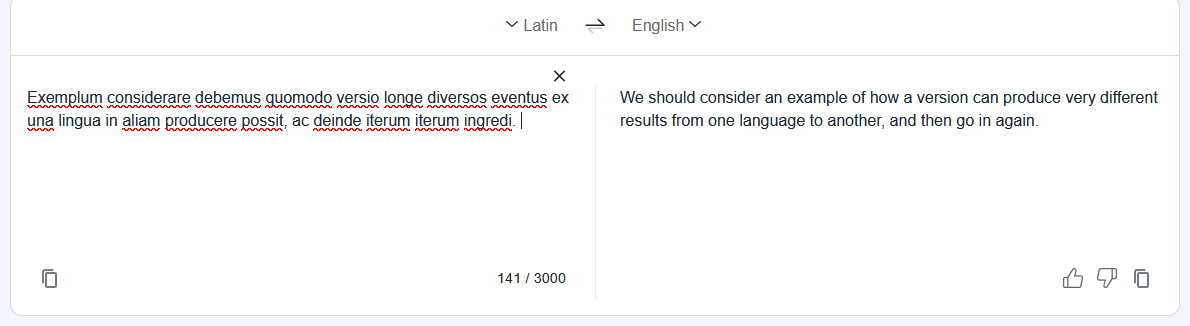
Below I have taken screen shots of translating a simple English sentence into Latin, and back again, several times, demonstrating how the translation changes each time. Now imagine instead of a modern translator website, you’re relying on a prejudiced monk or scribe who would prefer a certain meaning over another, or perhaps is not well educated enough to accurately translate every word. Now factor in just how complex the language of scripture is, with poetic descriptions, multi-layered metaphors, and colloquial idioms, and weigh that against the claim that the KJV is the true and perfectly preserved word of God. Unfortunately, since the basis of this belief is faith, the point would be lost on most believers who would reject it out of hand. Whatever has changed must have changed because God wanted it that way, and I can’t argue against that.
The following are some of the final verses of Revelation that Erasmus had to pull from the Vulgate because they were not part of Andreas of Caesarea’s commentary manuscript in Greek (minuscule 2814).
I Jesus have sent mine angel to testify unto you these things in the churches. I am the root and the offspring of David, andthe bright and morning star.
For I testify unto every man that heareth the words of the prophecy of this book, If any man shall add unto these things, God shall add unto him the plagues that are written in this book: And if any man shall take away from the words of the book of this prophecy, God shall take away his part out of the book of life, and out of the holy city, and from the things which are written in this book.
(Rev. 22: 16, 18-19)
If any man shall add or take away from the words of this prophecy, God will plague them and take their “part” out of the book of life. This is pretty incredible irony, considering the chain of textual custody that actually brought these words to the masses as the true and unblemished word of God.
Christianity - The Eternal Battlefield In the Mind
We will return to our examination of Revelation and the provenance of the New Testament scriptures, but first, a detour into considering the endless war of interpretation that has plagued the Christian west for centuries.
The philosopher Voltaire, writing in the 18th century, expressed the common Enlightenment era view when he wrote, “of all religions, the Christian should of course inspire the most toleration, but till now the Christians have been the most intolerant of all men.”
But what is it about Christianity that makes it such a uniquely persecutory religion? None can dispute that the history of the Inquisition, the Crusades, the wars of Catholic vs. Protestant demonstrate that the religion’s bloody history is in serious contradiction to the love-thy-neighbor decree of the Biblical Jesus Christ. But can we say that it still is a persecutory religion? To many listening, that answer may be no—but for anyone who has tried their hand at using their God-given faculties of logic and reason in the honest examination of the dogma and historicity of this faith, and done so publicly, they have felt the slings and arrows of the internet’s defenders of orthodoxy.
Fustel de Coulanges, writing in the 19th century, observed that, “Among all ancient nations the law had been subject to, and had received all its rules from, religion. Among the Persians, the Hindus, the Jews, the Greeks, the Italians, and the Gauls, the law had been contained in the sacred books or in religious traditions. . . . Christianity is the first religion that did not claim to be the source of law. . . . Men saw it regulate neither the laws of property, nor the orders of succession, nor obligations, nor legal proceedings. It placed itself outside the law, and outside all things purely terrestrial. Law was independent; it could draw its rules from nature, from the human conscience, from the powerful idea of the just that is in men’s minds. It could develop in complete liberty.”
Coulanges is correct in an exoteric way—Christianity was not directly responsible for the creation or rule of law, for most of its existence. On the other hand, this was because of its position not outside the law, but above it, in respect to the Catholic church and its tentacle like appendages which connected Rome, Constantinople, or Avignon, to nearly every fiefdom and kingdom in the known European world. What is important to understand is prior to Christianity, there was little to no separation between religious dogma, matters of belief and faith, and the law itself. This was a simplification of matters, rooted in the traditionality of pre-Christian western civilization, as opposed to the gradual and later rapid acceleration towards progressive societal structures in the post-Christian world.
“Now, in taking the unparalleled step of abolishing or transcending the law of the Torah, what did Christianity put in its place? A very inward and abstract injunction: to believe in and love God as well as to love one’s neighbor. Thus, as compared with paganism and even with the other monotheistic religions, Christianity is above all a religion of inner faith or belief; and as the official content of that belief became more elaborate over time, Christianity became a doctrinal or dogmatic or theological religion that made salvation contingent on the acceptance of certain often obscure or controversial dogmas (e.g., creation of the universe from nothing).”
Melzer, Arthur M.. Philosophy Between the Lines: The Lost History of Esoteric Writing
Jean-Jacques Rousseau, in the mid 18th century, commented on this phenomenon as well.
“Who does not see… that dogmatic and theological Christianity is, by the multitude and obscurity of its dogmas, above all by the obligation to acknowledge them, a field of battle always open among men?… You must think as I do in order to be saved. This is the horrible dogma that desolates the world.”
This relocation of the sacred from the outer world of rite and observance to the inner world of conviction did not arise from nowhere, and its true architect was the apostle Paul, who in his epistles set faith against works and made salvation a matter of what a man believes rather than what a man does. Whatever the Gospel Jesus may or may not have taught, the religion that conquered Rome is Pauline in its operating system, and it is from this interiorization of the holy that every later battlefield of the mind proceeds. Once righteousness has been moved inside the skull, the policing of belief becomes the central business of the faith, and for this the Church required an instrument the ancient world had never thought to forge: the concept of heresy.
The word itself betrays the theft. Heresy descends from the Greek hairesis, which meant nothing more sinister than a choice, a leaning, an inclination toward one school of thought over another, and which the philosophers used in perfect neutrality to describe whether a man followed the Stoic or the Epicurean way. There was no shame in it and no peril, because a man’s choice of allegiance threatened no one and damned no one. Christianity seized this innocent word for choosing and inverted it into its very opposite, so that hairesis came to signify the crime of choosing wrongly, the sin of holding an opinion the priesthood had not sanctioned, an offense for which a man might be excommunicated, dispossessed, broken, or burned. Consider the horror folded into that single transformation, for the faculty of choice itself, the very thing that makes a mind a mind, was rebranded as the original road to damnation. To choose was to err, and orthodoxy, from orthos and doxa, the right opinion, became precisely the condition of one who had surrendered his power to choose at all. The older world could punish a man for neglecting the public rites, since the rites were a debt owed to the city, but it could not punish him for the contents of his mind, because thought had not yet been carved into a list of propositions to be affirmed under penalty of one’s soul.
You see, traditional society, pre-Christian society, did not attempt to update and perfect its belief system. People merely continued the rites and customs as they were given them, and to do so was a legal requirement for citizenship in a polis or life in one’s village. The only ones questioning whether or not these traditions were right and true or not, were the philosophers, who made sure to do so in secret, or if spoken about openly, veiled in esotericism.
Condorcet, speaking on the ancient Greeks, asserted that “The philosophers thought to escape persecution by adopting, like the priests, the use of a double doctrine, whereby they confided only to tried and trusted disciples opinions that would too openly offend popular prejudice.” Sketch (1795)
What is too seldom appreciated is that Christianity itself once harbored exactly such a double doctrine, and that the Church’s earliest campaign of persecution was waged not against the pagan without but against this hidden wing within its own body. The Gnostics of the second and third centuries, the Valentinians, Manichaeism, the Sethians, Ophites, and the Basilidians, they were the natural heirs of the mystery schools wearing their era’s “Christian” dress, keeping an inner teaching for the initiated and an outer teaching for the multitude, precisely as Condorcet describes among the Greeks. They read the scriptures as veiled allegory, as a coded transmission whose literal surface was a mere husk around a living kernel. It was against these men that Irenaeus, Bishop of Lyon, composed around the year 180 his great heresy-hunting treatise Against Heresies, the very cornerstone of orthodox warfare, whose whole purpose was to brand the secret teaching as fraud and to insist that the truth was singular, public, and literal. The tragedy buried in this episode is near total, for at the precise moment when Christianity might have remained an initiatory path with an esoteric heart, the orthodox party hunted down and exterminated the only wing of the faith that still knew how to read its own books, or at least the only ones willing to initiate non-apostolic members. The Church did not turn persecutory by accident, nor by the slow corruption of later and more worldly centuries; it turned persecutory at the root, by first devouring its own initiated tradition. All that followed, the Inquisition not least, was merely the patient unfolding of that original act of self-cannibalism.
The philosophers rightly understood that to open the public forum to progressive ideas would lead to disasters that threatened all civilization. Christianity is just such a disaster. The combination of monotheism (and thus intolerance to any perceived “other” gods), eternal punishments and rewards, and sacred dogma that is centralized and standardized by a priestly order that by its own political nature is constantly riddled with internal disagreement, are factors which have made Christianity so uniquely persecutory in history.
We may test this diagnosis against the long memory of the pre-Christian world, and the verdict it returns is unambiguous. The Eleusinian mysteries endured for the better part of two thousand years and never once kindled a fire beneath a man for the crime of believing wrongly; the Mithraic and Orphic and Bacchic mysteries spread across the whole breadth of the Mediterranean alongside a dozen rival cults without ever igniting a war between them, for their architecture asked no man to affirm a proposition and condemned no man for declining the invitation. Initiation was earned and the meaning was passed in private, and the outsider remained simply an outsider, never a heretic to be hunted. Rome herself, so endlessly slandered as the great persecutor of the infant faith, was in truth the most tolerant religious power the West had yet brought forth, for her instinct upon conquering a people was not to abolish their gods but to adopt them, to seat Isis beside Jupiter and the Celtic mothers beside Minerva, so that her pantheon swelled with every fresh annexation. When Rome at last turned upon the Christians, if that even happened (later we’ll discuss the evidence that it did not), it was not because she could not abide their god, whom she would gladly have welcomed among the rest, but because they alone of all the peoples of the empire refused to return the courtesy, spurned the civic rites, and pronounced every other god a demon. The intolerance arrived in the world with the new faith. It did not find it waiting there.
And here we arrive at the present hour, where the reader who imagines all of this safely interred in the Christian past has mistaken a change of costume for a change of substance. The persecutory engine did not perish when the West grew ashamed of its theology; it outlived the god who built it, and it labors among us still, every ancient gear of it intact, beneath a secular and even an openly anti-religious veneer. The reigning orthodoxy of our own day holds, exactly as monotheism held, that there exists but one permissible framework through which the contested questions may be approached, and that every rival framework is not an honest disagreement but a symptom of moral disease. It has resurrected the concept of heresy beneath a wardrobe of fresh names, hate speech and misinformation and racism and every phobia, each of them a polite synonym for the old crime of choosing an opinion the new priesthood has not blessed. It has kept excommunication as cancellation, refined now by a digital apparatus that renders the modern exile more absolute than any medieval bishop ever dreamed of imposing. It has reinstated public confession in the “struggle session” and the compelled apology, and it has reinvented original sin as a stain inherited at birth by whole categories of persons, a debt no finite act can ever discharge but only the unending penance of atonement without absolution. The bitterest irony of the whole spectacle is that this engine persecutes in the name of tolerance, brandishing the very word with which Voltaire and Rousseau once assailed the Church, having seized upon the philosopher Karl Popper’s narrow caution that a tolerant society need not tolerate those who would destroy it and inflated that bounded warning into a boundless license to crush whomever the orthodoxy has first taken care to define as intolerant. The result is a regime that persecutes with a cleaner conscience than the Inquisition ever enjoyed, persuaded as it is that it stands as the heir of tolerance rather than its betrayer. And so the thoughtful man falls silent once more, holding his true mind in private while he performs the public creed, which is to say he has been driven back into Condorcet’s double doctrine, into the oldest refuge of thought beneath tyranny, in the very age that fancies itself the freest the world has ever known.
“There is nothing, if I may say so, sound or right in any present politics, and that there is no ally with whose aid the champion of justice could escape destruction, but that he would be as a man who has fallen among wild beasts, unwilling to share their misdeeds and unable to hold out singly against the savagery of all, and that he would thus, before he could in any way benefit his friends or the state, come to an untimely end without doing any good to himself or others—for all these reasons I say the philosopher remains quiet, minds his own affair, and, as it were, standing aside under shelter of a wall in a storm and blast of dust and sleet and seeing others filled full of lawlessness, is content if in any way he may keep himself free from iniquity and unholy deeds through this life and take his departure with fair hope, serene and well content when the end comes.”
Socrates in Plato’s Republic (Book VI)
Sometimes I wonder if Socrates was right about the futility of trying to aid the cause of justice, if there is really any hope of making a difference in the status quo. I reserve that outcome to God’s judgement, and instead only concern myself with my own relationship to truth, and sharing with those who want to follow my thoughts.
Members’ Only Section
Jesus, Venus and Lucifer (the Morning Star)
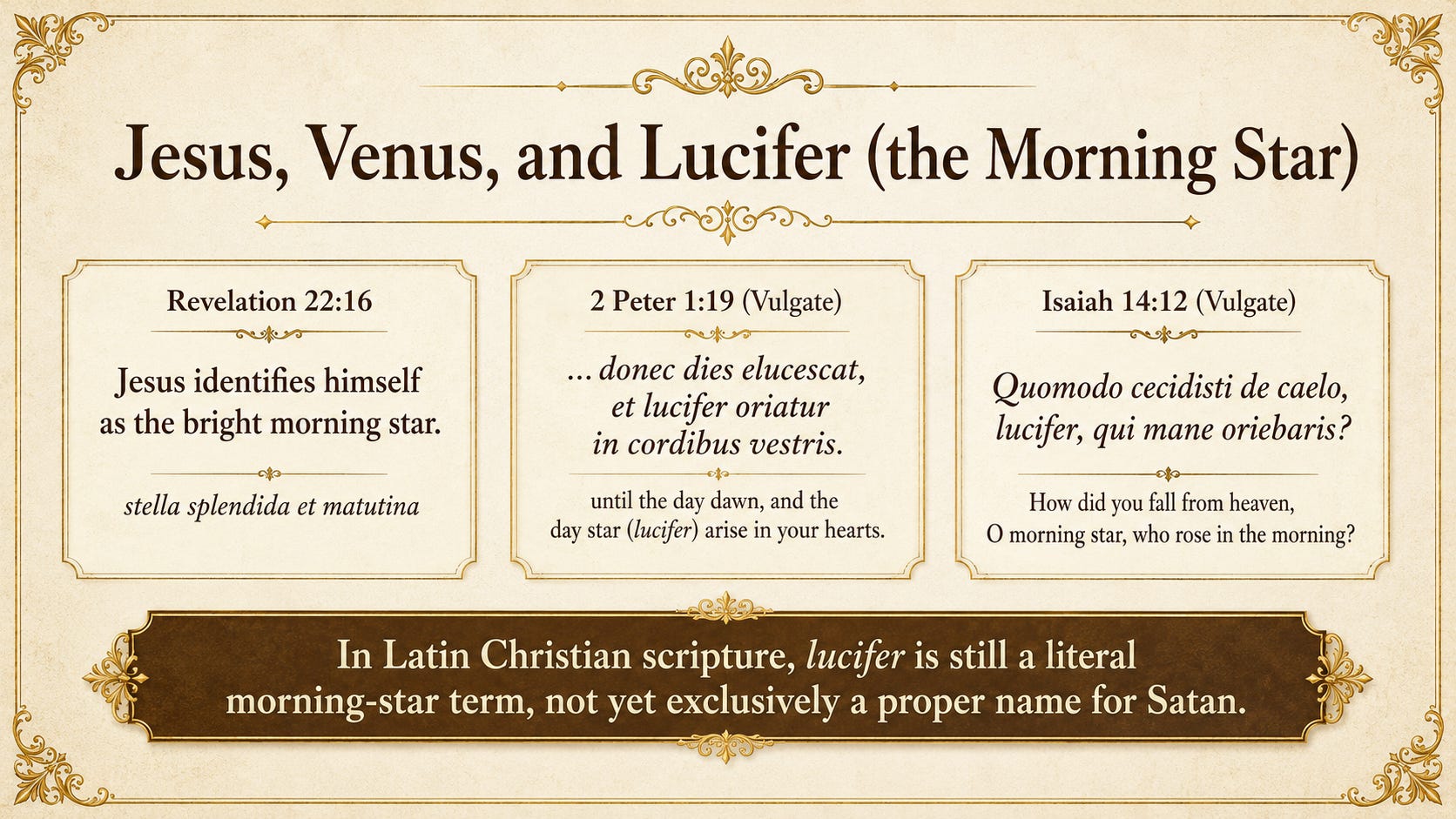
We can’t ignore Rev. 22:16 having Jesus say that he is “the bright and morning star,” in the Vulgate. While Jerome chose to write it out in this verse, as “stella splendida et matutina,” the fact remains that the word lucifermeans “light bringer,” and “morning star.” In the Latin Vulgate, 2 Peter 1:19 reads:
“Et habemus firmiorem propheticum sermonem, cui benefacitis attendentes quasi lucernae lucenti in caliginoso loco, donec dies elucescat, et lucifer oriatur in cordibus vestris.”
“We have also a more sure word of prophecy; whereunto ye do well that ye take heed, as unto a light that shineth in a dark place, until the day dawn, and the day star (Lucifer) arise in your hearts.”
In the Latin Vulgate, Job 38:32 reads:
“numquid producis luciferum in tempore suo et vesperum super filios terrae consurgere facis”
Literally this says “Can you bring forth the morning star (Lucifer) in its time, and make the evening star (vesperum) rise upon the children of the earth?”
The KJV version: “Canst thou bring forth Mazzaroth in his season? or canst thou guide Arcturus (the bear) with his sons?”
Do you doubt that the “day star” to “arise in your hearts” is Jesus? The reason Lucifer is associated with the evil principle, Satan, or the Devil, is because Isaiah 14:12 in the Vulgate says, “Quomodo cecidisti de caelo, lucifer, qui mane oriebaris?” Literally in English, this says: “How did you fall from heaven, O morning star, who rose in the morning?”
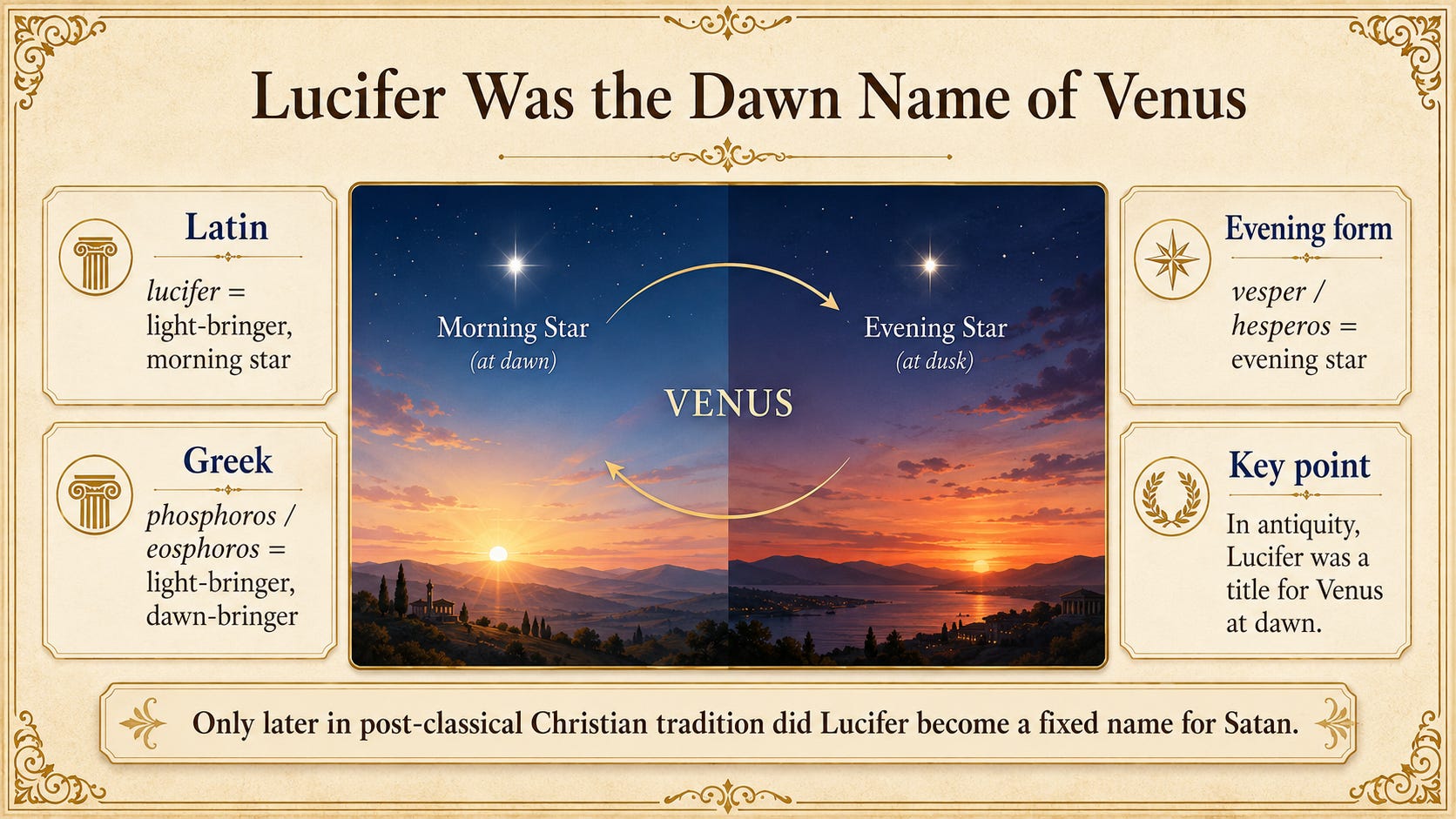
In antiquity, Lucifer was strictly the Roman name for the planet Venus when it appeared at dawn. This is easily verified. The Greek equivalent was Phosphoros, which also means “light bringer,” or Eosphoros, “Dawn Bringer.” There will be some of you wondering about the Goddess Aphrodite or Venus, and trying to reconcile that character with Satan, Jesus, or the light in the sky we currently call Venus, but you don’t need to do that. This is exactly why Dylan likes to call this stuff “farrago,” a Latin word that means “a confused mixture, a hodgepodge, a random assortment of things.” Farrago is a type of fodder for livestock, literally meaning an assortment of whatever is on hand regardless of what it is. The priest class has tended throughout history to see the vulgar people as livestock, and feeds them farrago while keeping their true doctrines private. It was only in post-classical Christian tradition that Lucifer became a name for Satan. If you want to better understand the actual, esoteric relationship between Jove, Jesus, and Satan, creator, preserver, destroyer, revisit episodes 6 and 7 of this podcast.
The fact that Jesus identifies himself with Venus, or Lucifer, should do one of two things: immediately dispel all superstitious notions about Lucifer being the Devil, and bring the pre-Christian mythology of Venus into examination as a precursor to Christian doctrine. The figure that dogmatic Christians fear and revile is the very same celestial body that Christ admits as his own. This merger happens inside the very verses that Erasmus filled in from the Vulgate to account for the missing Greek in minuscule 2814, meaning this doctrine was established and concrete within the Catholic system.
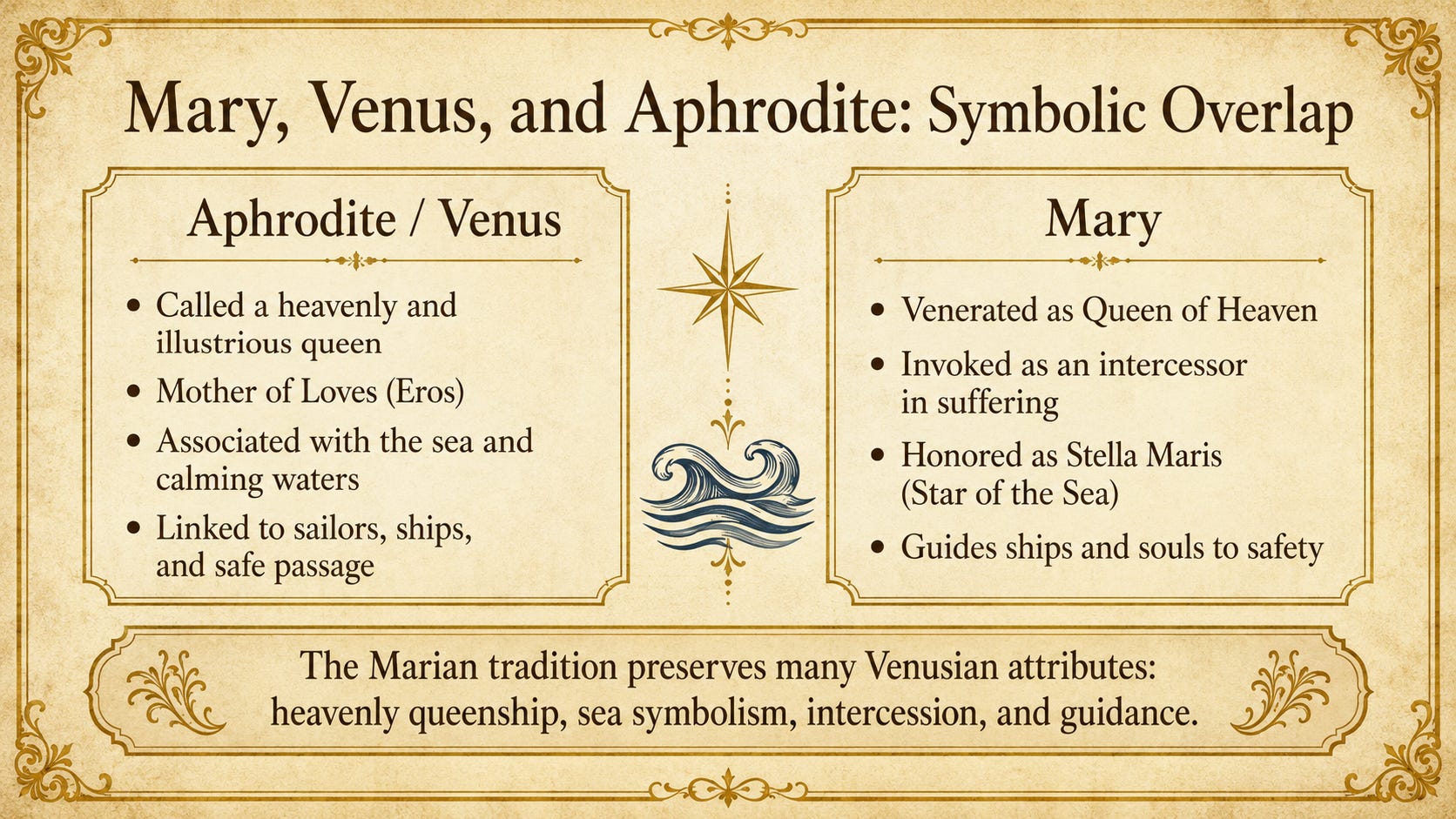
In recent episodes we have presented a great deal of evidence that Mary is in fact Venus or Aphrodite. To briefly review, the Orphic Hymn to Aphrodite calls the goddess, “Heavenly, illustrious, laughter loving queen” and the “Mother of Loves,” (Eros). The Hymn recognizes her universal power over fate, the stars, and the cosmos, in other words, she’s the Queen of Heaven, just as Catholic hymns to Mary call her the Queen of Heaven and the cosmos. The 6rd century BC poet Sappho’s Ode to Aphrodite reads as a plea to a divine mother figure for the soothing of pain and heartbreak, which might as well be identical to the “Hail Mary” tradition of asking the Virgin Mary to intercede in human suffering. Mary is widely venerated as Stella Maris (Star of the Sea), who guides ships and souls safely, and Aphrodite is revered as being sea-born and the one who calms the waters to aid sailors. If you look into goddesses who are associated with ships, shipbuilding, and seafaring, you’ll find it is a ubiquitous trait, which has symbolic overlap with the Ark and Cosmic Egg.
The Goddess and Her Son / Lover
But why would Jesus be associated with Venus, a goddess? It only makes sense through the lens of my overarching theory regarding the endless multiplicity of divine figures in myth and religion: they are all one, each name and epithet alludes to certain qualities of the deity or its representation in a certain place and time. They are akin to sub-personalities that were interacted with as emanations from a single source. Jesus is Venus, both male and female, and this explains the epithet Venus Barbata, or “Bearded Venus” that is mentioned by Macrobius when he describes a statue of a bearded Venus in Cyprus. There are many examples of bearded goddesses in antiquity.
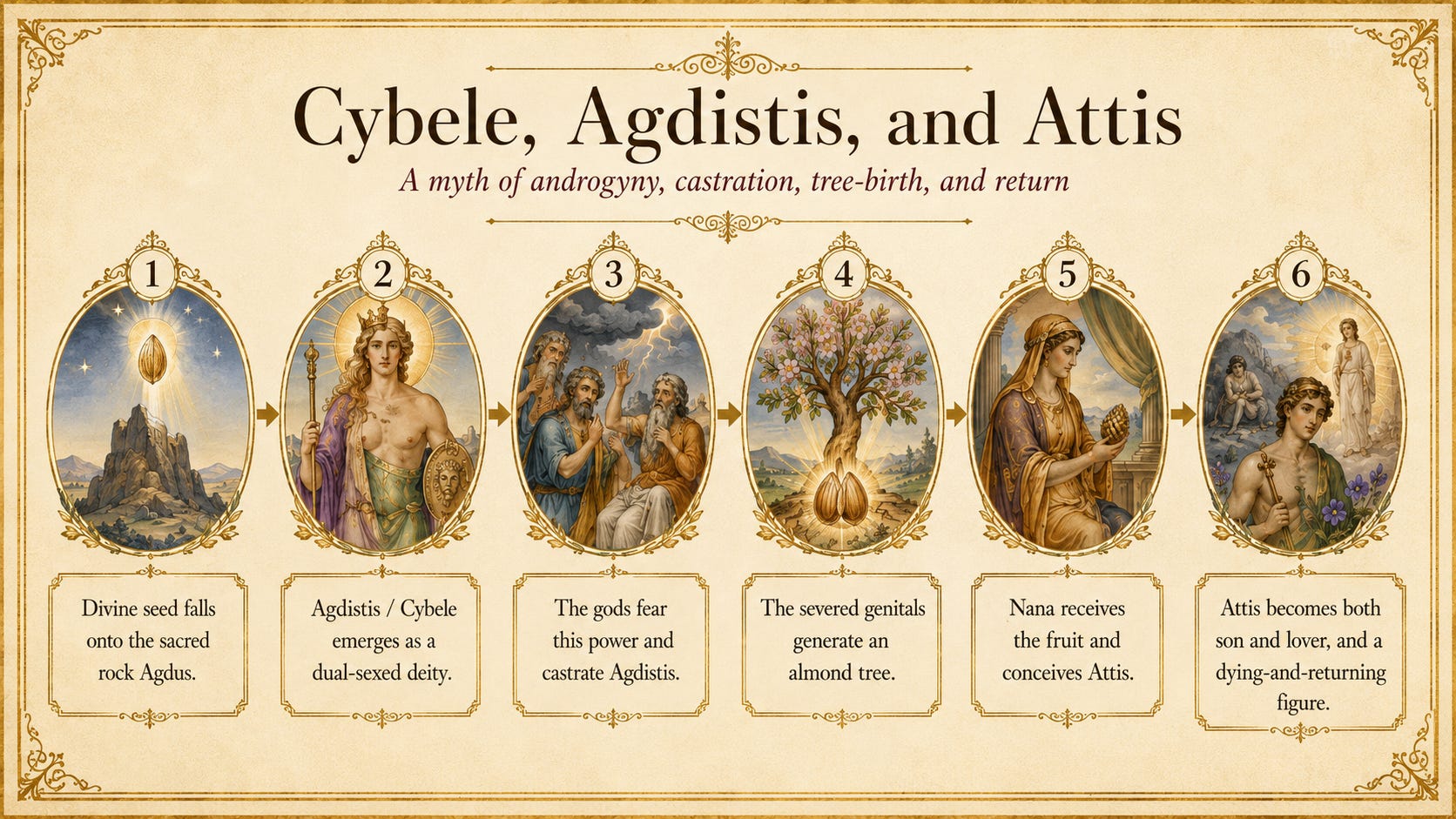
In the Phrygian wing of Greek mythology, Cybele (or Agdistis) was a hermaphroditic deity who was born from Gaia, the earth, when Zeus or Ouranos accidentally spilled his seed on a sacred rock called Agdus. The story goes that the other gods feared Agdistis’ dual-sexed power, and castrated it. The severed genitals fell to earth and spawned an almond tree, the fruit of which later impregnated the river nymph Nana, who gave birth to Attis. Attis goes on to become the lover of Cybele. Attis becomes associated with annually dying and resurrecting. There are various versions of these stories but the main points remain the same. The Sacred Rock that is impregnated by Zeus, Agdus, is the name of a mountain in Phrygia. The root αγ / ag in Ancient Greek means to lead or to carry. δυσ or Dus/Dys meant “bad, ill, or hard.” But it’s also phonetically very similar to Deus, Dis (as in Dis Pater, a version of Hades), and Zeus. In other words, Ag + Deus is the leader or carrier of Deus, God. That’s incredibly similar to Lucifer, the light bearer who leads (goes in front of) God. Furthermore, the gamma or Greek letter g is very often pronounced quite lightly, or even like a Y. Considering the interchangeability of D and T, Agdus is very nearly identical to Attis. This means the mountain or rock that served as the womb of the goddess Cybele and carried the seed of Zeus, was also her son and lover, Attis. Also note that the river nymph Nana, who is impregnated by the almond “fruit” is basically “Anna” - the mother of Mary. The other major Aphrodite connection here is the “seed” of the sky father and the severing of Agdistis’ genitals, as Aphrodite was said to have been born when Kronos castrated Ouranos (the sky) and his genitals fell into the ocean, producing a foam which became Aphrodite.
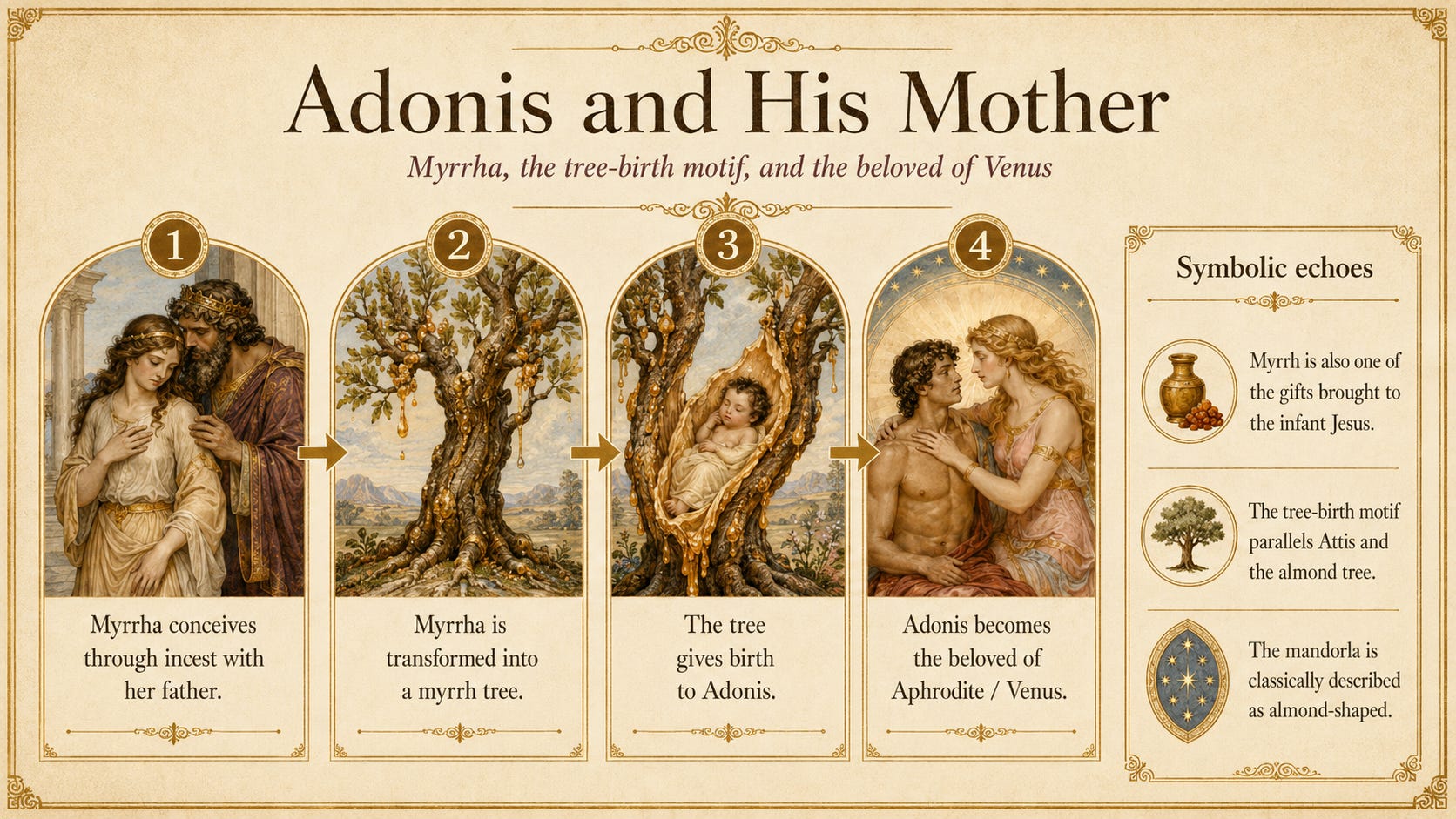
Now consider Adonis, the lover of Venus/Aphrodite, and the figure who shares a name with the Hebrew Old Testament’s God, who is called Adoni. Adonis’ mother was Myrrha (Mary), who conceived him through incest with her own father. Myrrha was transformed into a Myrrh tree (the very same gift given by the wisemen at Jesus’ birth). The tree gave birth to Adonis, similar to the way Attis is born of the almond tree. Adonis is yet another annually dying and resurrecting savior. The conception of Adonis through the unholy union of father and daughter was incited by Aphrodite herself, usually described as a jealous revenge plot against her mother, who boasted that Myrrha was more beautiful than Aphrodite. In a symbolic way, this makes Aphrodite a sort of mother to Adonis, who would not have existed without her divine interference.
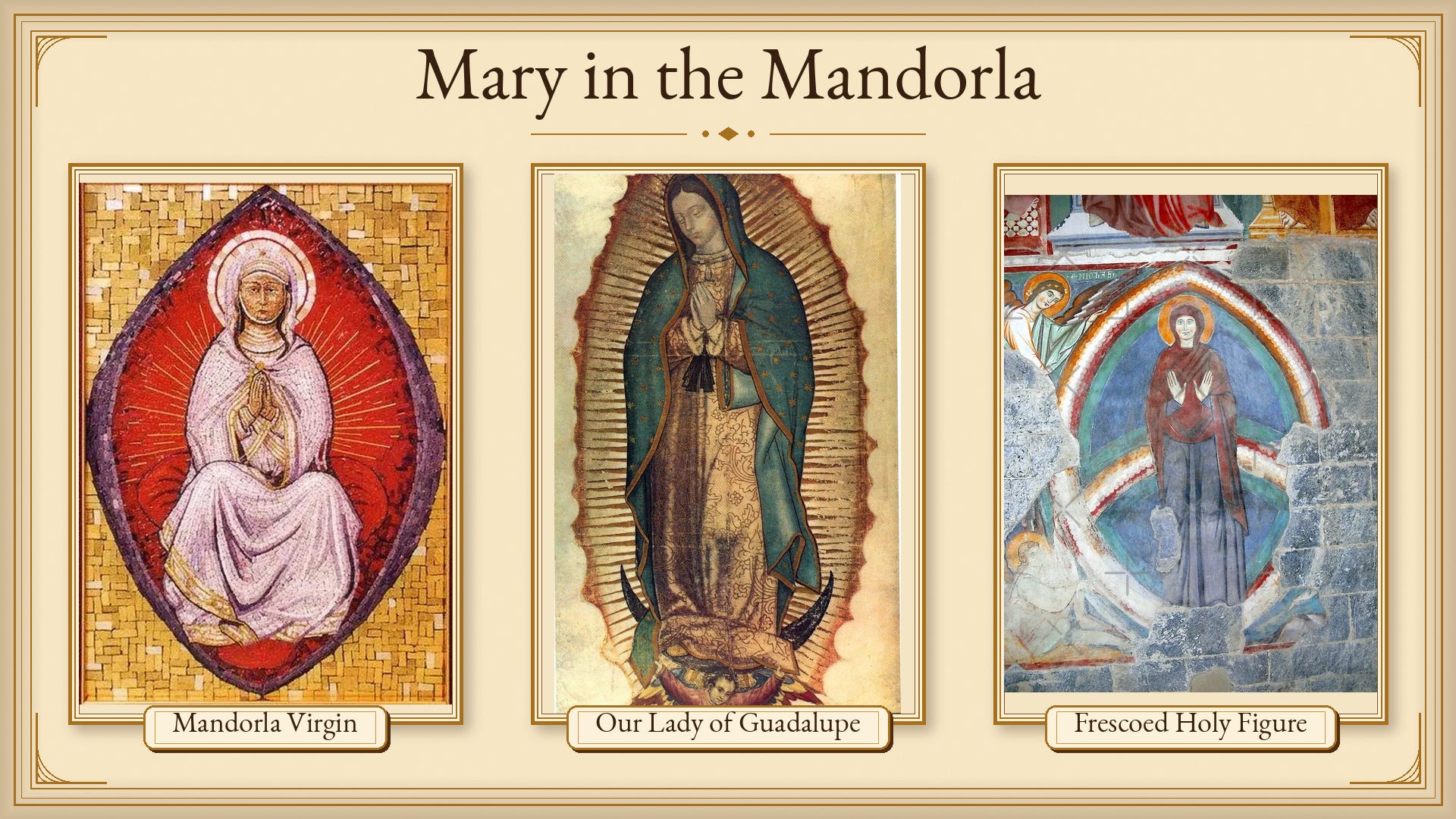
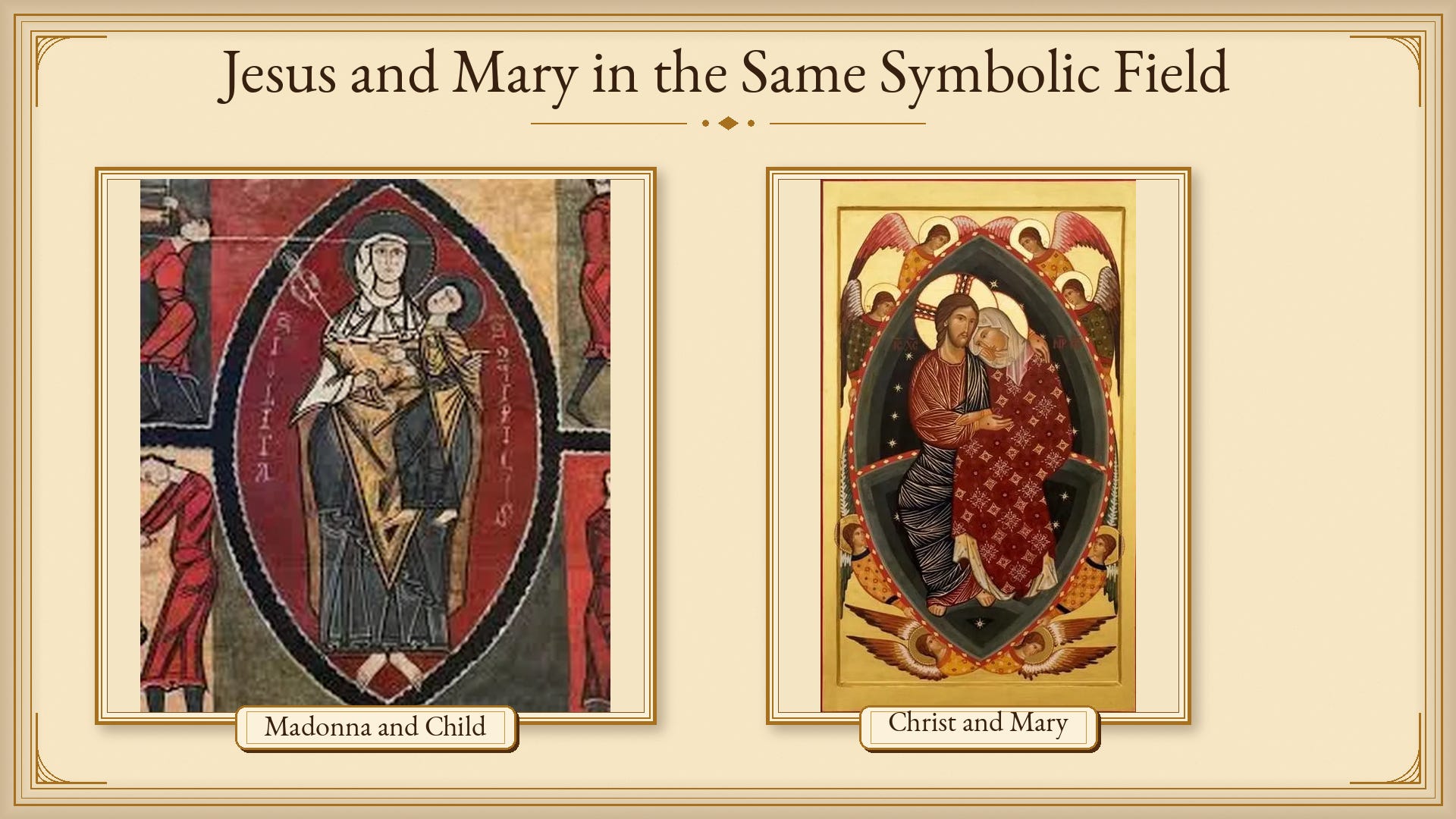
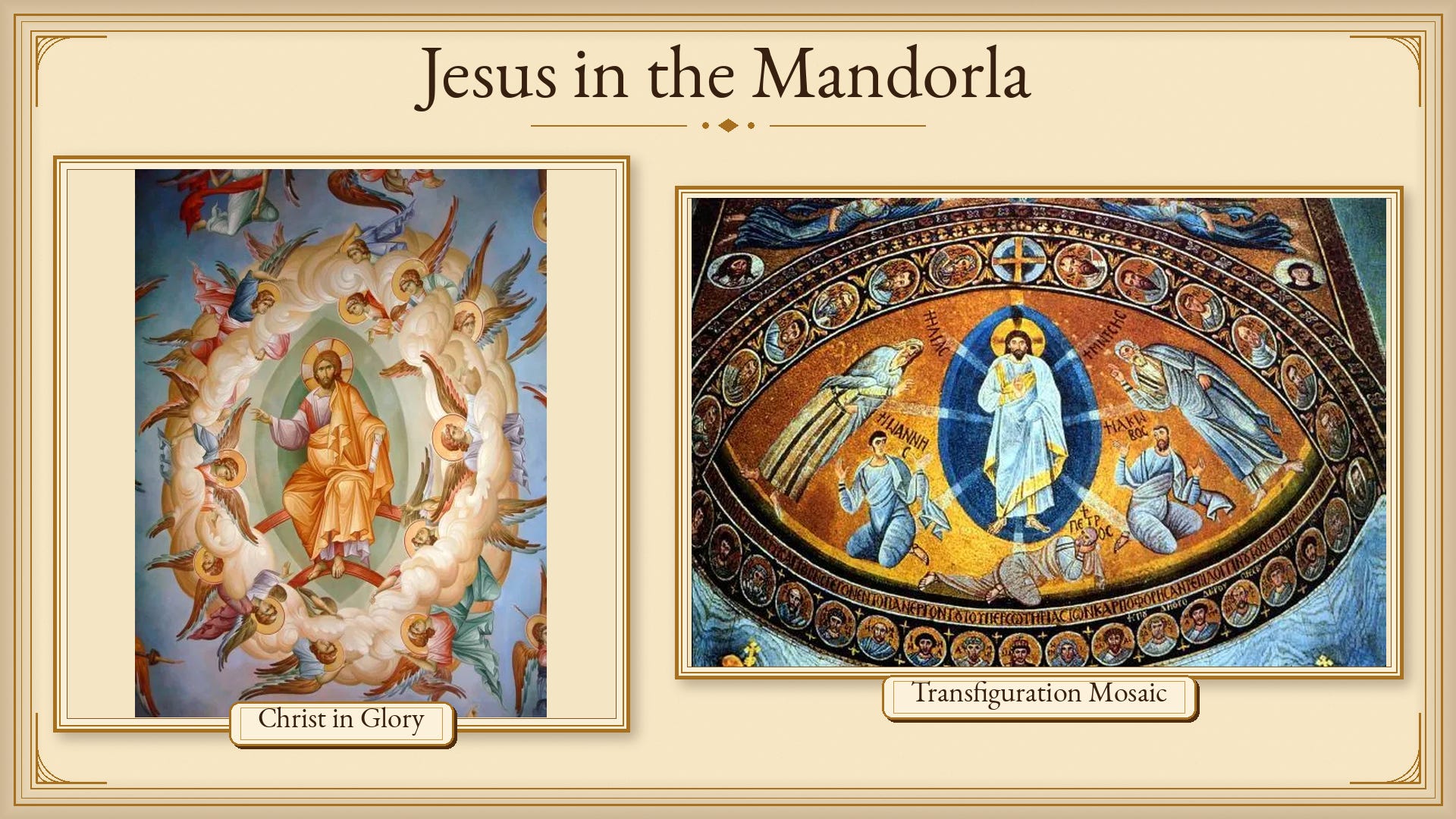
The classic description of the Vesica Piscis or mandorla is “almond shaped,” which is a geometric match to the female generative organ. But Jesus is nearly as often inside the mandorla too, often without Mary. We could go on about the many traditions which have this self-born hermaphroditic deity, such as Phanes in the Orphic, and Atum in the Egyptian, but the point is made. Esoteric Christianity does not have such a distinction between Jesus and Mary as the literalist dogma would expect. They are in fact one and the same, the Hermes-Aphrodite, the Bearded Venus, the androgynous savior.
The association of the gods with the planets, as we take for granted in modern times, is based on equally shaky foundations. The academic tradition holds that Epinomis, a text of unclear authorship that is possibly a forgery meant to be deceptively attributed to Plato. The physical oldest surviving copy dates back to the 9th or 10th century. Aristotle’s De Caelo also describes these correspondences, and, you guessed it, only physically exists back to the 9th or 10th century. Babylonian and Egyptian references to the planets-are-gods assertion only enter the archeological record in the mid 19th to 20th century. I am not saying the correspondence did not exist, but showing that there is a legitimate possibility that some or all of the works alleged to come from antiquity that make this association are medieval forgeries. There are many more references to Saturn as Phainon, Jupiter as Phaethon, Mars as Pyroeis, Venus as Phosphoros/Eosphoros, and Mercury as Stilbon. Being skeptical about this stuff will help you not get so lost in the farrago, trying to make it all make sense as if it’s something real, as if there’s a “right” interpretation to fight over.
The Book of Life, the Tree of Life
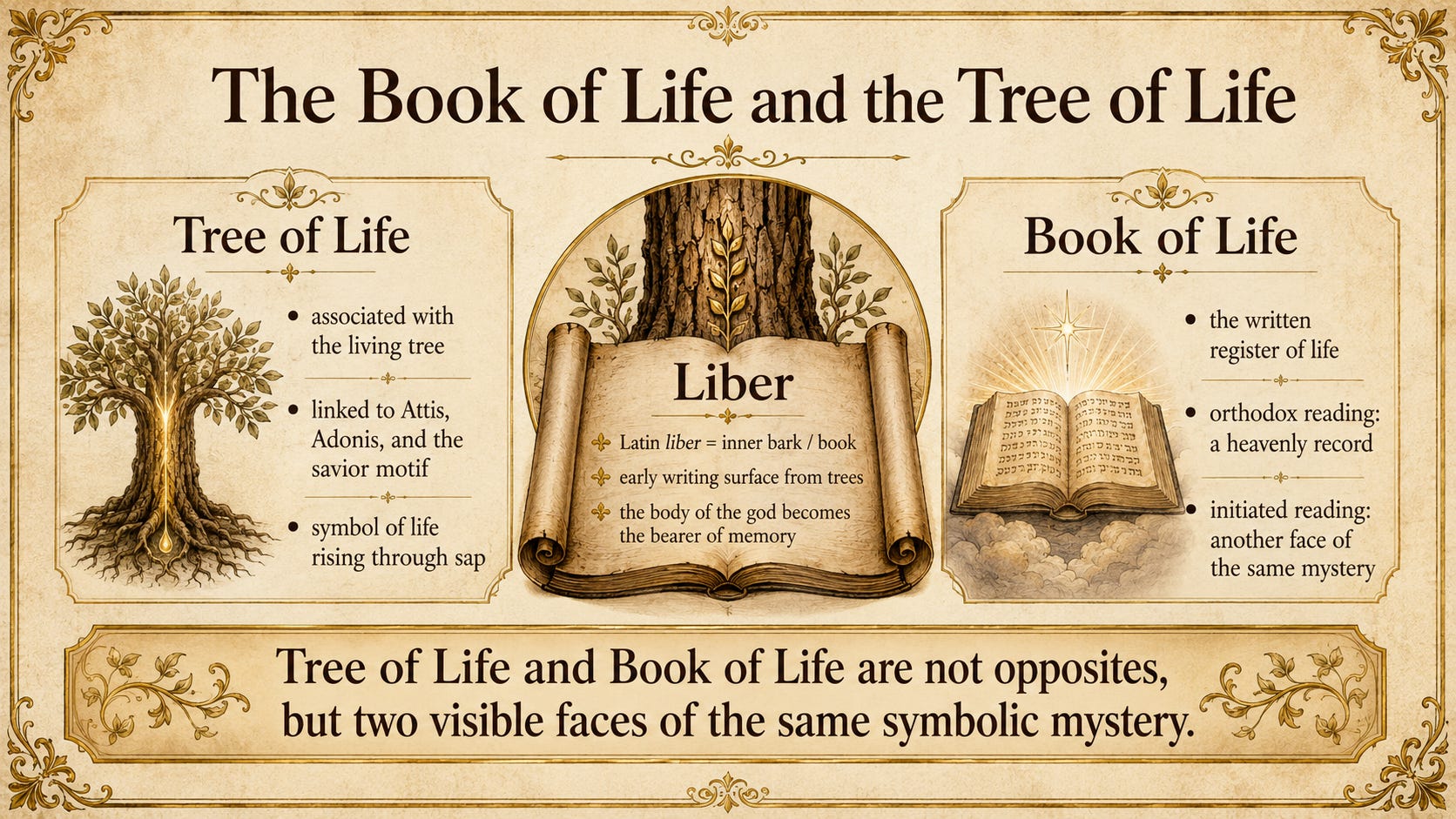
Another example of editorializing by Erasmus in the Textus Receptus (the Received Text), as his compilation came to be known, is that phrase “book of life,” which is contradicted by other manuscript fragments, which more often say “tree of life.” But as we know that Jesus is Dionysus/Bacchus, whose epithet was Liber Pater, we also know that the tree and the book of life are one in the same. One of the earliest forms of paper was produced by the inner bark of trees, which was called Liber, a word that also means book in Latin. Remember that Adonis and Attis, precursors to Jesus, are actually born into life by trees. The inner bark of a tree is the layer through which the sap rises, which is symbolically akin to the oil associated with Christos. Apply liberally, begrease yourself with the blood of the vine, the carrier of the Bacchic spirit. In this sense the book, to the ancients who originated this system, wasthe body of the god rendered into a surface that can be written on, a body that became a literal preserver of knowledge across time. So the wavering between Tree of Life or Book of Life in different versions of Revelation is not a binary of two different things, it’s a choice of which face of the same mystery to make visible. The orthodox reading makes this concept into a Santa Claus naughty and nice list. The initiated reading holds all these symbols as one image: Liber, the tree, the book, the inner bark, the rising sap, and the savior/loosener of bonds, all the same.
The Name of the Beast, 616?
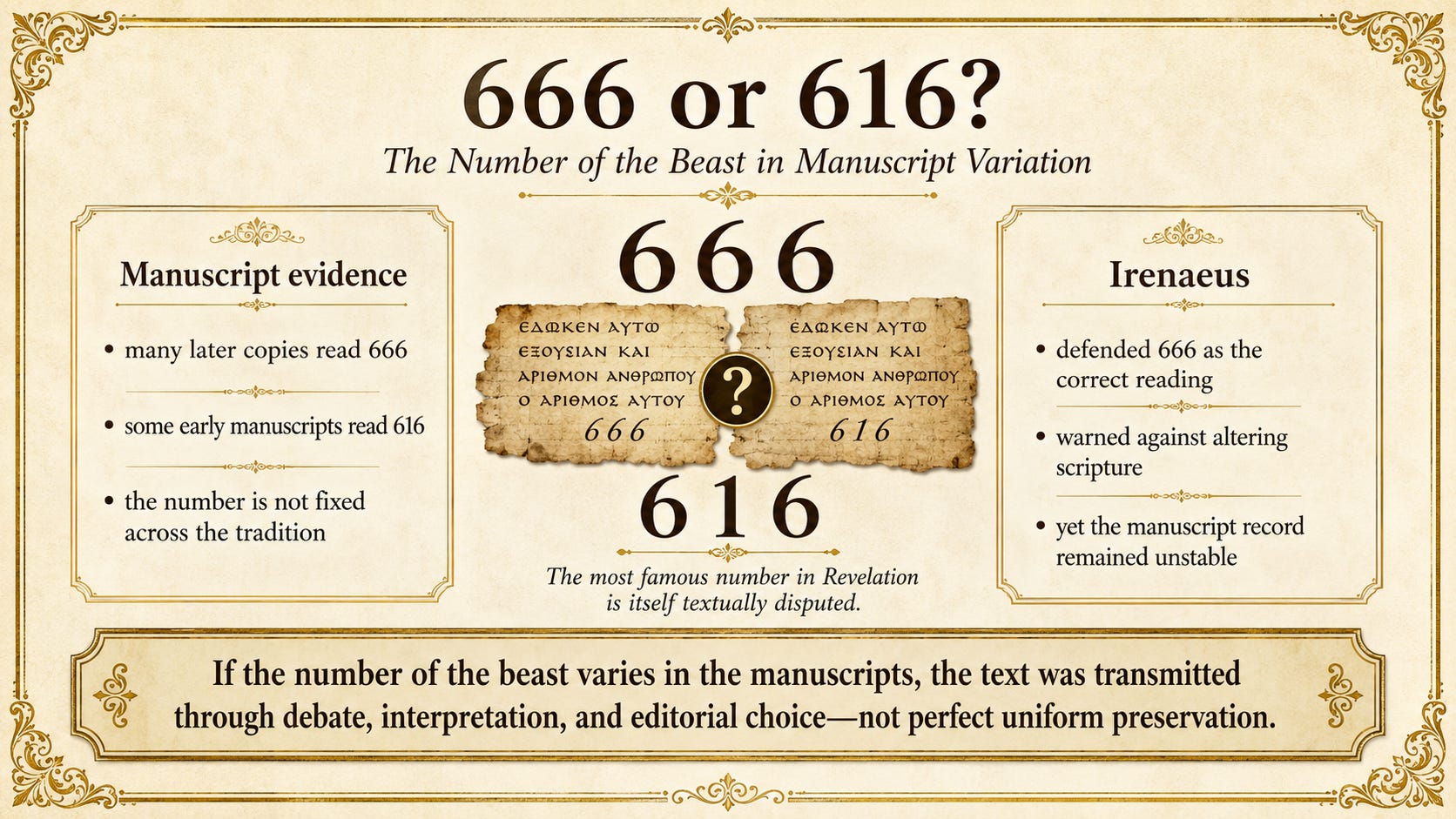
The most culturally iconic single number in the entire New Testament, the origin of cringe goth tattoos and countless conspiracy theories, 666, the mark of the beast, is itself not agreed upon by the actual manuscript evidence that exists. Many of the 3rd/4th century manuscripts read 616, not 666. I’m not here to debate the theology or gematria, but Irenaeus’ defense of 666 is weak. In Against Heresies he argues that 666 is found in the most approved and ancient copies of the Apocalypse, claiming this fact is supported by those who saw John directly, which is a lie, as we will see in a moment, as nobody was actually sure which John was supposed to have authored the thing in the first place. There is serious irony in Iranaeus’ warnings about the spiritual and practical dangers of altering scripture, when in his time scripture was anything but concrete and consistent. Just imagine, a horrible antichrist could show up with 666 on his forehead, and if people think the number of the beast is 616, they won’t realize how the bad man has appeared! I think it’s interesting that the creepy occultist and comic book writer Alan Moore named the Marvel Comics main universe, Earth-616. Could be a coincidence, but I’m not sure.
He writes in Against Heresies that 666 is the fitting number, “since he sums up in his own person all the commixture of wickedness which took place previous to the deluge, due to the apostasy of the angels. For Noah was six hundred years old when the deluge came upon the earth, sweeping away the rebellious world, for the sake of that most infamous generation which lived in the times of Noah. And also sums up every error of devised idols since the flood, together with the slaying of the prophets and the cutting off of the just. For that image which was set up by Nebuchadnezzar had indeed a height of sixty cubits, while the breadth was six cubits; on account of which Ananias, Azarias, and Misaël, when they did not worship it, were cast into a furnace of fire, pointing out prophetically, by what happened to them, the wrath against the righteous which shall arise towards the end. For that image, taken as a whole, was a prefiguring of this man’s coming, decreeing that he should undoubtedly himself alone be worshipped by all men. Thus, then, the six hundred years of Noah, in whose time the deluge occurred because of the apostasy, and the number of the cubits of the image for which these just men were sent into the fiery furnace, do indicate the number of the name of that man in whom is concentrated the whole apostasy of six thousand years, and unrighteousness, and wickedness, and false prophecy, and deception; for which things’ sake a cataclysm of fire shall also come.”
This is the same Irenaeus who argued that Jesus lived to be an old man, rather than ministering for a single year as the Orthodox dogma believes. As for the passage above, we’re seeing delusional faith based mental gymnastics, or esoteric encoding of the world age doctrine, which is the real meaning encoded in Noah’s age (the Naros cycle) and the Apocalypse being set 6,000 years after the world’s beginning (10 Neros cycles) with Jesus ruling for a single “day” of God, 1,000 years (the rest day). This is something we covered more extensively in Vibe Rant ep. 147, linked below.
Which John Was It Again?
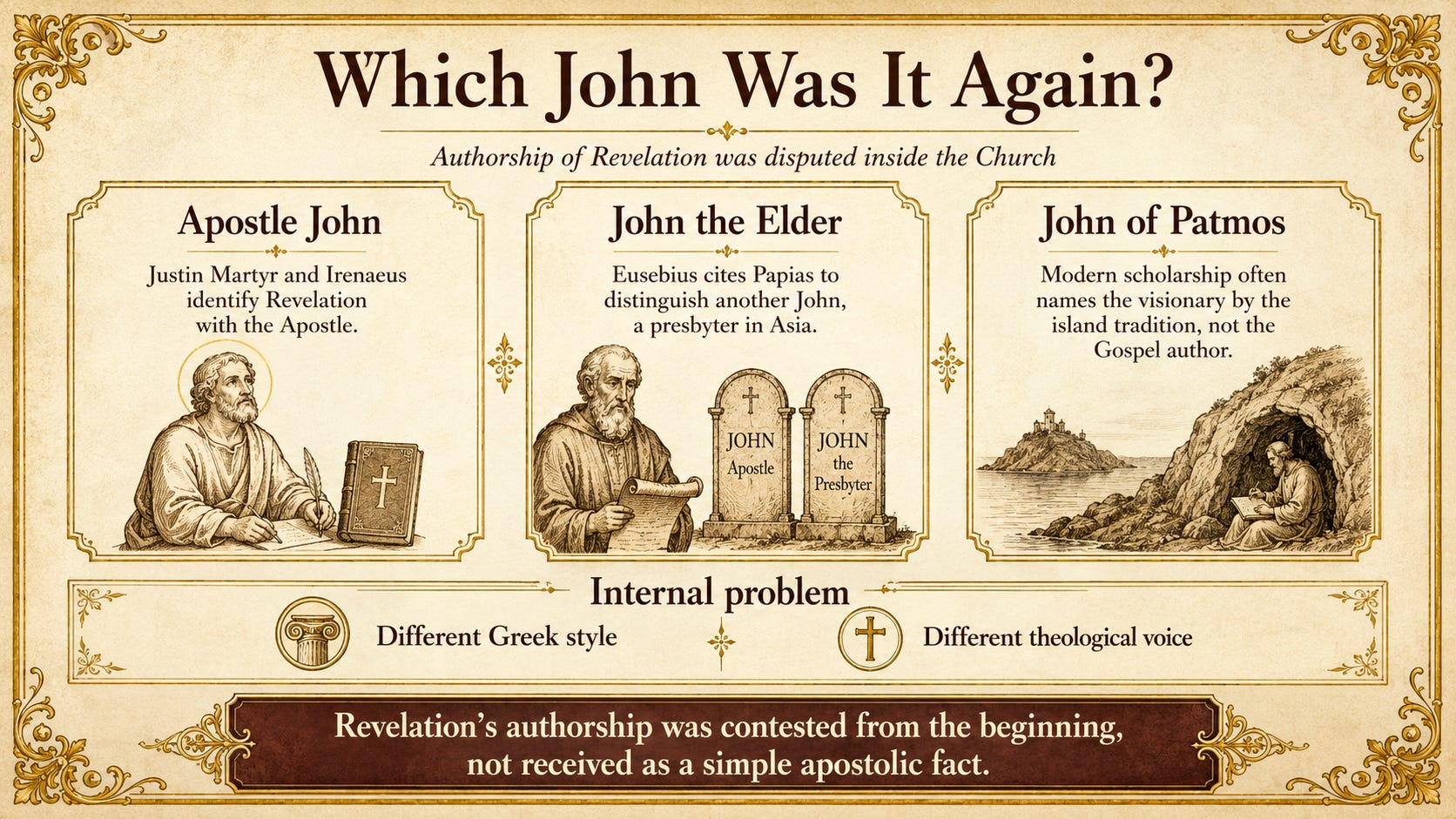
Even the John who was supposed to have written Revelation originally is not agreed upon by the Church fathers. Eusebius, father of ecclesiastical history, wrote:
“But that it is he [the Apostle] who wrote this, I would not say... But some think that it was written by the other John, who was in Asia, since they say that there are two monuments in Ephesus, each bearing the name of John.”
In Church History Book 3, Chapter 39, Eusebius quotes Papias to historically demonstrate that a second, distinct “John the Elder” (or Presbyter) lived in Ephesus alongside the Apostle:
“Here it is worth noting that he twice mentions the name of John: the first in connection with Peter and James and Matthew and the rest of the Apostles... but the other John he mentions after an interval... and he distinctly calls him a presbyter.”
A presbyter is an elder churchman, a priest. Despite Justin Martyr and Irenaeus asserting that it is the Apostle John of the Gospels, the father of church history says it was a church elder, meaning this book of Revelation was written after the founding of the Catholic Church. Modern scholarship disputes the writing style and theological differences between the Gospel of John and the Revelation, choosing to call the latter, John of Patmos (the name of the island he was said to have been exiled on when receiving this vision). But how would someone who was exiled to an island not only survive, but also record his visions in writing? Did they leave him with a stack of paper and a pen? How did he preserve these papers against the elements from the time he was exiled to the time the Romans came and picked him up by boat? When you drop the notion that these texts are any sort of literal history, you no longer need to be a Gold Medal Olympics Level Mental Gymnast to retain your belief system, and you can start receiving the actual messages that the initiated were communicating to one another through the esoteric tradition.
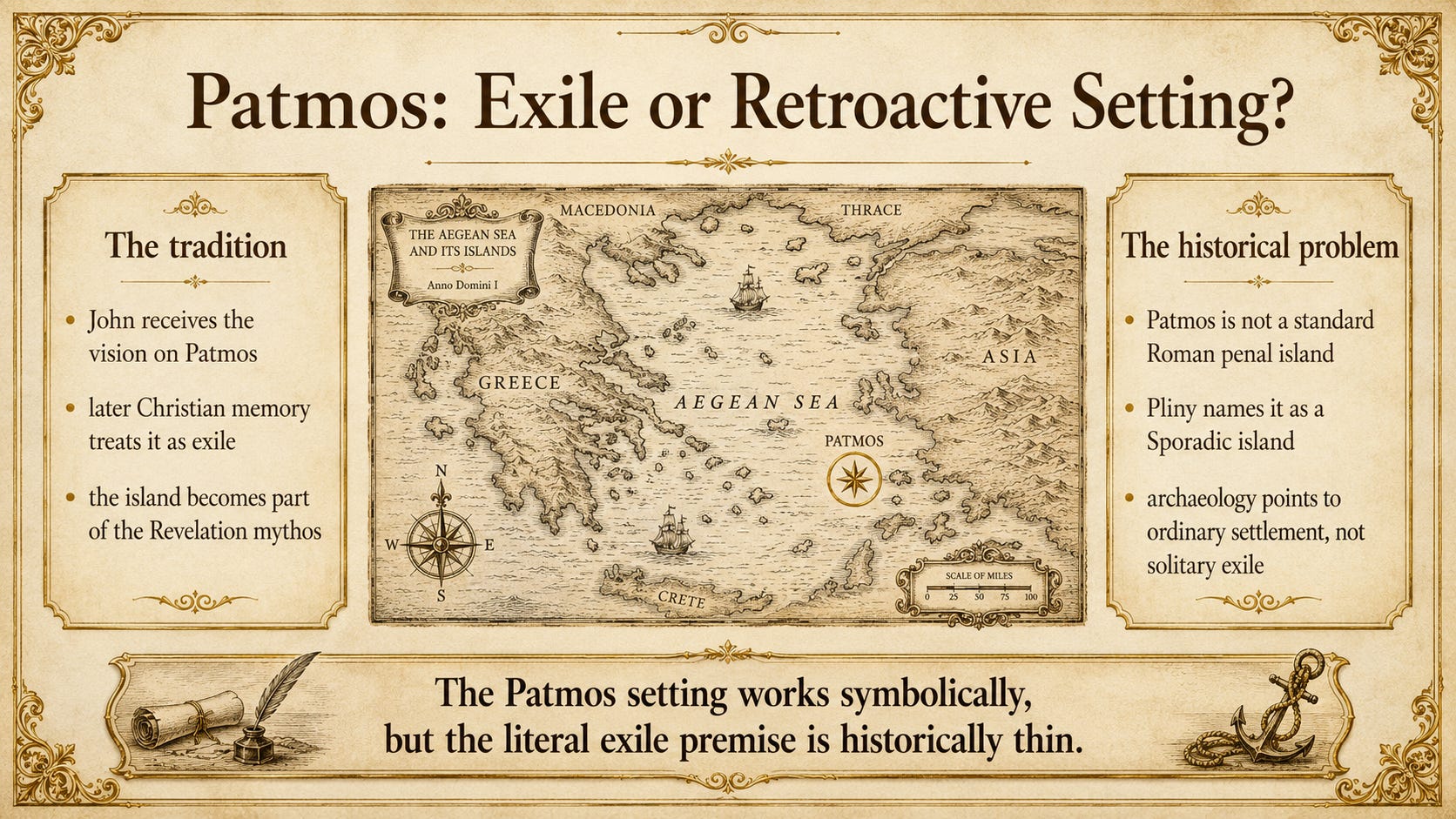
The “exiled to the island of Patmos” premise that historical literalists believe produced the Apocalypse vision, is itself historically unsupported. Patmos appears nowhere in Roman administrative records as a penal colony. The Romans kept careful documentation of where they exiled political and religious offenders, and the standard list of Roman exile islands includes places like Pandataria, Pontia, Gyaros, and the Sporades archipelago collectively, but not Patmos. Pliny the Elder mentions Patmos as a Sporadic island, but says nothing about exile use. The narrative of “John” being exiled there appears to have been constructed retroactively by the Christian tradition. The archeological record reveals a bustling community with fishing villages and temples, dated to the Hellenistic and Roman periods. Somebody should gently break it to the literalists that “exile” means solitude, not a vacation on a beautiful and populated Greek island.
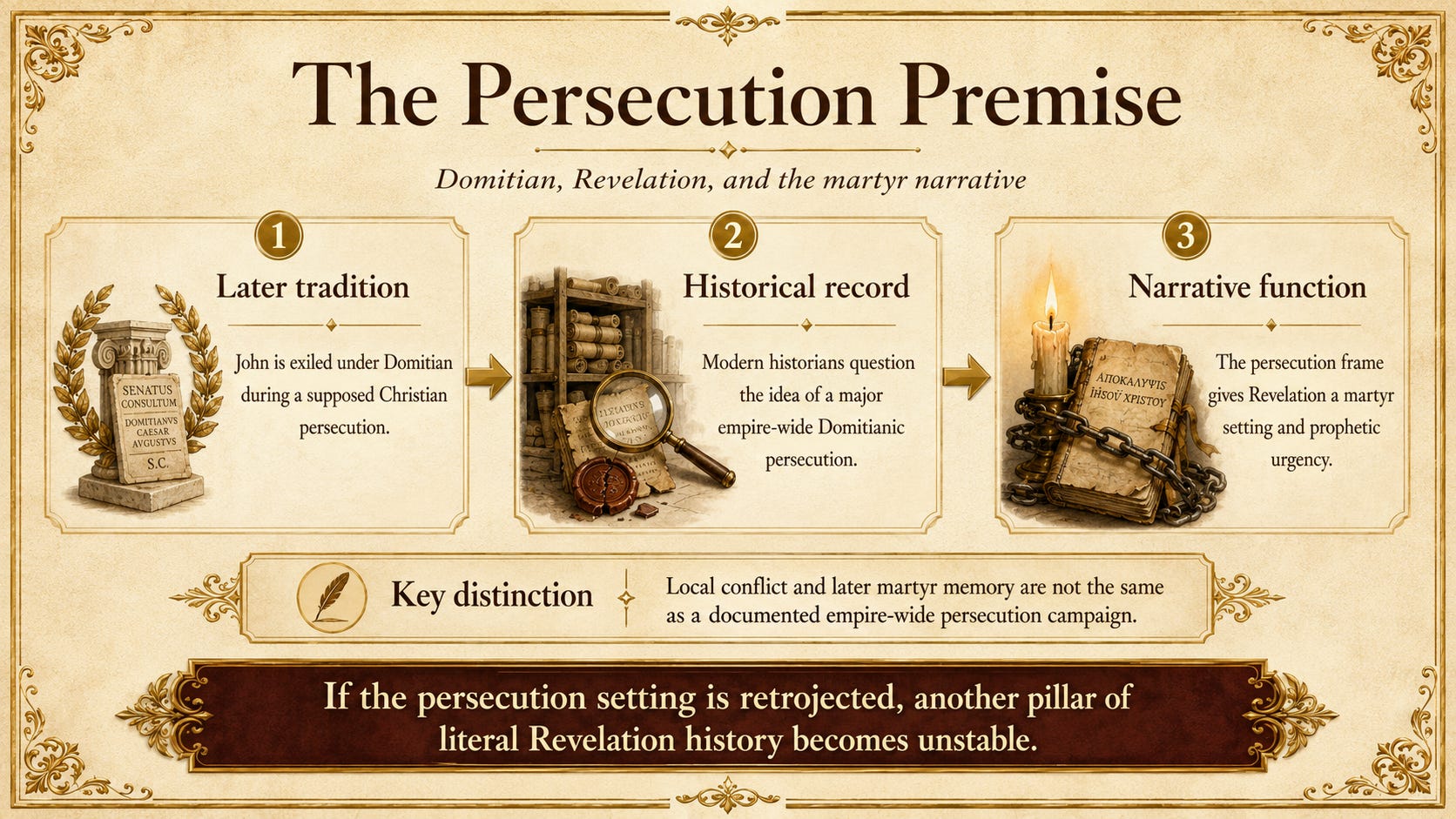
This projection of Biblical narratives onto the historical record is par for the course with “antiquity” as it’s presented to us by the mainstream. The whole “Christians were persecuted by the Romans” thing is equally spurious when one looks at the actual historical and archeological records. It was supposed to be Emperor Domitian who led this Christian persecution that resulted in a hippie named John getting sent to Patmos to have a psychedelic trip and write it down for future generations of special boys to obsess over. Some modern historians have actually dismantled this false claim of persecution. Brian Jones in his biography of Domitian, and Leonard Thompson in his study of Revelation, have shown that the so-called great persecution under Domitian was a literary invention of the 4th and 5th century Christian historiographical tradition, projected backwards to give the early church the martyr-narrative it needed. Sound familiar? It’s a classic tactic: invent or exaggerate past atrocities to give your group the victim card and immunity from scrutiny.
The dispute over “Johannine authorship” was raised as early as the 3rd century by Dionysius, Bishop of Alexandria, a student of Origen. He is said to have performed the first stylistic analysis in Christian textual criticism, comparing the Greek of the Gospel of John against the Greek of the Apocalypse and concluding that the two could not have possibly been written by the same hand. The Gospel uses polished, elevated Greek, while Revelation uses a Greek that is so riddled with grammatical irregularities that no native or well-trained Greek writer could have produced it. I don’t have the linguistic chops or access to whatever manuscripts he looked at to check his work, but if true, this could be evidence for the Latin origin of at least this book of the New Testament. Eusebius preserved this argument of Dionysius in his Church History, Book 7, Chapter 25. The authorship of Revelation was contested from within the church as soon as the book began to circulate.
In the Eastern side of the early Christian world, the Council of Laodicea in around 363 produced a canon list of scripture that explicitly excluded the Book of Revelation. At around the same period, Cyril of Jerusalem gave his students a canon list that also excluded it. Gregory of Nazianzus, one of the Cappadocian Fathers who shaped the theology of Eastern Orthodoxy, excluded it. The Syriac Peshitta, which is the equivalent of the KJV for Syriac Christian churches, did not contain Revelation for many centuries. So the book that modern Christians treat as the ultimate apocalyptic movie script prophecy was not even considered a legitimate part of the Bible for a very long time. I expect the “little season” bros will say that this information was inserted into the historical record by Satan to trick us into thinking Jesus hasn’t returned yet.
So the exile location of Patmos is undocumented, the persecution that allegedly caused it never happened on the scale that the literalist tradition claims, and the authorship of the visions is contested even by the church fathers themselves. The historical scaffolding around Revelation collapses like a house of cards at every point of contact with the rest of the historical record.
Rome and the Whore of Babylon
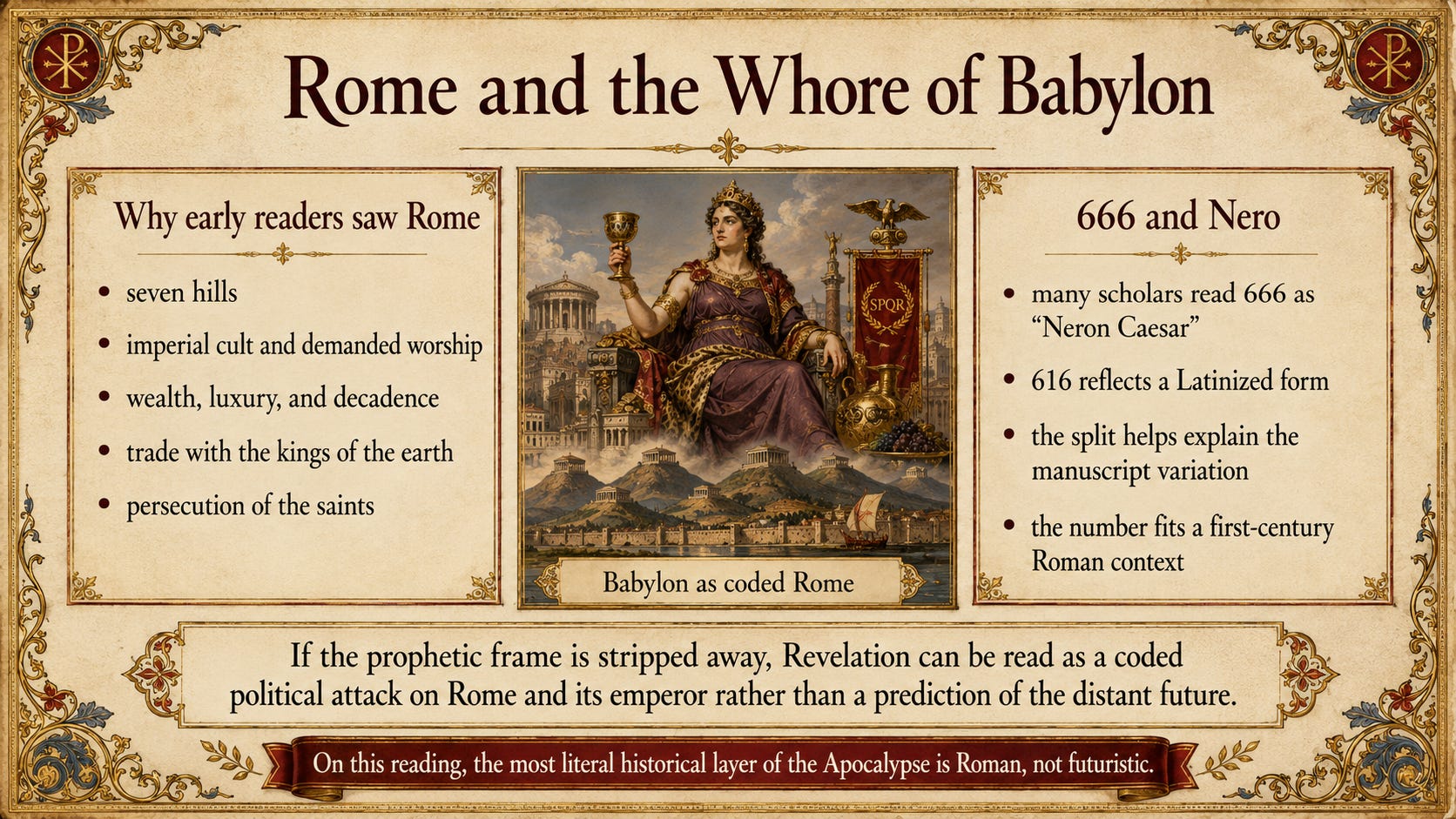
The political function of the Apocalypse becomes visible once the prophetic frame is removed. Almost every early commentator who lived in the Roman world understood that the Whore of Babylon was a coded reference to Rome itself. The seven hills she sits upon, the imperial cult that demands worship, the persecution of the saints, the trade with the kings of the earth, the wealth and decadence and luxury, all of it maps onto first century Rome with very little interpretive strain. Many scholars also read the famous 666 itself through Hebrew gematria as Neron Caesar, which produces 666 in Hebrew letters and produces 616 in Latin letters, which neatly explains why the manuscript tradition split between those two numbers. Isn’t it interesting that Emperor Nero shares a name of the very Naros/Neros cycle that aligns to this number? Such correspondences might lead one to suspect that the whole history prior to Christianity was a mythos.
Considering that writing against a ruling establishment was very dangerous, and defense of one’s own life was one of the primary reasons for esoteric writing, it’s very possible that Revelation was a coded political pamphlet directed against the specific emperor and the specific empire its author lived under, veiled under an exoteric narrative about a prediction of the distant future. The only “literal/historical” weight that the Apocalypse has would be this particular reading. The “literal” meaning of the book is not about a thousand-year reign and a little season and a future Antichrist, it is about Nero and Rome and the political situation in the late 1st century, possibly even meant to support the notion that such a time in history even happened. The “great fire” during Nero’s reign that destroyed half of Rome is suspiciously similar to the “great fires” that destroyed much of the “Roman” style architecture of the Americas. There’s a thread here, beyond the scope of this episode.
The Apocalypse Is Sus
Anyone who wants to go deeper into scrutinizing the Bible’s authenticity can start by looking at the alleged oldest complete manuscript of the New Testament called the Codex Sinaiticus, and ask yourself why it was only found in part in the 18th century, and other parts of it not found until 1975 and later. And why was it found in Egypt, of all places? The main method by which they date this codex is paleography, the study of handwriting, which is easily forged by one who is acquainted with historical styles of calligraphy (see Poggio Bracciolini and the fourth episode of Inner Whirled). The “Eusebian apparatus” in this codex, a series of cross-references in the margins, are of a format created by Eusebius, which means the text can not have been produced before the fourth century. And remember the quote from Erasmus at the beginning of this section, where he criticized Protestantism for making everything public, which should be reserved for the initiated.
The other “oldest” manuscript is the Codex Vaticanus, paleographically dated to the 4th century, held in the Vatican Library since the 15th century (that’s not very long, relatively speaking). The relevant fact is that Vaticanus breaks off mid-sentence in Hebrews 9:14, is missing the rest of Hebrews, the Pastoral Epistles, the Epistle to Philemon, and the entire Book of Revelation. The Apocalypse is not in Codex Vaticanus at all. When you step back and look at the two anchor manuscripts that supposedly stabilize the early text of the New Testament (Sinaiticus and Vaticanus), justifying the modern “Textus Receptus” as the “received word of God,” the only one that is even admissible in my opinion, Vaticanus, is missing Revelation completely.
Remember the letter Erasmus wrote, to criticize Martin Luther for “making everything public and giving even cobblers a share in what is normally handled by scholars as mysteries reserved for the initiated.” This is the same priest who doctored the Apocalypse, omitted and then restored the Trinity verse under pressure, back-translated Latin into Greek when his manuscript was incomplete, and who left ninety alterations in the final book of the New Testament alone. He’s on the record warning that the mysteries of scripture should be reserved for the initiated and not handed to the cobblers, while fully aware of what he himself was doing. The printed Bible was the cobbler’s Bible, the public Bible, the exoteric text that the laity would treat as the literal word of God, while the actual textual situation, the missing verses, the fabricated manuscripts, the contested authorship, the manuscript variants, the back-translations, the symbolic readings, the Bacchic substructure, all of that was kept among the educated humanists and the church scholars who knew the score. Erasmus legitimately cobbled together a Bible for the “cobblers” that he saw as below his priesthood. The pattern Erasmus described in his letter is the pattern his own editorial work participated in. The Apocalypse, the unveiling, ended up veiled more thoroughly by the priesthood that printed it than by any pagan mystery cult that ever existed. The cobblers received the literal book and the literal beast and the literal prophecy. The initiates kept the unveiling for themselves.
Discussion about this video
InnerVerse Podcast
InnerVerse is a podcast for creatives, syncromystics, healers, and occult researchers who are ready to take personal responsibility to create a more magical life. Pry open your third ear and flow in perpetual synchronicity.
InnerVerse is a podcast for creatives, syncromystics, healers, and occult researchers who are ready to take personal responsibility to create a more magical life. Pry open your third ear and flow in perpetual synchronicity.