

Full Research Evidence & Show Notes Below the Paywall (108 Pages)
Watch the free half of this podcast on Youtube
BECOME A PAID MEMBER TO UNLOCK THE FULL VIDEO EPISODE
🔓 Support the podcast and get access to double length episodes by becoming an InnerVerse Plus+ member.
This episode checks every claim made by a very popular creator in the Old World Reset genre. I dig for all possible records on 19th century insane asylums, the Kirkbride plan and Kirkbride buildings. We look at construction photos for Fergus Falls and Buffalo State, the mass graves at Milledgeville and the Mississippi State Lunatic Asylum, Franklin Pierce's 1854 federal asylum program veto, the Independence Iowa paper trail with named architects, stonemasons, and donor lists, on-site brickmaking from glacial clay, and the chemistry of vanilla skies in old photographs.
Remote Biofield Tuning sessions with Chance are available via Zoom. Learn more and book at https://www.innerversepodcast.com/biofield-tuning
SUPPORT INNERVERSE WITH AFFILIATES
Tippecanoe Herbs (coupon code ‘innerverse’)
The Sonic Slider: World’s Best Tuning Fork
My last research project exposed the bad research template of typical Tartaria/Reset content by examining a JonLevi video and an article on Tartaria Britannica. After this aired, I was sent a video by a Youtube channel called Lucius Aurelian that was presented to me as having the “good” research on the topic. I thought that anything was probably better than Levi’s meander through the Utah asylum, and in fairness I ought to check it out and see if there was anything I missed that might help me change my mind on the reset-narrative question regarding these 19th century insane asylums. You can watch it below:
The 72 minute video in question was a livestream with lots of chat banter, but about one third of it does contain serious claims, or implications in the guise of incredulous questioning, and so we will focus on chasing down as many of these as we can. I know nothing about Lucius Aurelian apart from this one video, in which he appears to me as a typical Tartaria/Reset genre content creator, albeit with a better presentation of some sources than JonLevi, who produced essentially nothing but a few photographs and a poorly shot on-location field trip to the Provo asylum’s amphitheater.
I must reiterate that I don’t have any particular attachment to the outcome of this investigation other than to get to the truth of things. If that means accepting legitimate observations from Lucius, I’d be happy to do that, and learn something useful in the process. But if the investigation debunks his position, I challenge you to accept that outcome. I will say it again, and many more times in the future: the burden of proof is on the one making the claims. Falsifying claims does not automatically produce an alternative sweeping narrative explanation of reality that is satisfactorily contrarian to mainstream history. As I’ve been recently accused of “just reading history books and regurgitating them,” let me be clear that my target for this investigation are primary sources, not “history books.” If primary sources converge to a coherent history, it is what it is.
My good friend Gabe, aka Slick Dissident, shared some wise words, “Beware the joy of unworthy enemies. Strawmanning is not inferior to Steelmanning merely because it is common or gregarious, but rather more so because its promise of discomfort ensures innovation.” That really stuck with me as I did this research. It’s easy to get annoyed or attack the messenger, but its hard to try and see things from the other side’s perspective, not only giving them the benefit of the doubt, but even trying to improve their argument to its strongest potential before addressing it. Wherever possible, I attempt to steelman Lucius’s claims in this exploration. I hope that in the process, some innovative insights have emerged. And for the record, Tartaria and Reset proponents are not my enemies. We’re on the same side, the side of truth, which is why I hope you can come on this research journey with me as we look at Lucius’ video and consider his claims.
The Repurposing/Reset Theory
Let’s get this one out of the way first. This is the biggest claim that Reset theorists make about the asylums. Once challenged with the evidence that these facilities were actually built by 19th century Americans, they retreat to saying that even if they were, it doesn’t matter, because there’s “so much other evidence” for the reset. But when they’re talking to their followers, they’ll continue to say that the asylums were used to quarantine and indoctrinate the people who wouldn’t get with the program, those who remembered and spoke about the lost old world. You can’t have it both ways. Either these asylums are not important enough to the theory to matter when scrutinized, or they’re very important to the theory as the main way to explain how and why the public memory of this lost civilization was effectively erased. He front-loads his claim with “potentially” and then goes on to act as if it’s a proven statement, which is an example of the motte and bailey fallacy I’ve been pointing out as prevalent in this genre.
Fergus Falls, Provo, Buffalo State - Photo Evidence of Construction
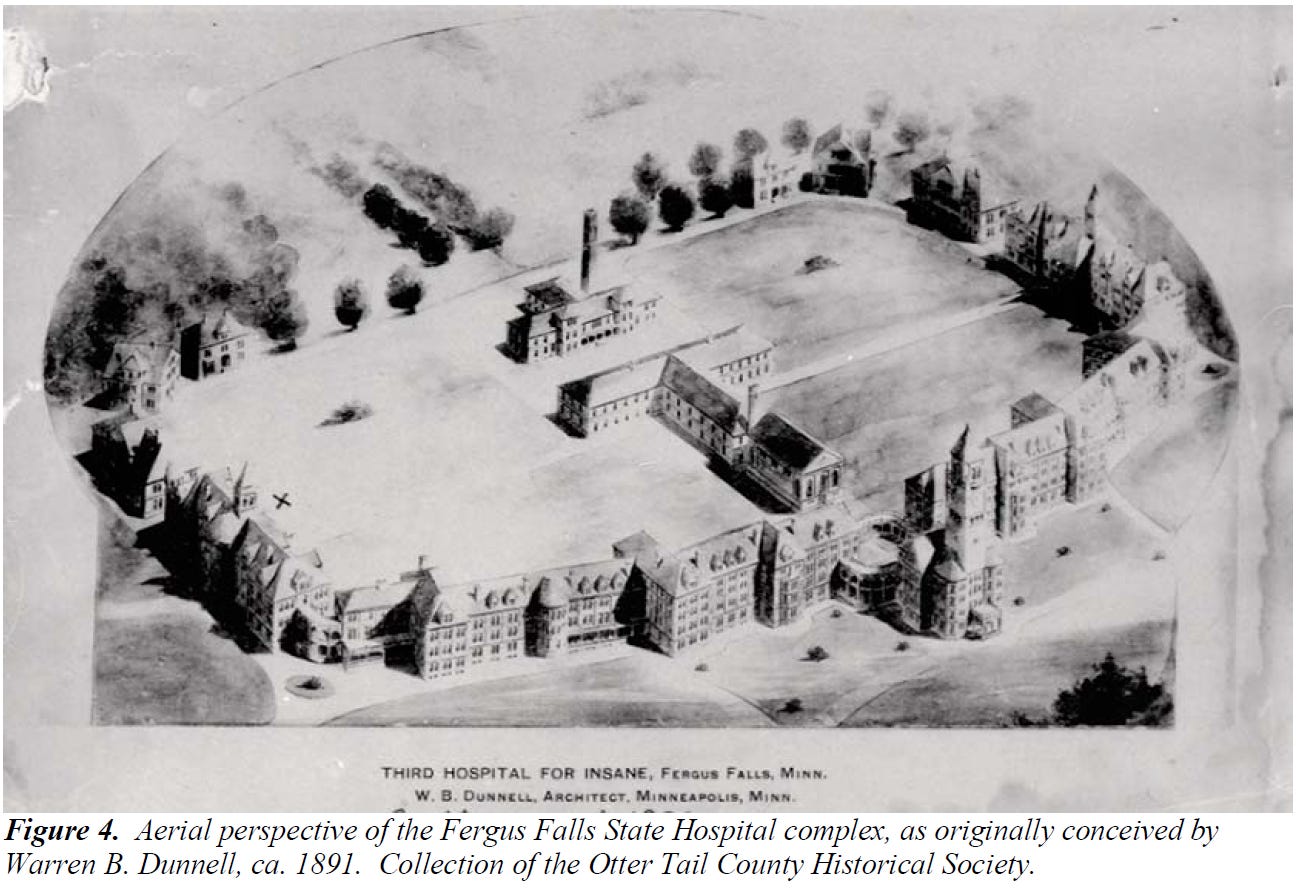
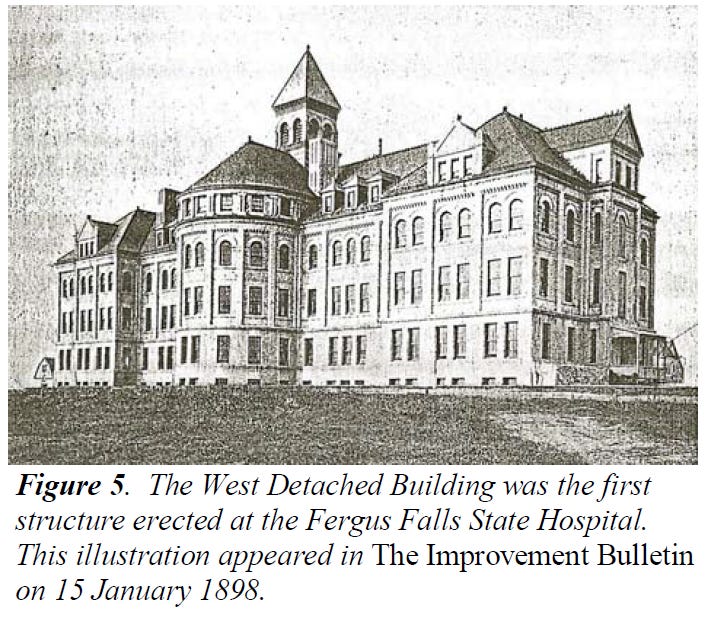
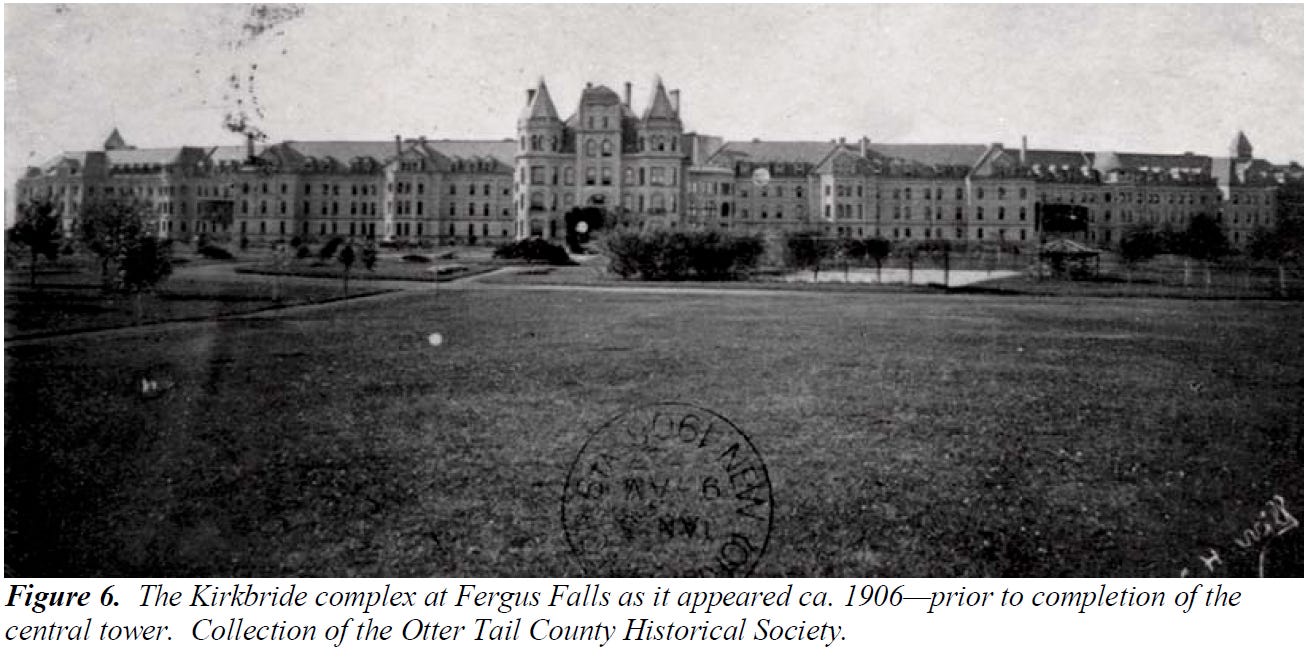
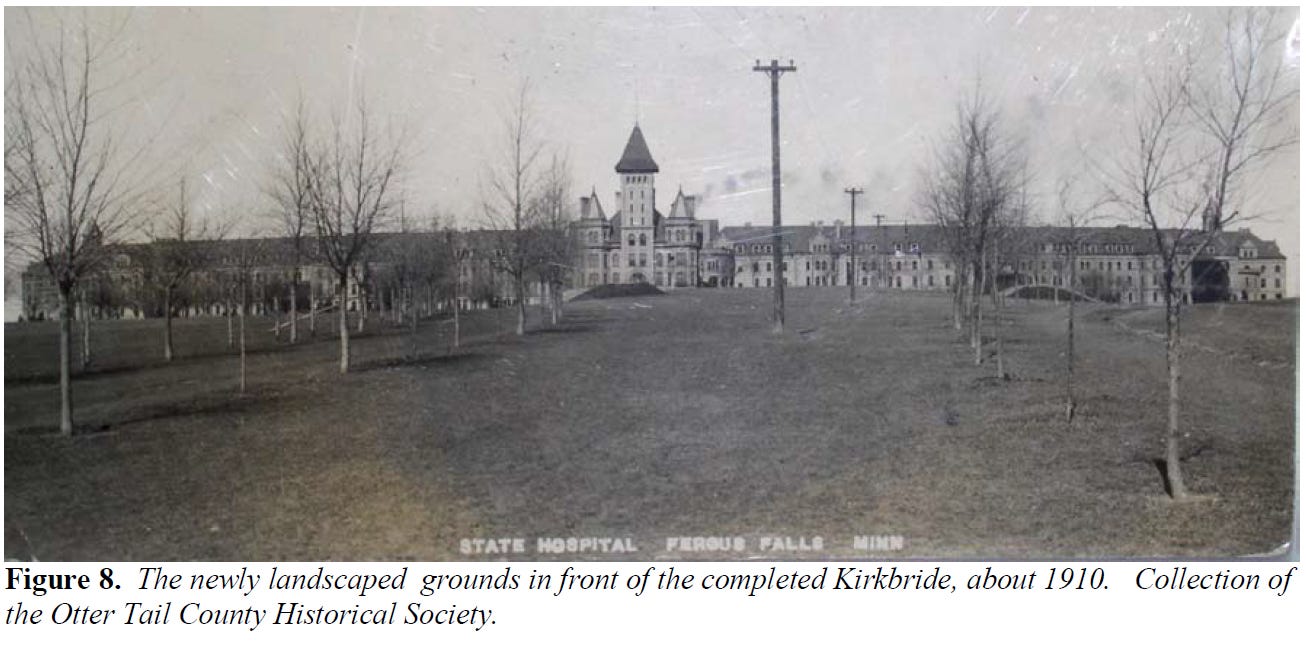
If we can show evidence that asylums were actually built and used for the purpose of treating insane people, these quarantine claims are invalidated, and with it, a major explanation of how the proposed old world civilization and cataclysm was so easily forgotten by the population of 19th century America.
The Minnesota Historic Property Record: Fergus Falls State Hospital is a treasure trove of information. It has dozens of citations and primary source documents that describe the entire construction process of all the buildings on this site. Construction began in 1888 and was ongoing all the way to 1912. The document records administrators and their protocols, how treatments evolved over its existence, and much more.

Here’s a partially built asylum in Provo Utah, 1888, followed by the completed building, which was finished in 1891.
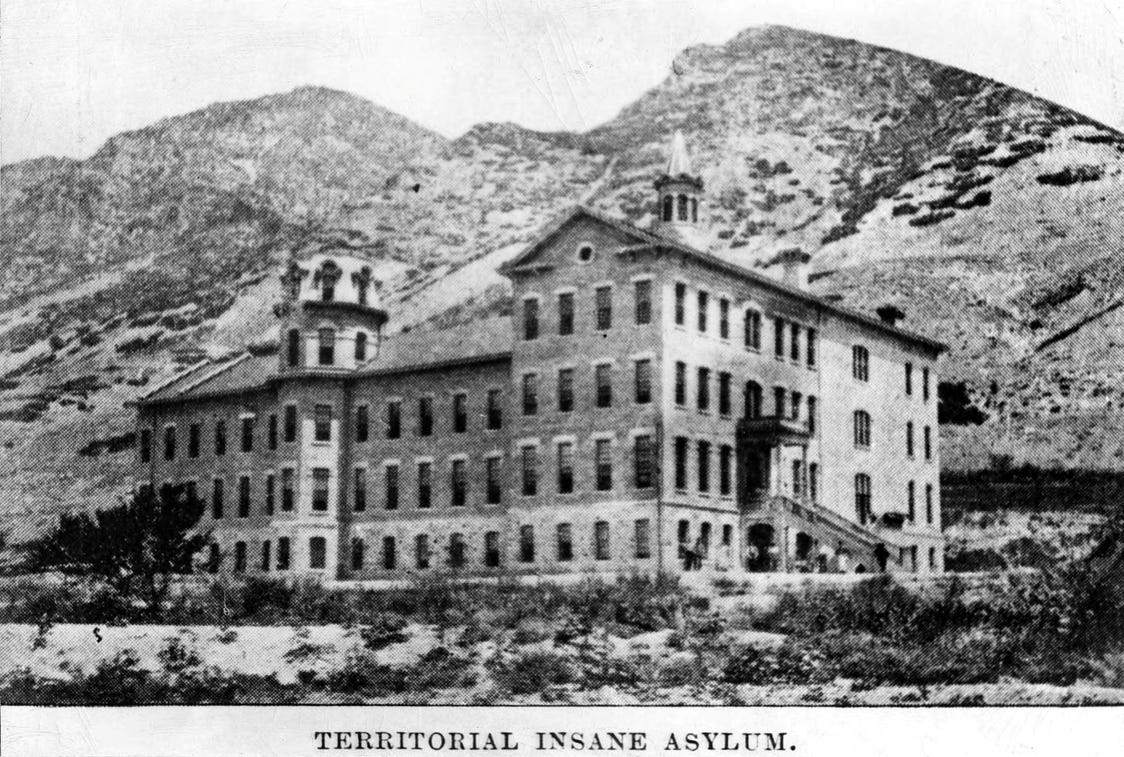
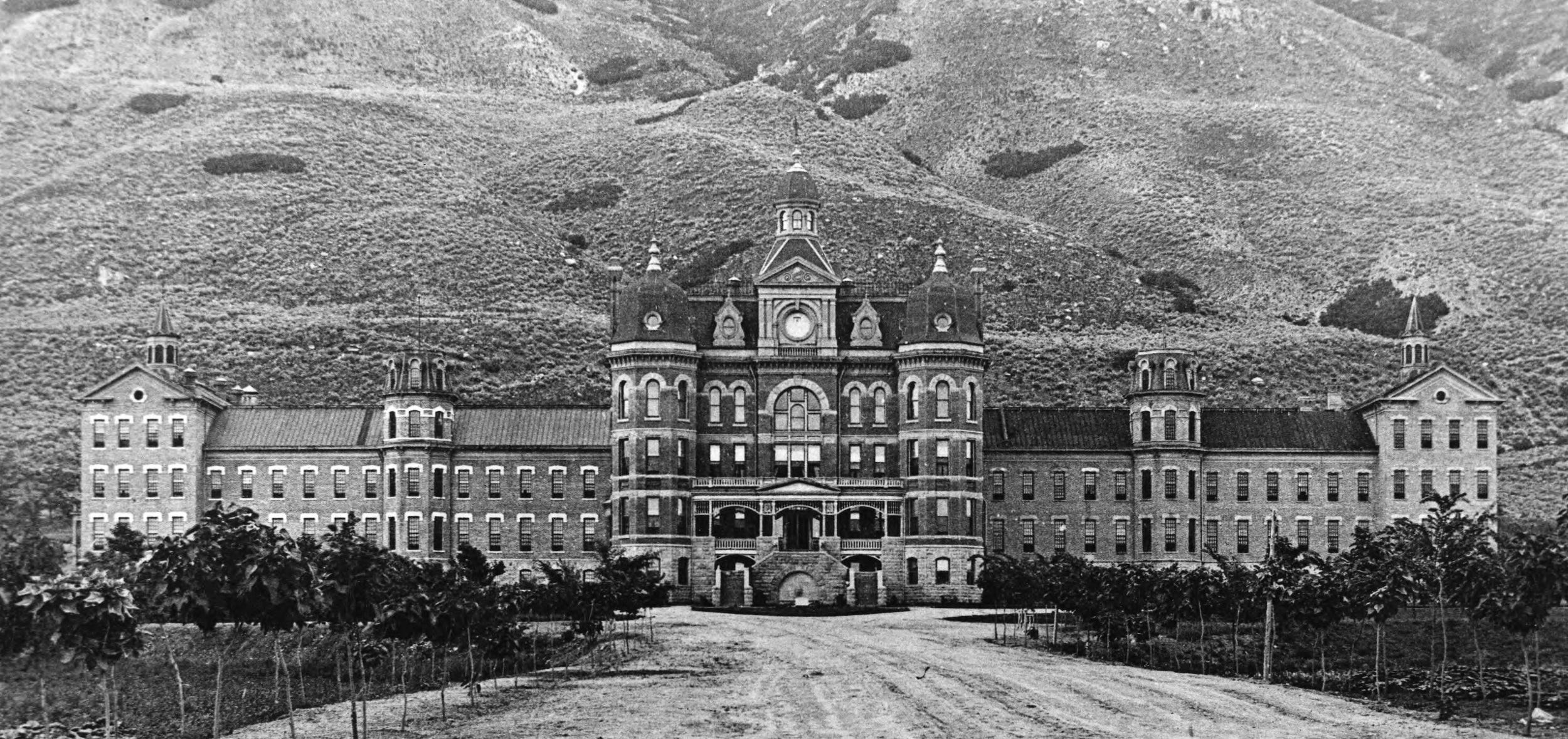
And then there’s the Buffalo State Asylum, still standing today as the Richardson Olmsted Complex. I talked about this in my last video in more detail. The heavily documented build happened in phases from 1871 to 1896, opening in 1880 with only the east wing complete. A ten year construction halt occurred during an economic depression.
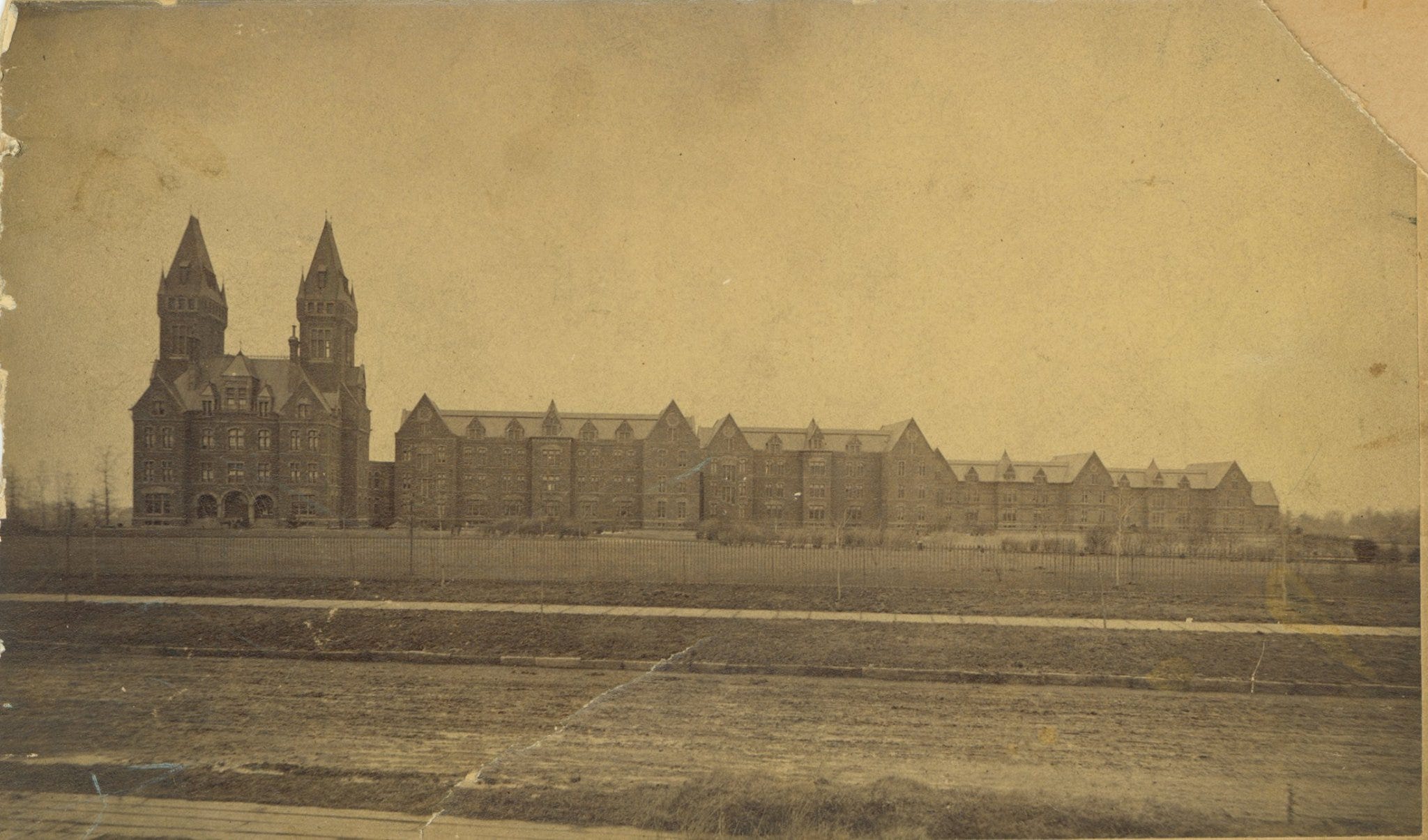
This photo is from 1880, when only the east wing of the Buffalo State Asylum had been completed. I hadn’t found this photo last time, I had to use The Wayback Machine to discover it, because it’s current URL is 404.
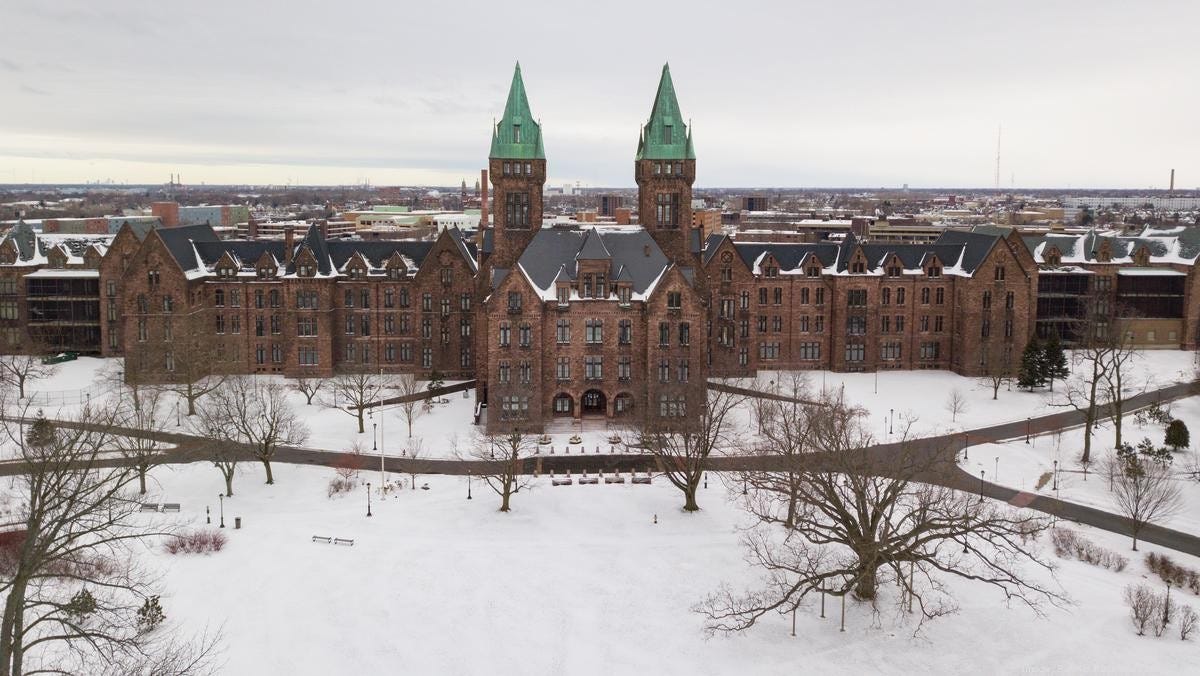
As you can clearly see, this “batwing” style Kirkbride building, like dozens of others, features two wings, and in 1880 they had not yet built the second. There many not be a ton of easily accessible digitized photos that show phases of construction for all of these buildings, but we’re talking about stuff built between 1850 and 1900. Only the stuff in the tail end of that time frame is likely to have any photographic documentation at all, and it’s not guaranteed that it survived or was ever digitized, because few people have ever cared to go digging in physical county or state archives for this stuff to put it online. That’s not weird, it’s typical for historical archives.
Crazies Check In, But They Never Check Out
At 37:26, Lucius waves off the idea that an asylum was “a place to go and recover,” as the Tartaria suppressing authorities “playing games with words,” and earlier he floats that these were potentially extermination centers, which we’ll get to in a bit. So the implied claim is that recovery was a cover story. That’s testable, and I found many stories from the period that demonstrate people getting out of the asylum, who were there for legitimate reasons. Alcoholics or drug abusers typically stayed about three months, not unlike modern rehab centers. People wrote about their experiences, so the story is not just coming from the authorities.
Between 1850 to 1900, the US population went from mid-20 million to over 70 million. The reset theory would imply that of all those 20 million in 1850, the dozen or so asylums that were operational in the US at that time were enough to contain the people who remembered this old world civilization or would talk about it. Let’s do the math here. Say there were 15 asylums that held 2,000 people each (which most did not have anywhere near that capacity). This generous ballpark figure gets us to 30,000 asylum patients, which out of 20 million is 0.15%. Census figures estimate the number at that time as between two and five thousand, total, meaning a more reasonable estimate of institutionalized population by percentage lands at around 0.025%, that’s two and a half percent of one percent, very small. By 1890, that figure grew to about 74,000 nationwide, which provokes a legitimately worthwhile question—why were so many more people in need of mental health care? Industrialization and urbanization are obvious likely culprits, but also the change in philosophy that shifted responsibility on this issue away from church and family and towards the state and private doctors would also have changed the situation. The whole point of the “Kirkbride plan” and its precursors was to get insane people who had no other recourse out of being chained to the wall in jail basements. 74,000 insane patients out of the 62 million population in the 1890 United States, while being a large number of patients compared to before, is still 0.12% of the total population.
The bigger picture: is this: the United States grew from five million people in 1800 to sixty-three million by 1890, a twelvefold increase. An urban factory family in a tenement could not do what a farm household could, so responsibility migrated to state institutions as a consequence. The asylum was the catch-all, housing senile dementia, epilepsy, alcoholism, intellectual disability, and late stage of syphilis. They all landed in the same building because no other public institution would take them. And chronic cases accumulate: even a hospital that discharges half its admissions stacks the other half, year over year, for decades. The math maths.
This “concentration camp” theory never thinks about these kinds of numbers. Why would you need to lock up a tenth of a percent of the population or less? Wouldn’t more people than that have problematically good memories? Couldn’t you just write off such a tiny minority’s beliefs as inconsequential anyway? It falls apart on basic scrutiny, but we can falsify it more totally with evidence. Keep in mind that I’m not saying these asylums were perfect. Bad things happened in places like this, just not the Tartaria-Reset suppression things.
To be as fair as possible to the horror concern that underlies the concentration camp concept, involuntary committal was a real thing. The standards for it were much looser than modern standards, and some people genuinely did go in and never come out, sometimes winding up in an mass graveyard on the property with little more than an unmarked stone. That’s a legitimate dark chapter in this asylum story and I am definitely not waving it away. My goal is not to make these institutions out to be rosier than reality, it’s to answer the question as to whether the asylums were treatment institutions that sometimes failed at their duty, or death camps in disguise. So let’s look at the recovery data from the period.
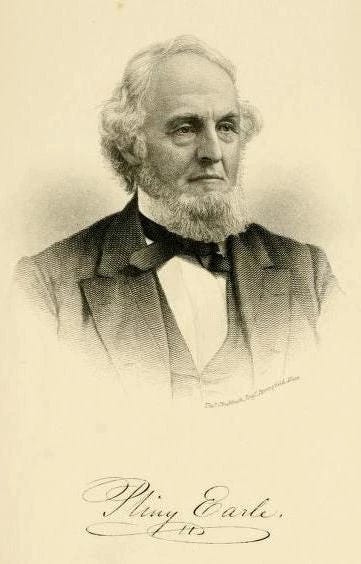
Pliny Earle was half a year younger than Thomas Kirkbride, and his contemporary in the alienist field. Although Kirkbride gets the historical credit in the name of the asylum template, Earle was equally crucial to the development of the environmental determinism medical philosophy. Works include A Visit to Thirteen Asylums for the Insane in Europe (1841), Institutions for the Insane in Prussia, Austria, and Germany (1854), The Curability of Insanity (1887), and others. His tour of asylums in Europe was no doubt influential on Kirkbride and the other founding members of the Association of Medical Superintendents of American Institutions for the Insane (AMSAII).
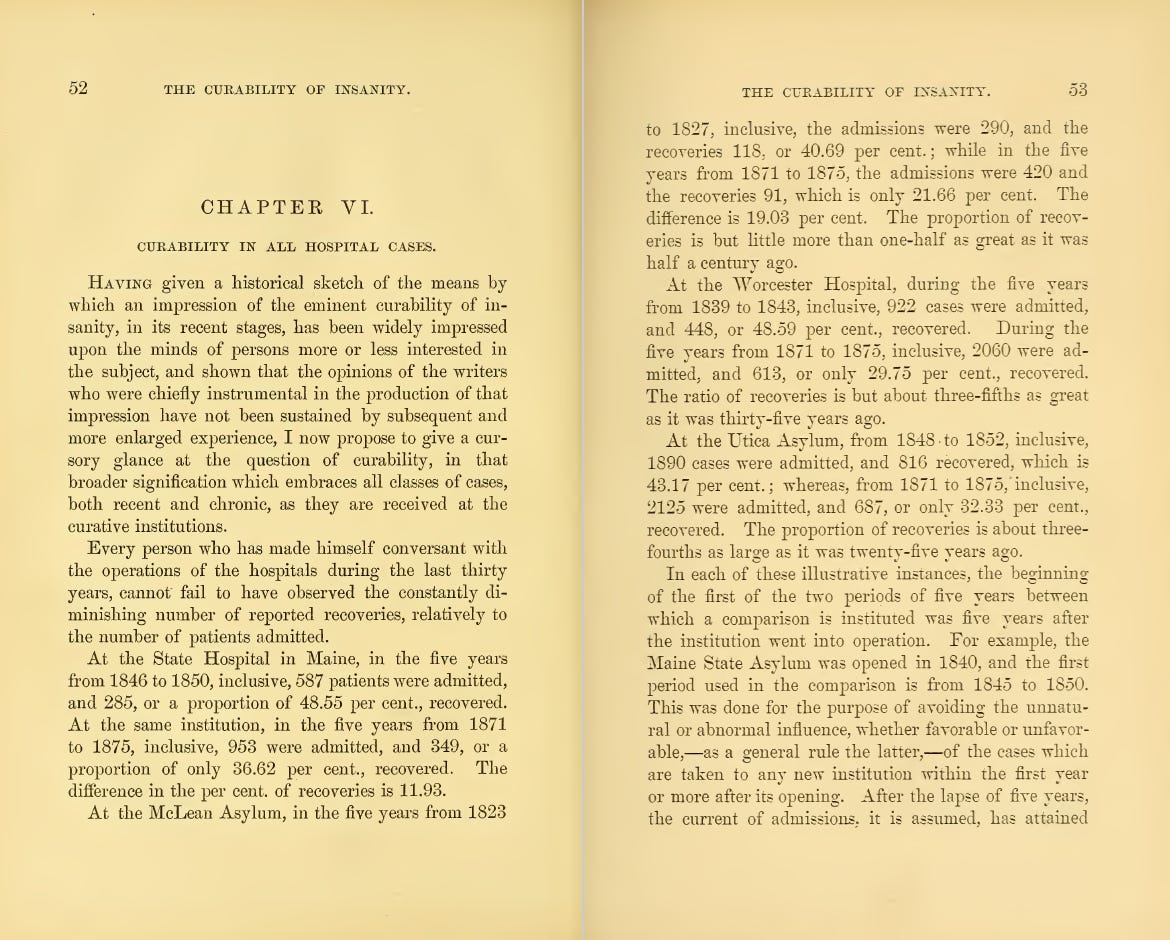
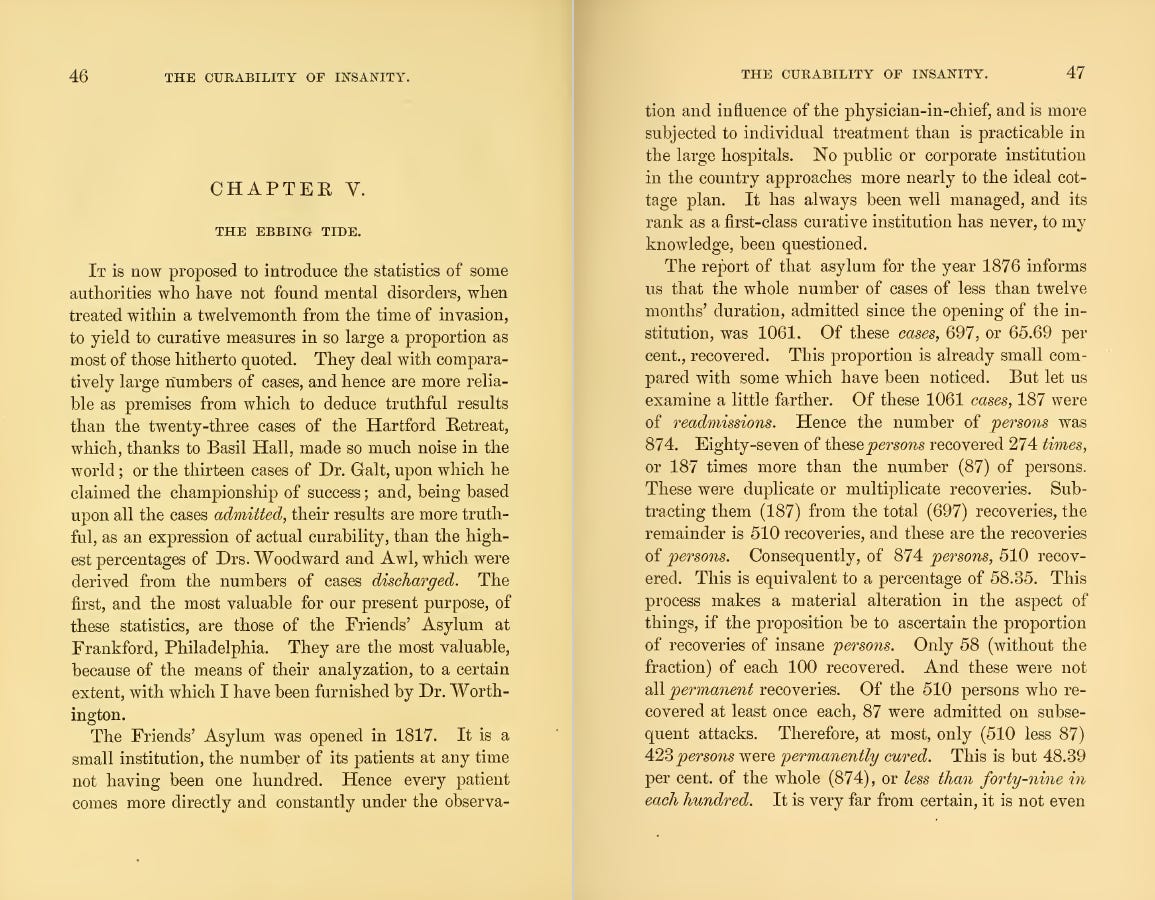
These pages from The Curability of Insanity give hard institutional statistics on patient recovery rates. He even accounts for the Friends’ Asylum in PA, where Kirkbride worked his first cases, saw some people come in and out of the asylum more than once, and the statistics are skewed by it: “Eighty-seven of these persons recovered 274 times... Subtracting them (187) from the total (697) recoveries, the remainder is 510 recoveries, and these are the recoveries of persons... of 874 persons, 510 recovered.” That's 58.35% of unique individuals. He goes on to show that excluding the 87 who relapsed and were readmitted, "at most" 423 permanently cured, 48.39% (p. 47). Even Earle's harshest, most skeptical recount still has essentially half of everyone treated walking out for good.
There’s a ton more data in this book but that’s enough to show the point, a reputable source writing a critical analysis of whether or not his professional cohorts were effective at their stated goal of curing insanity.
From a journal called Alienist and neurologist…
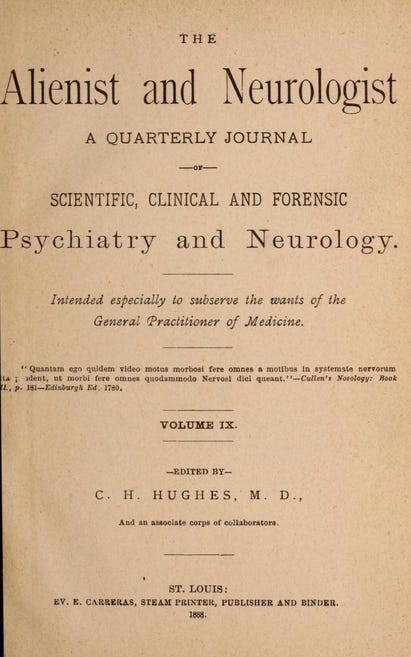
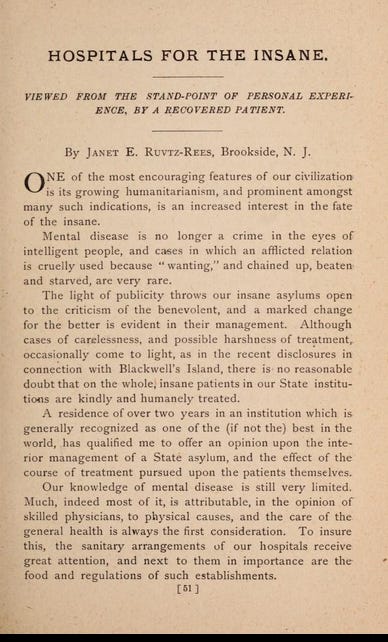
Janet Ruutz-Rees, a recovered patient formerly cared for in the State Asylum for the Insane at Morristown New Jersey writes:
“One of the most encouraging features of our civilization is its growing humanitarianism, and prominent amongst many such indications, is an increased interest in the fate of the insane. Mental disease is no longer a crime in the eyes of intelligent people, and cases in which an afflicted relation is cruelly used because “ wanting,” and chained up, beaten and starved, are very rare. The light of publicity throws our insane asylums open to the criticism of the benevolent, and a marked change for the better is evident in their management.”
A residence of over two years in an institution which is generally recognized as one of the (if not the) best in the world, has qualified me to offer an opinion...
A larger archive of such accounts is held by Kent State University’s "Insane Asylum Memoirs, 1842–1890" collection. The many first hand accounts here vary from singing praises of their doctors for helping them get better to exposing horrific mistreatment and abuse. The whole spectrum of light and dark was at play, just as it always is in all times and places in this world. The one thing that I found no mention of was the persecution of the Tartaria memory keepers.
Milledgeville and the “Extermination Center”
He dares to say that large cemeteries equals extermination centers. That is a serious claim. Since we’ve already addressed the first part of the theory, that these were concentration camps for Tartaria memory keepers, we can just look at the numbers here.
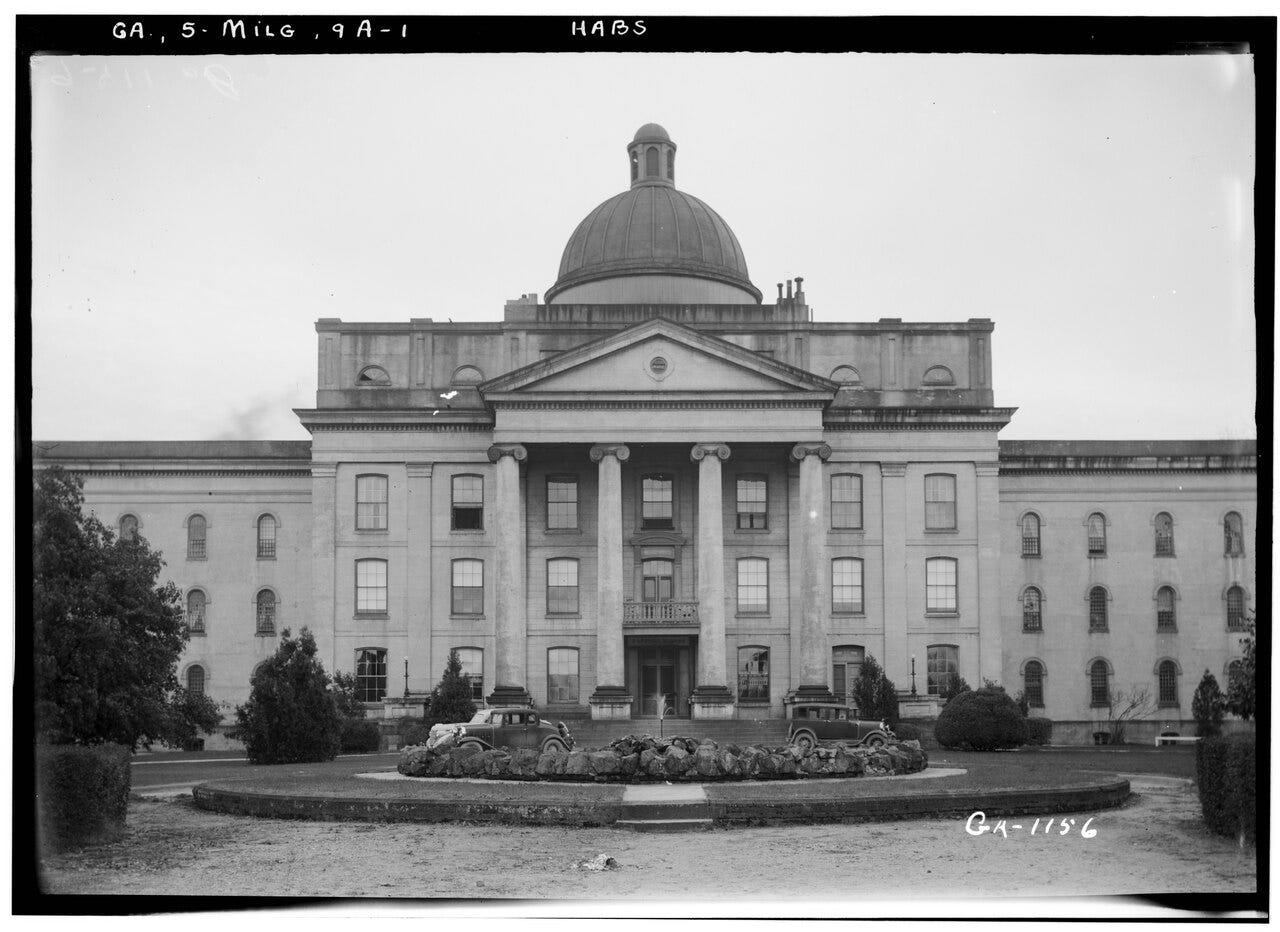
This asylum opened in 1842, meaning it was one of the earliest of its kind, and not a true Kirkbride because his book was not published until twelve years later. But as you can see, the trend was already underway to build large asylums outside of heavily urbanized areas. This building was in use from 1842 all the way to 2010, an incredibly long period of institutional operation.
So he gets the 25,000 number right, that’s accurate to what the state of Georgia itself has said in official records. I think Lucius is absolutely right to see a number and graveyard like this and ask questions. Can we find a satisfactory answer? Quick math: 25,000 deaths over 168 years of operation averages out to 148.8 per year. By the 1960’s this was the world’s largest mental institution with over 12,000 patients, 6,000 employees, and over 8,000 acres of land. This cemetery kept growing for almost the entire span of time the asylum was operational—keep in mind, many people with mental illness have physical illness too, and many that are institutionalized til death are poor or have no families.
Seeing a big cemetery might be spooky, but 168 years is a very long time to be hosting sick and dying patients, of whom a large percentage might not have the family or means for a proper burial elsewhere. I’m not convinced this is suspicious.
Okay, that’s true, but Milledgeville was the state capital of Georgia from 1807 to 1868, so the first 26 years of the asylum’s history, it was an capital-city institution serving as a centralized location for a state service. They got a railroad depot in 1853. The current size of Milledgeville has no real weight as an argument for his extermination theory. Lucius later brings up the Milwaukee soldier’s asylum as his backup proof of the theory, Wood National Cemetery. A large soldier’s cemetery with tombstones going back to the Revolutionary War, not evidence of his theory either.
He does mention experimentation and abuse at asylums, which I already said I don’t dispute, the institutional records themselves admit to these things. Horrifying, but not concealed, and not a Tartaria extermination program.
More mass graves at asylums
Anyone who looks into this further like I did will find that Lucius didn’t mention how common mass graves are at these sites. It’s actually much more intense than he shows here with the single example. Fields of numbered iron stakes. Tens of thousands of anonymous dead. When Lucius calls these places “extermination centers” and shows you a cemetery, he is pointing at the single most emotionally powerful evidence in his entire case, and I’m not going to brush it off and move on. I’m going to steelman it and show you much more than he showed.
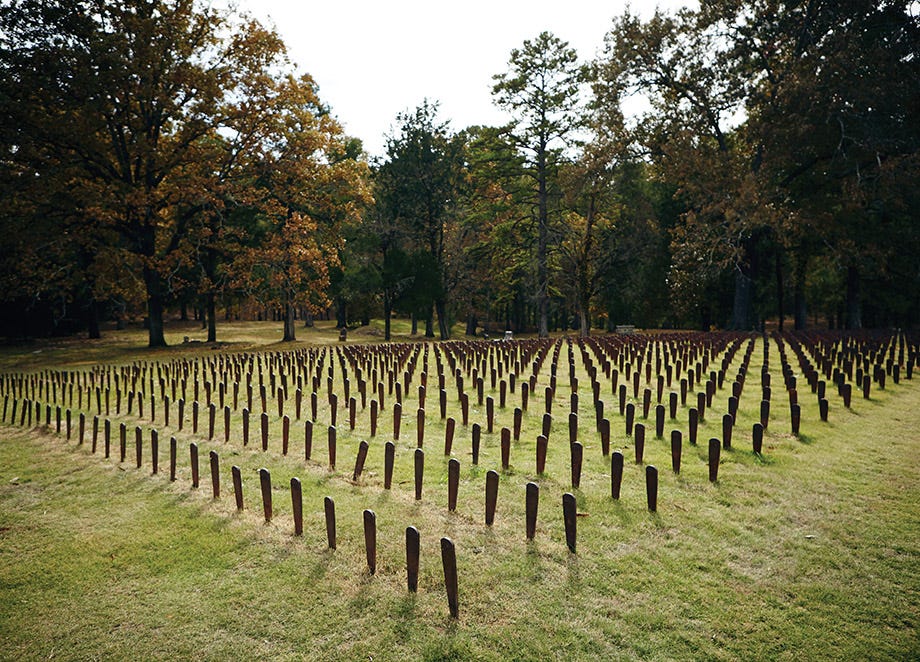
The mass graves are real. After I saw his segment, I went looking for more like it, expecting to find mostly rumors, and instead I found archaeology. At the Mississippi State Lunatic Asylum in Jackson, construction crews at what is now the University of Mississippi Medical Center hit coffins in the 1990s, then sixty-six more in 2012, then over a thousand more in 2014; ground-penetrating radar now estimates as many as 7,000 bodies across roughly twenty acres. In New York, the state’s own estimate is that around 55,000 former patients lie in anonymous graves statewide, with roughly 5,800 at the Willard asylum alone. At the Utah Territorial Insane Asylum, 485 patients were buried without markers in the Provo City Cemetery.
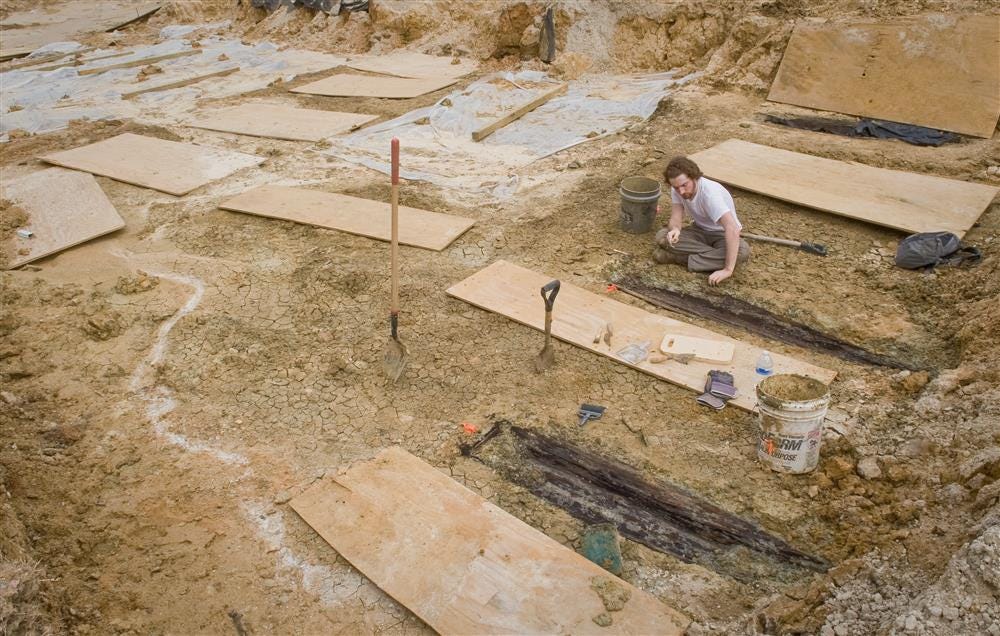
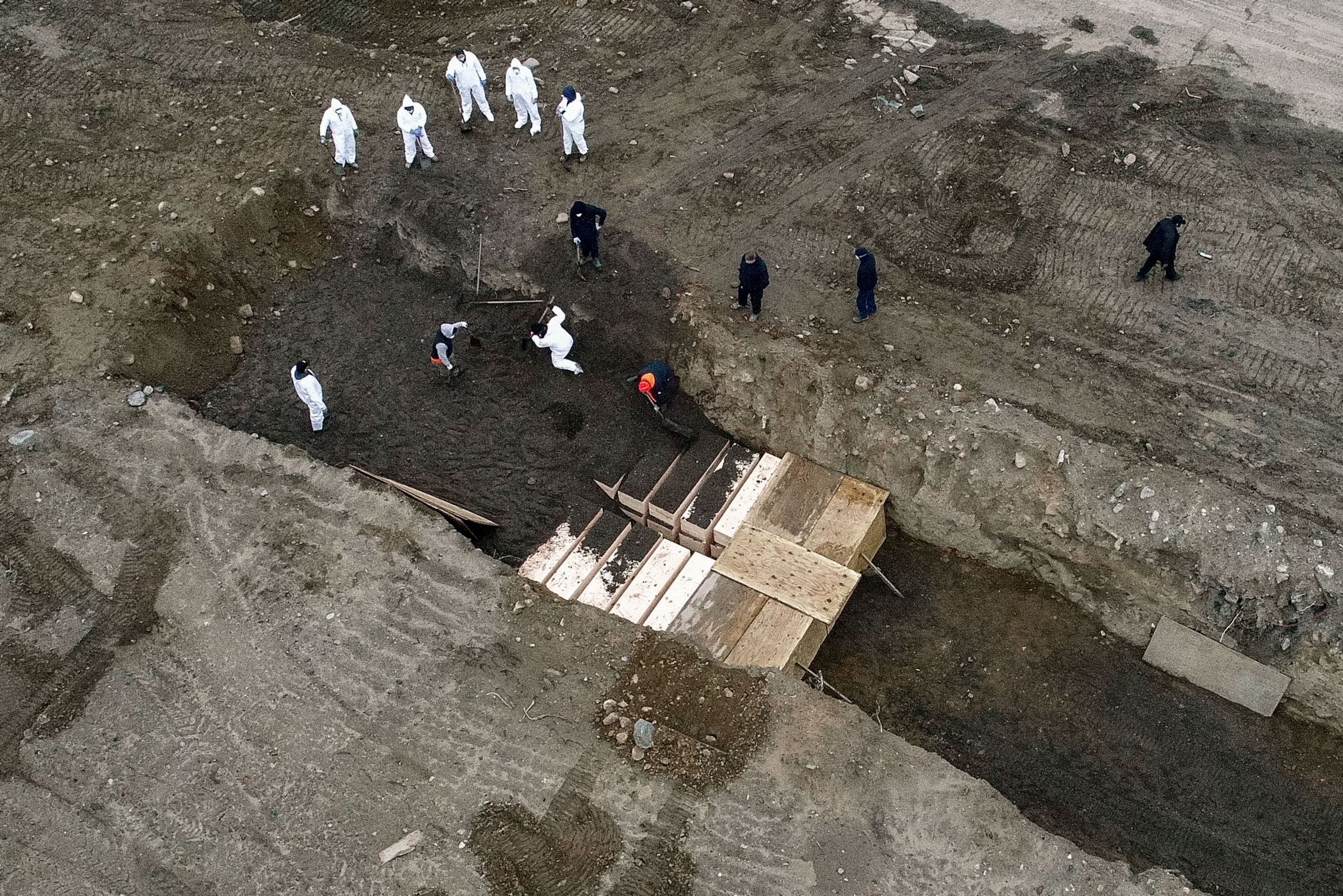
Here is what the evidence actually shows about how those people came to be in the ground, and this is where the “extermination” reading falls apart.
We’ll start with the numbered markers: rows of iron stakes stamped with numbers instead of names. Numbered markers were standard practice for institutional pauper burials across the country. And at Milledgeville specifically, we know exactly why the cemetery became anonymous: the graves were marked, with numbered iron poles, and in the 1960s prison inmates assigned to groundskeeping duty pulled thousands of those markers up and threw them into the woods without recording where they’d stood. The dead didn’t vanish into a secret pit. They were made anonymous later, by neglect, by a chronically underfunded institution that couldn’t be bothered to protect its own graveyard.
Mississippi tells the identical story with even better documentation. The project’s own researchers are explicit: the graves were marked originally, mostly with painted wooden stakes, and the wood simply rotted in the Mississippi climate over the better part of a century which is why the graves are now unmarked. The bodies were in individual coffins, laid out in orderly rows, buried with the ordinary respect afforded the unclaimed poor of that era. The Mississippi State Archives still hold the admission and death records, and the documentary made about the site states that the archives “reveal why many were admitted and how they died.” A regime running secret death camps to erase the memory of a lost civilization does not carefully file the paperwork and leave it in the state archives for a century. Cover-ups destroy records. These institutions kept them.
And when researchers examine the remains themselves, they don’t find what an extermination would leave behind. They find what poverty and pre-modern medicine leave behind: pellagra, the niacin deficiency that comes from a diet of cornmeal and fatback and produces dementia-like symptoms; signs of syphilis, an affliction notorious in the asylum era for its coincident symptoms of madness. These are the fingerprints of neglect, malnutrition, untreated disease, and overcrowding in institutions the public wanted to forget, but evidence of outright murder.
If your instinct, watching Lucius, was that something genuinely terrible happened in these places, your instinct was correct. Something terrible did happen: people were committed on thin evidence, warehoused in numbers that destroyed the therapeutic ideal these buildings were designed around, left to die of preventable disease, buried as anonymous paupers, and then forgotten so completely that groundskeepers threw their headstones into the woods.
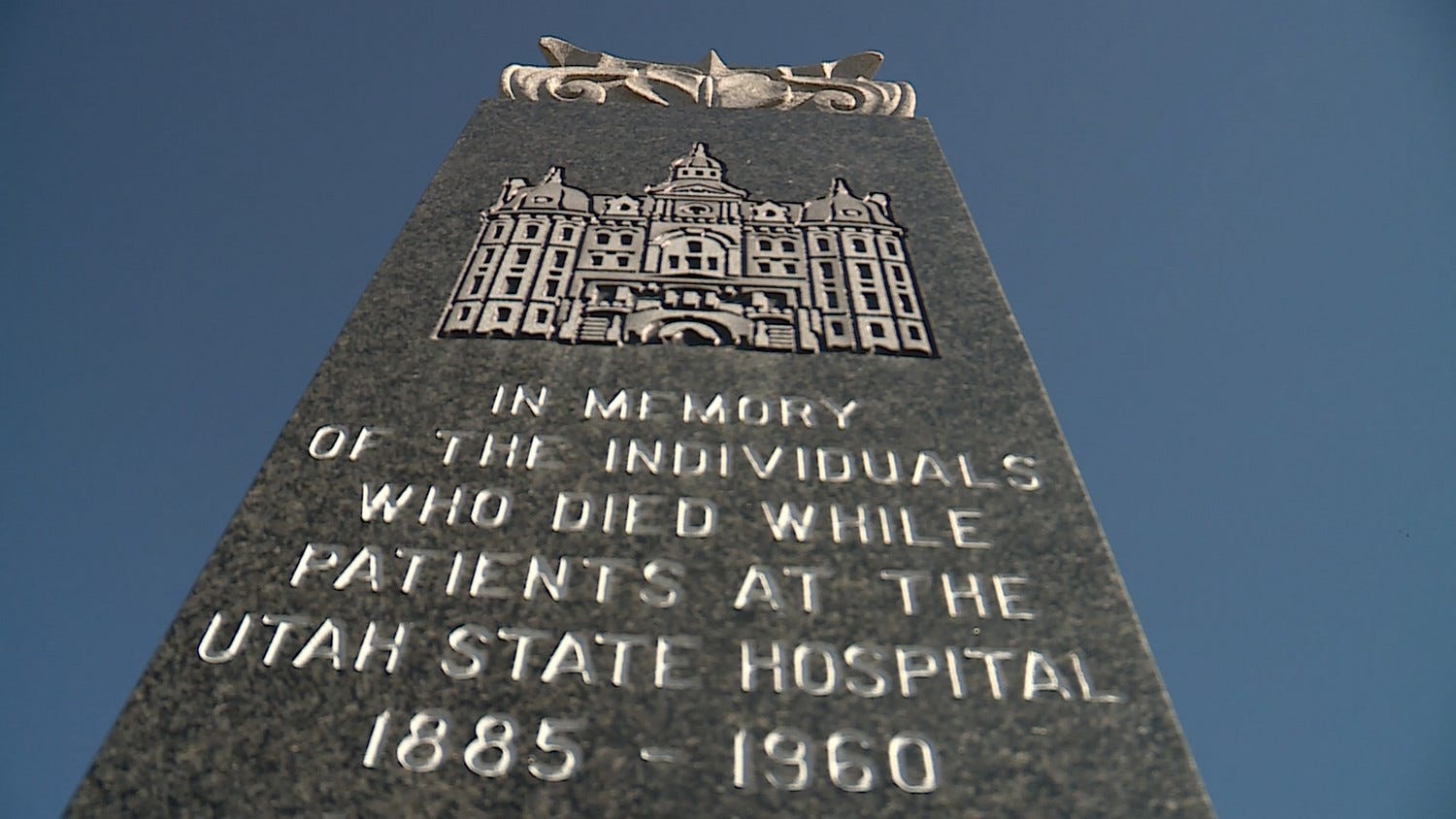
We know about this because the graves are being dug up, catalogued, and memorialized, by universities and state legislatures and volunteer genealogists. Milledgeville’s 1997 restoration launched a nationwide movement to memorialize asylum dead. Utah unveiled a monument naming all 485 of its patients in 2018 . Mississippi’s legislature put $3.7 million toward exhuming and honoring its 7,000. That is not how a hidden extermination stays covered up.
Doctor Thomas Story Kirkbride
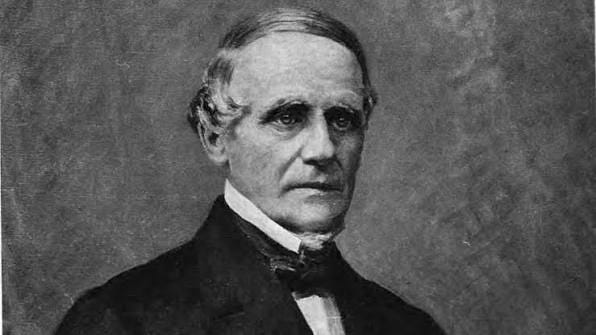
Before we get into Kirkbride, a review. In my other asylum video, there was a huge segment you might not have seen, because it was behind my paywall. In order for the rest of this breakdown to make sense, we have to catch you up to speed or give you a review on the central historical character in the 19th century asylums story-line. This doctor’s name was in fact Thomas Story Kirkbride. And yes I’ll talk about his middle name being Story in just a moment, but let’s recap who this guy was and what his role is said to have been in the creation of the infamous Kirkbride asylums.
Let’s look at the accepted standard history of this guy first. Dr. Kirkbride was a Philadelphia Quaker and physician, who was born in 1809. He received a medical degree from the University of Pennsylvania in 1832. He was then a resident physician at the progressive Friends Asylum for the Insane, originally called The Asylum for the Relief of Persons Deprived of the Use of Their Reason. This is said to be the first private mental healthcare facility in the country. It was operated by Quakers, and seems to have been more of a charity than a hospital at first.
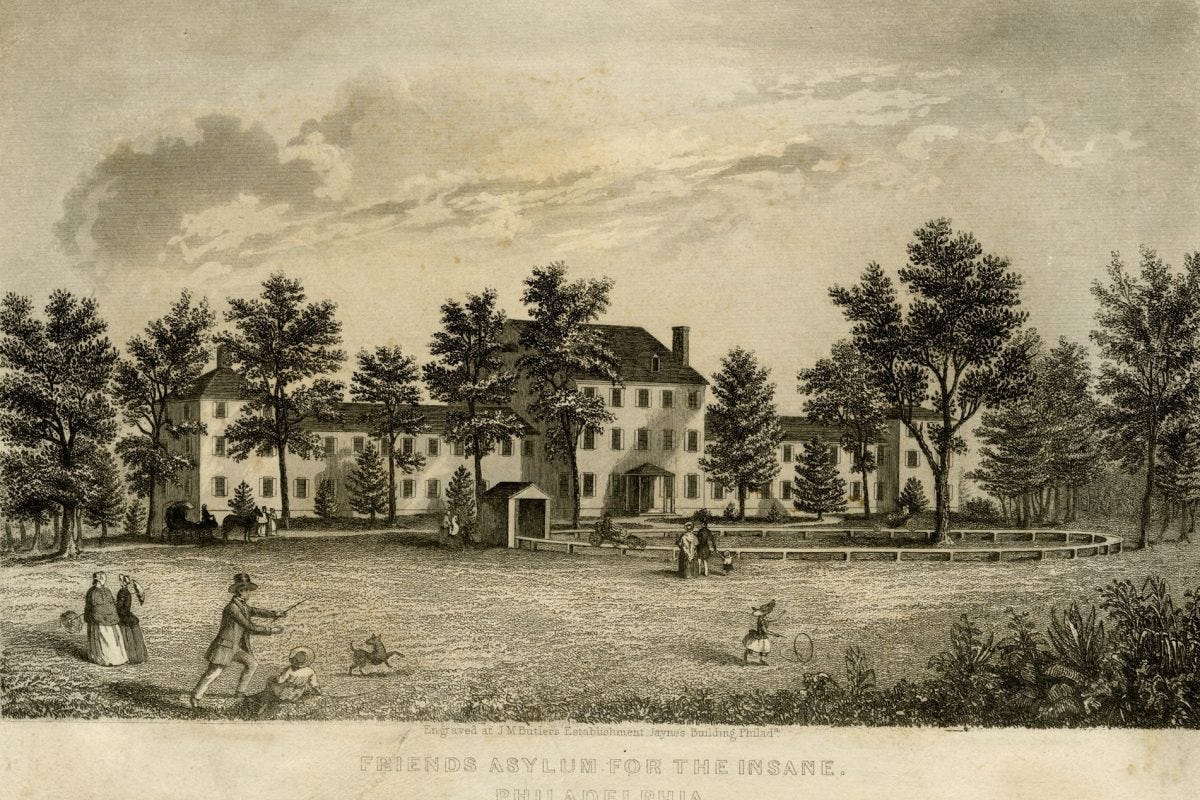
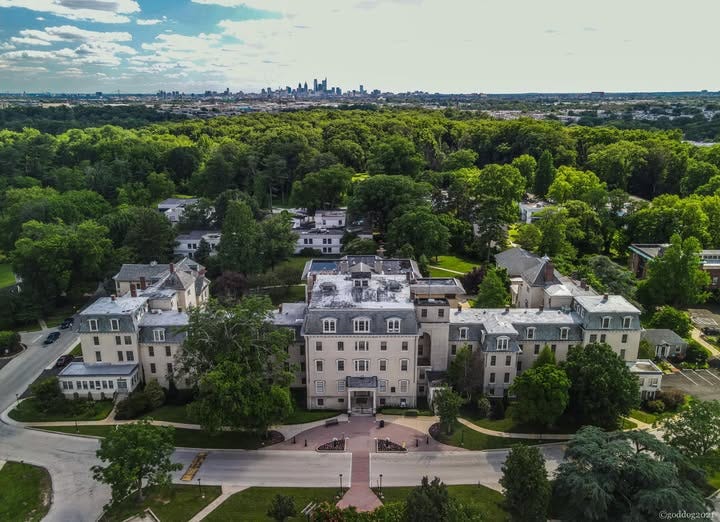
In 1841, overcrowding in other state facilities is said to have led to the construction of the Pennsylvania Hospital for the Insane, where Kirkbride became the first superintendent and remained in that chair over forty years until his death in 1883. Kirkbride is important to the asylums because he was both one of the founding members of the The Association of Medical Superintendents of American Institutions for the Insane (AMSAII), and he literally wrote the book on the philosophy and blueprint of these buildings: On the construction, organization, and general arrangements of hospitals for the insane.
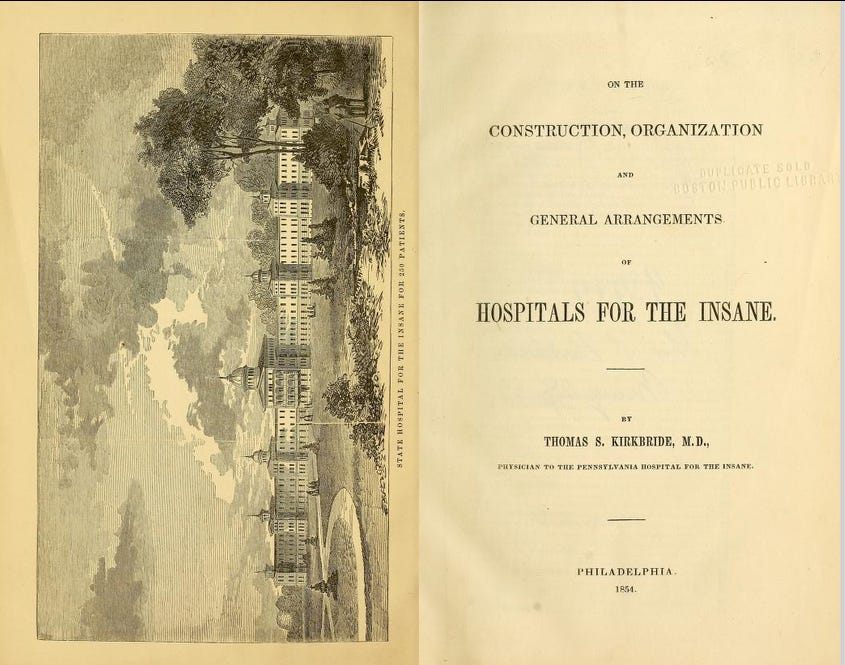
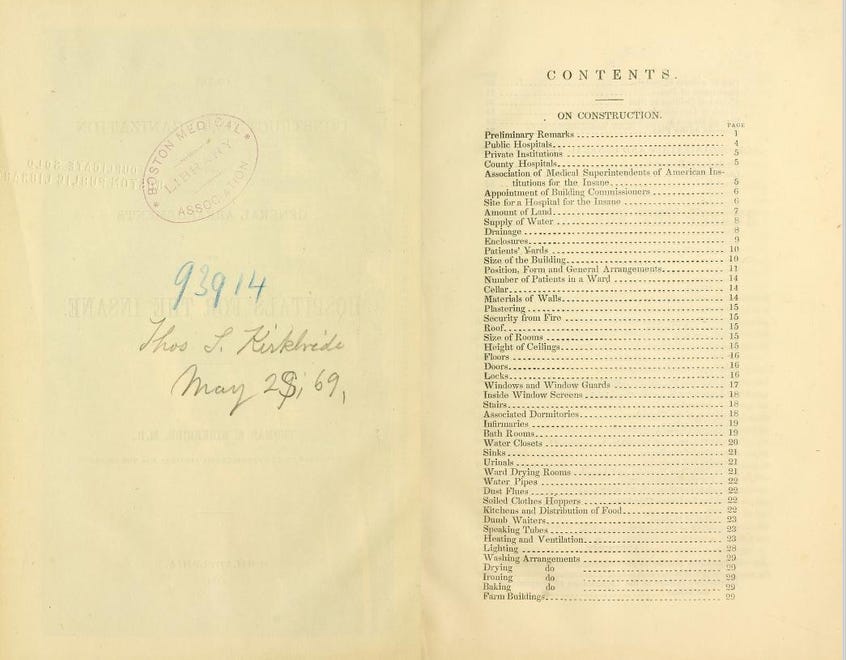
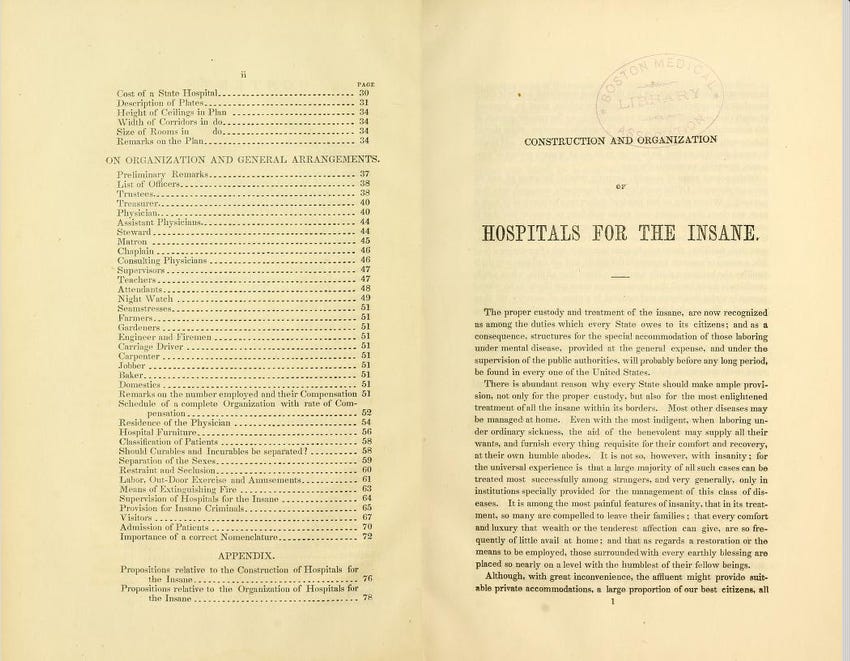
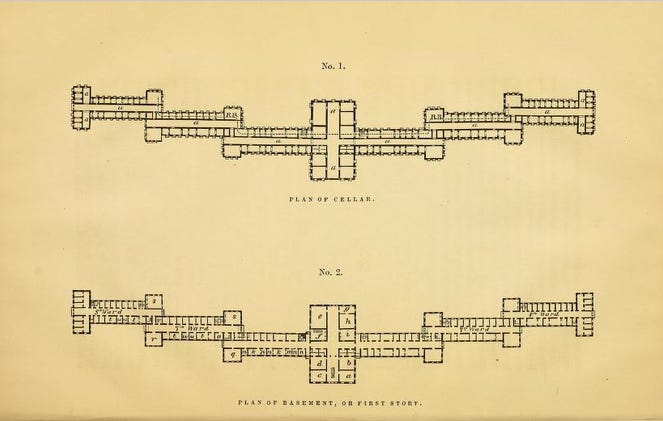
Calling all evidence that disagrees with your position fake or forgery is a denial tactic, but it doesn’t hold up in reality. This book has existed in medical libraries and archives since 1854. It contains the blueprint that dozens of hospitals copied. Kirkbride’s influence with the wider community of alienists institutional leaders is easy to track down as he had membership in several organizations, most of which are still around today in one form or another. The AMSAII he helped found is now the American Psychiatric Association (APA). I am not saying these were good organizations who have always been honest, it’s obvious that mainstream psychiatry has become corrupted. But that doesn’t take away the existence of this book or the many primary sources in archives that discussed it, debated it, or implemented its recommendations. If you want my full presentation about that, you can find it in the back half of my last episode: Tartaria and 1800s Insane Asylums: Debunking the Conspiracy Claims with Historical Records.
Lucius’ Commentary on Kirkbride
The Kirkbride plan of asylums, as it has become known, is incredibly well documented in every state that built 19th century asylums, 25 states, 73 asylums. Let’s see what Lucius has to say about Kirkbride himself.
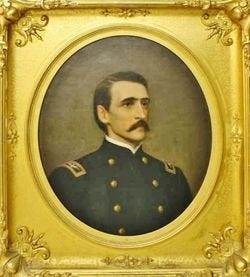
Photos of Kirkbride
He implies that it’s suspicious that they don’t have a good photo, names the daguerreotype (duh·geh·ruh·tipe), and then explains that Kirkbride lived in the era of this sort of photography. Naming the technology that explains the photo that was just claimed as suspicious is self defeating. To be fair, expecting good photos of a man famous into the 1880s is reasonable, and some exist. The only thing missing is early photos, which is exactly what the invention date given for photography predicts.
The daguerreotype was invented in 1839, so no photos of Kirkbride could exist before he was 30. The process wasn’t refined until the mid 1850s. A blurry early portrait of a man in his thirties or forties is exactly what the historical record would predict. After the mid 1850s, there would be ambrotype or tintype photos of him, at an older age.
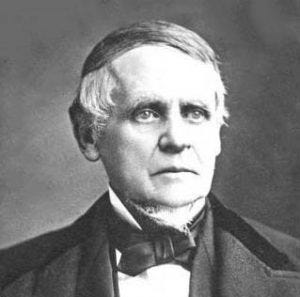
Minutes after saying the daguerreotype was a “strange excuse for why they don’t have a good photo,” he shows these later, better photos, and says nothing about the “no good photo” statement ever again.
“Ambiguous” involvement & the “perfunctory” passage
For the record, I used a transcript of his video to best be able to index his claims about specific terms, especially Kirkbride, so I can confidently say that Lucius never actually refers to which biography is a little thin. There are books by the man and books about the man. Next he seems to double down on the thin-biography thing and explains why he thinks this.
Notice the motte-and-bailey fallacy that is so consistent with this content genre. He makes an unsubstantiated claim that he can’t defend with any evidence, and then retreats to the motte: “Not that I’m saying that’s what’s happening, but… chuckles, oh yeah” So which biography is he talking about being skimpy on details regarding Kirkbride’s involvement? Since he never actually tells us his source, a good guess is that he means Wikipedia. That page is indeed pretty light on details.
There’s a lot more to the story of Thomas Story Kirkbride than the Wiki. I found that the Quaker community he was involved with had already established the doctrine of “moral treatment” of the insane. He wasn’t even the first to write a book advising other caregivers on the architecture question. Practical hints on the construction and economy of pauper lunatic asylums is one such book, by a fellow Quaker named Samuel Tuke, published in 1815.
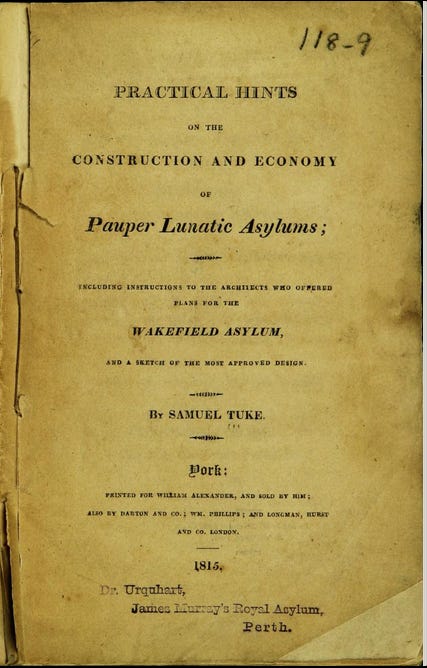
“Chains, which seemed to identify the madman and the felon, are discarded from some of the largest establishments ; and maniacs, who for many years were manacled with irons, are on a sudden, under a more mild and vigilant system of management, found to be gentle and inoffensive. But though much has been done — much still remains to be effected. There are still Asylums which stand in need of reform… At a time, therefore, when so many Asylums are erecting, it seems incumbent on those, whose duty or inclination leads them to observe the wants of insane persons, and the defects of the older erections, to point them out for general consideration.”
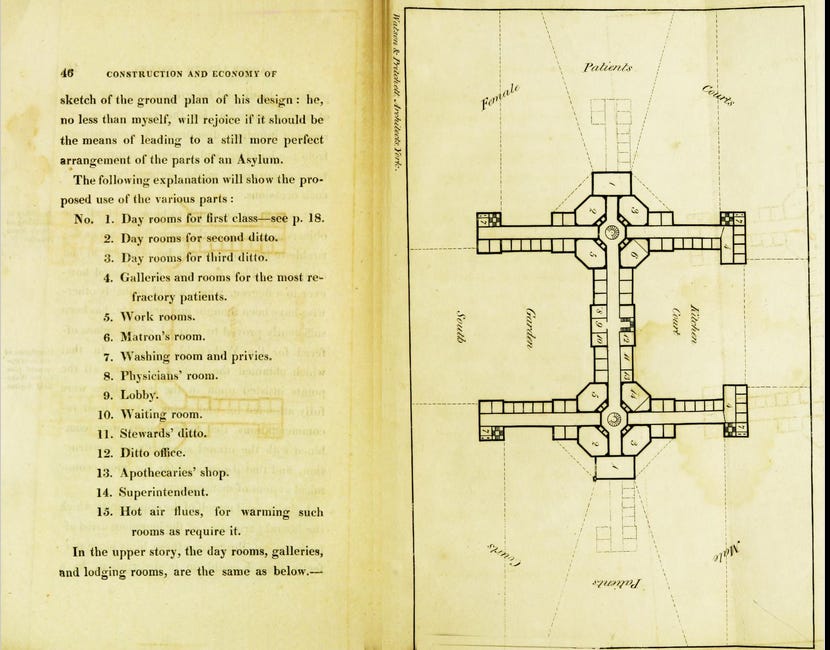
Once you read this book, it becomes clear that Kirkbride was not a patsy who shadowy elites pinned the asylum plan on so they could make their cover-up of the old world seem more credible. Kirkbride was one in a line of reformers, who was particularly effective at bringing about changes in his field.
Thirty seconds after claiming that Kirkbride’s involvement was ambiguous, he says Kirkbride was the one who was all about conducting it. This is a true statement according to primary sources I could find.
Kirkbride went on an 1845 tour and kept a journal, which is held in the Pennsylvania Hospital Archives under the title: Kirkbride, MS journal of “Visit to 9 Institutions for the Insane.” This work wasn’t digitized, but it is cited by other researchers of Kirkbride’s life, who you might even call biographers. This journal and his tour are evidence of both his “involvement” with the national reform movement, and the experiences that shaped his later book on the subject.
In the members section of my other asylum video, I discussed the asylum built in Utica, New York, which was beset with problems in its construction due to over-reach by an amateur architect. You can find out more about that in my other video, but the gist is that Utica’s asylum was never completed to the extent to which its original blueprints and intentions were drafted. This was one of the stops Kirkbride made on his asylum tour, and when the famous Quaker alienist visited the site in 1845, two years after it opened, he wrote, that the “original plan, which was to occupy 13 acres and to contain 1,000 patients, has been abandoned.”
In Trenton, New Jersey, the state legislature went to Kirkbride directly for his input on the building plan. He wrote about in the second edition of his book, On the construction, organization, and general arrangements of hospitals for the insane.
The general features of the first linear plan which has been described, were originally prepared by the writer at the request of the Commissioners for putting up a State Hospital for the Insane in New Jersey, and the designs for that building were made from the sketches at that time furnished to its architect. Convenient, as most of the arrangements of that institution have been found to be, it is to be regretted that various modifications were made in the details of the original plan, which although diminishing its cost, impaired its completeness and made it in many particulars much less perfect than it otherwise would have been. The additions since made, however, have more than compensated for what was omitted or changed.
I confirmed this with the Votes and Proceedings of the Sixty-ninth General Assembly of the State of New Jersey (1846). They really did solicit his advice.
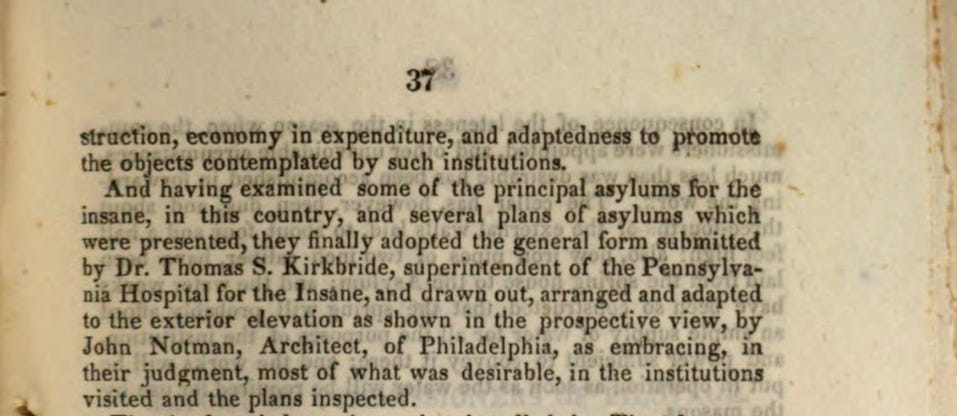
And just like every other asylum I’ve looked at, there appears to have been both a recognized need for it, and a paper trail indicating it did not exist, and the state government decided to build it. See the 69th General Assembly of New Jersey from the year before Kirkbride was consulted.
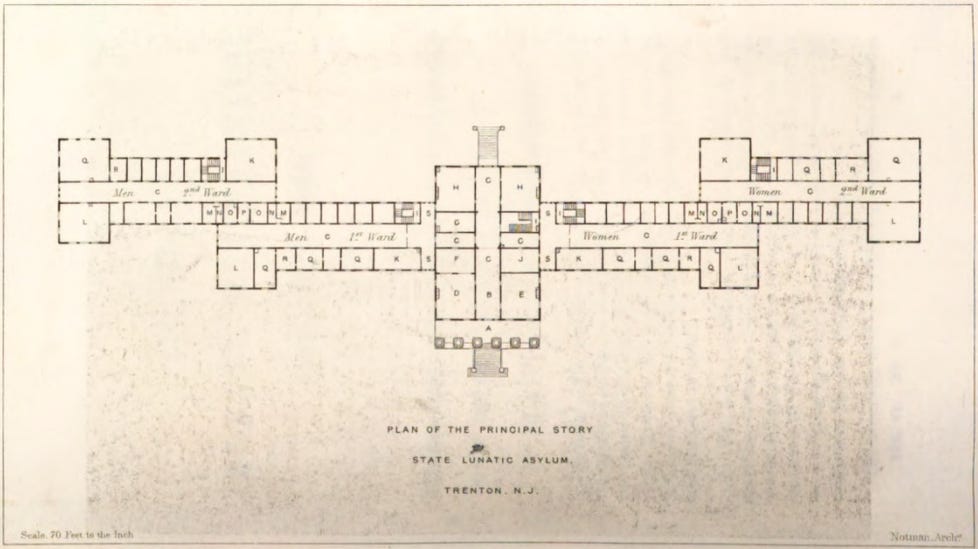
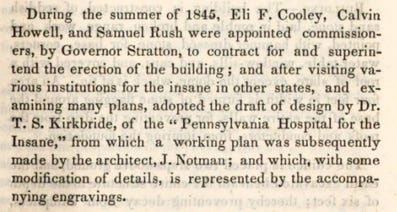
Notman, the architect mentioned here by the NJ legislature, actually published the drawings for this asylum in an 1848 issue of The American Journal of Insanity (pages shown are numbers 425 and 429 of the PDF, not the page numbers of the actual journal issue).
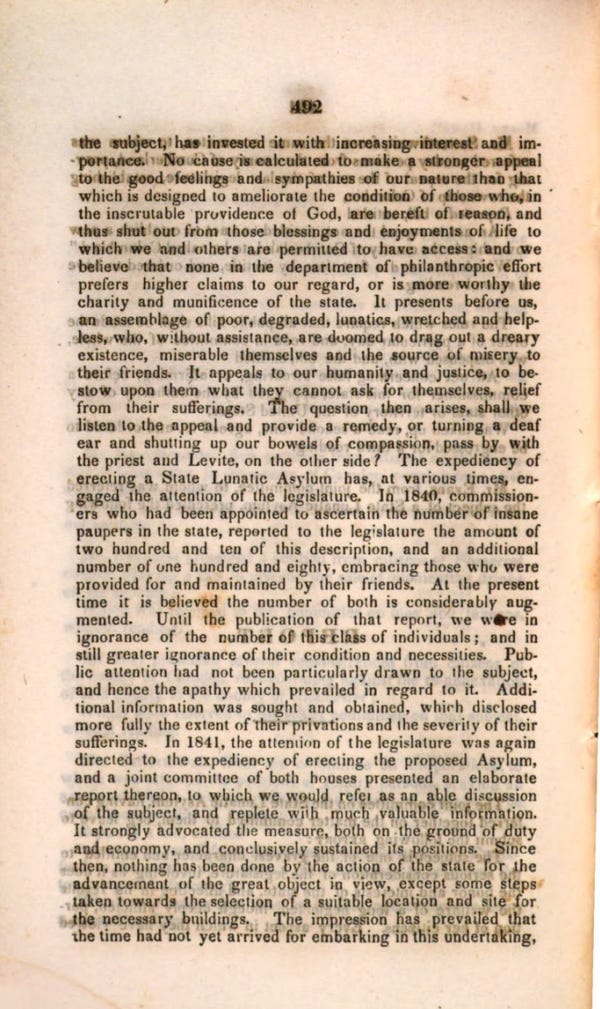
One thing that’s been said to me by people who don’t like my research on this stuff is you’re just reading the official fake history narrative back to us! If this is fabricated history, the frauds did a most thorough and incredible job at it. Those are primary sources, meaning firsthand accounts, and even under oath for the legislative recorder’s case. Numerous secondary sources describe similar state legislature consultations with Kirkbride for other asylums.
The point is, Lucius told you “there’s just a perfunctory mention of his involvement with the plan, but then he spent the rest of his time being his own physician and treating his own patients. It’s really strange.” I have to disagree here. A doctor spending most of his time practicing medicine is just a man doing his job.
The word choice perfunctory is worth examining, because it’s uncommon and possibly misused or misunderstood. Perfunctory means done as a routine formality, without real interest or care, going through the motions. As in when you’re required to perform a certain duty but your heart isn’t in it. And even though we don’t know for sure which biography he’s talking about, nobody writes a perfunctory sentence about the thing a person is famous for, they write perfunctory sentences about the mundane minutiae. Kirkbride is regularly written about for his influence in this asylum plan—his actual patient history and practice itself as a doctor is what gets perfunctory treatment in the biographies. From what I have seen written about him, this “perfunctory mention” claim is the inverse of the truth.
As for being the individual “they” (whoever they are is never said), decided to “assign credit for the plan to,” this is just how history works oftentimes. Kirkbride may have got the spotlight in history for this, but he’s far from the only one who is documented in the credits of this particular story. An entire lineage of doctors throughout England and France precede Kirkbride and influence his writing, and I’ll show you those in the Plus+ extension of this episode. Some architects like Stephen Vaughn Shipman designed multiple Kirkbride buildings in more than one state. This Wisconsin architect did five asylums: Elgin IL, Anna IL, Oshkosh WI, Mendota WI, and Independence IA. Later in the video Lucius claims the Independence asylum had no records, but I found plenty of records, even some that had seemingly been lost to history. We’ll get to that.
Kirkbride’s modest tombstone
Lucius says “oddly enough, this is Mr. Kirkbride’s tombstone. Not really what you’d expect, though. I mean, a very modest tombstone… I was expecting a much larger tombstone for somebody who is as famous and well known as Thomas Story Kirkbride.”
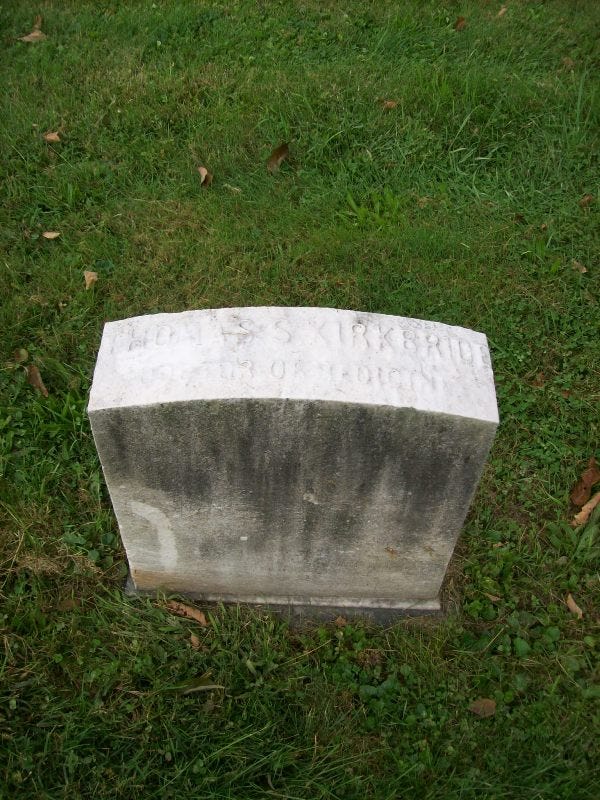
Kirkbride had a modest tombstone, it’s true. And that is unusual for historically significant people, at least those who were recognized as widely as Kirkbride was in his own lifetime. There’s a very mundane answer here. Quakers historically believed that if it was inappropriate to elevate some individuals above others in life, it was equally inappropriate to do so in death. If you know the first thing about Quakers like Kirkbride, a simple tombstone is predictable, not problematic. The following is from Swarthmore College, an old Quaker school in Pennsylvania:
The Disciplines of Philadelphia Yearly Meeting specifically forbade grave markers until the last quarter of the 19th century as "Marks of Superfluity and excess" and "inconsistent with the plainness of our Principles and Practice."
This practice changed around the 1850s, and simple gravestones, restricted to name, age, and death date only, came into use among Quakers. Kirkbride, a Quaker who died in 1883, had a religiously appropriate simple grave marker. This was one of the easiest things to verify in the entire research project.
Not two minutes before his tombstone bit, Lucius defeats his own argument of “the tiny tombstone is odd,” by stating that Kirkbride comes from an old Quaker family. He’s stated the very evidence that resolves the alleged problem of the grave. This is another example of the unwitting self-defeat trend in these sorts of videos: make claim, show evidence, never address that the evidence undoes the claim.
Why Kirkbride’s Middle Name Was “Story”
The implications made about Kirkbride’s middle name, Story, are poetic. Sometimes the universe is poetic in ways that give us clues to what lies below the surface of things. Sometimes a name is a name, and the poetry of it is elsewhere than we first think. It shouldn’t need to be said that one man’s middle name being Story holds zero weight as proof of anything else claimed in this genre, but let’s falsify his assertion anyway, that Story is code for “welcome to the new reality.”
My first thought about this was, could an unusual middle name like Story be a family surname, perhaps his mother’s maiden surname? I thought this because my own middle name happens to be my mother’s maiden name. And I was right in my intuition, as it turns out his mother was Elizabeth Story. Her father was Thomas Story, and his father was John Story. This is easy to find out, and the surname Story or Storey is well recorded in the Quaker community.
Unfortunately we see this pattern in the genre very often: show a suggestive detail (like this unusual middle name, or a weird photo), project the suspicion vibe to the audience, and never follow up on whether or not the suggestive detail could be explained.
The “Nationwide Federal Asylum Program”
If you assume a nationwide program, it’s a very reasonable question to ask how did they coordinate and fund it. This funding/resources problem frames much of the content in the Lucius video, and is pretty standard for the genre. Asking that question in general is also reasonable, but framed as a nationwide program it’s actually a strawman, and I’ll show you exactly why that is. A straw-man is when a debater invents an argument for his opponent that he then attacks. When someone disputes an opposing claim that their adversary never made in the first place, that’s a straw-man. In this case, he’s saying that the asylum program was nationwide, and that’s where he’s wrong. The premise is wrong, because there was no federal program. Each of the 25 states who built these asylums had to figure out their funding and resources on their own, and usually there was some disagreement involved, and its all on the record. Contractors going over budget and past deadlines is almost a cliche, so we should be able to find evidence for that, and I did.
To be fair to the “nationwide program” idea, I probably used similar language in my previous video during the members’ only section when I brought up the Kirkbride plan; I had not at that time looked into the Federal role in all this. When the history reports something with a headline name as an umbrella for a whole movement, it naturally sounds like it must have been organized from the top down. The truth is, this was never a federal program to begin with, and I can prove it. The United States Federal government explicitly refused to create such a program. A bill was presented by Congress to hand 10 million acres of federal land to the various states, and the interest off the sale of that land would have been used to fund permanent care for the “indigent insane” nationwide. This was Dorothea Dix’s bill, the famous lobbyist for mental healthcare reform. President Franklin Pierce shot it down on May 3rd, 1854. This is well documented.
May 03, 1854
To the Senate of the United States:
The bill entitled “An act making a grant of public lands to the several States for the benefit of indigent insane persons,” which was presented to me on the 27th ultimo, has been maturely considered, and is returned to the Senate, the House in which it originated, with a statement of the objections which have required me to withhold from it my approval.
In the performance of this duty, prescribed by the Constitution, I have been compelled to resist the deep sympathies of my own heart in favor of the humane purpose sought to be accomplished and to overcome the reluctance with which I dissent from the conclusions of the two Houses of Congress, and present my own opinions in opposition to the action of a coordinate branch of the Government which possesses so fully my confidence and respect.
In spite of the “deep sympathies of his own heart,” his veto was based on a specific constitutional principle: if the federal government can fund care for the insane, it can fund care for everyone. His own words: “It can not be questioned that if Congress has power to make provision for the indigent insane without the limits of this District it has the same power to provide for the indigent who are not insane, and thus transfer to the Federal Government the charge of all the poor in the States.” Once you’ve opened that door for one form of welfare, you open the door to universal welfare, which of course, eventually did befall our country, but not on President Pierce’s watch. He also expressed worry about what federal money would do to the states themselves, that they’d stop funding their own institutions and start waiting on Washington to do it for them, what he called becoming “humble suppliants for the bounty of the Federal Government.”
This is why almost every one of these asylums that I’ve looked into has had debates in their respective state legislatures about how to pay for these buildings. These state legislatures have well recorded minutes for each session of their Congress, and being important records, they’re archived and digitized, even searchable. None of this is concealed, anyone can look it up. State after state with similar asylum stories—it could look at first glance like a nationwide program, in reality it was each state deciding how to deal with the growing problem of mental illness, at least partly a result of urban industrialization, and deciding how to handle it, with most opting to follow the recommendations of the leading experts of the day, i.e. Kirkbride and his cohort.
But Lucius does correctly state that federal income tax did not exist before its first implementation as a Civil War measure. With no income tax, Washington did not have a revenue mechanism strong enough to fund a federal, nationwide asylum, which is why the Congressmen who tried to enact such a program and were vetoed had proposed selling off federally owned lands to fund it.
Where did the resources come from? How did they coordinate it?
The point he’s making about “how did they coordinate it” in reference to a “nationwide” effort is essentially moot, because there is no single answer to that question. There is only a case-by-case basis of each asylum, individually being funded and built by their respective administrative bodies. Often that’s not the answer we want—it’s more enticing to have a sweeping simple answer to paint a whole situation, but this is reality. We can look at a few examples to prove the point.
Fulton, Missouri (1847-1851)
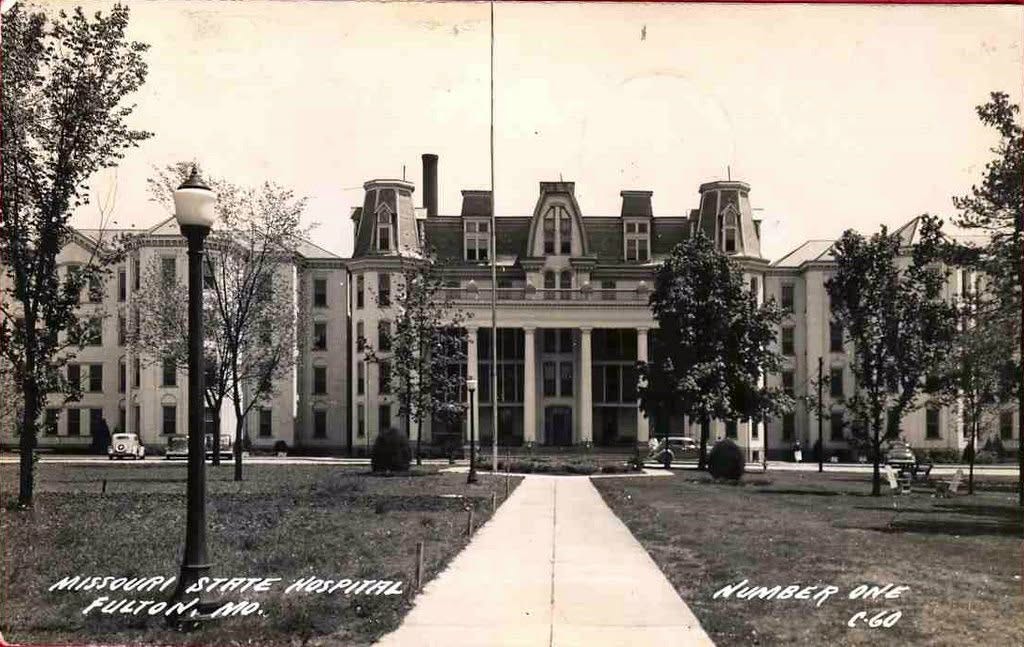
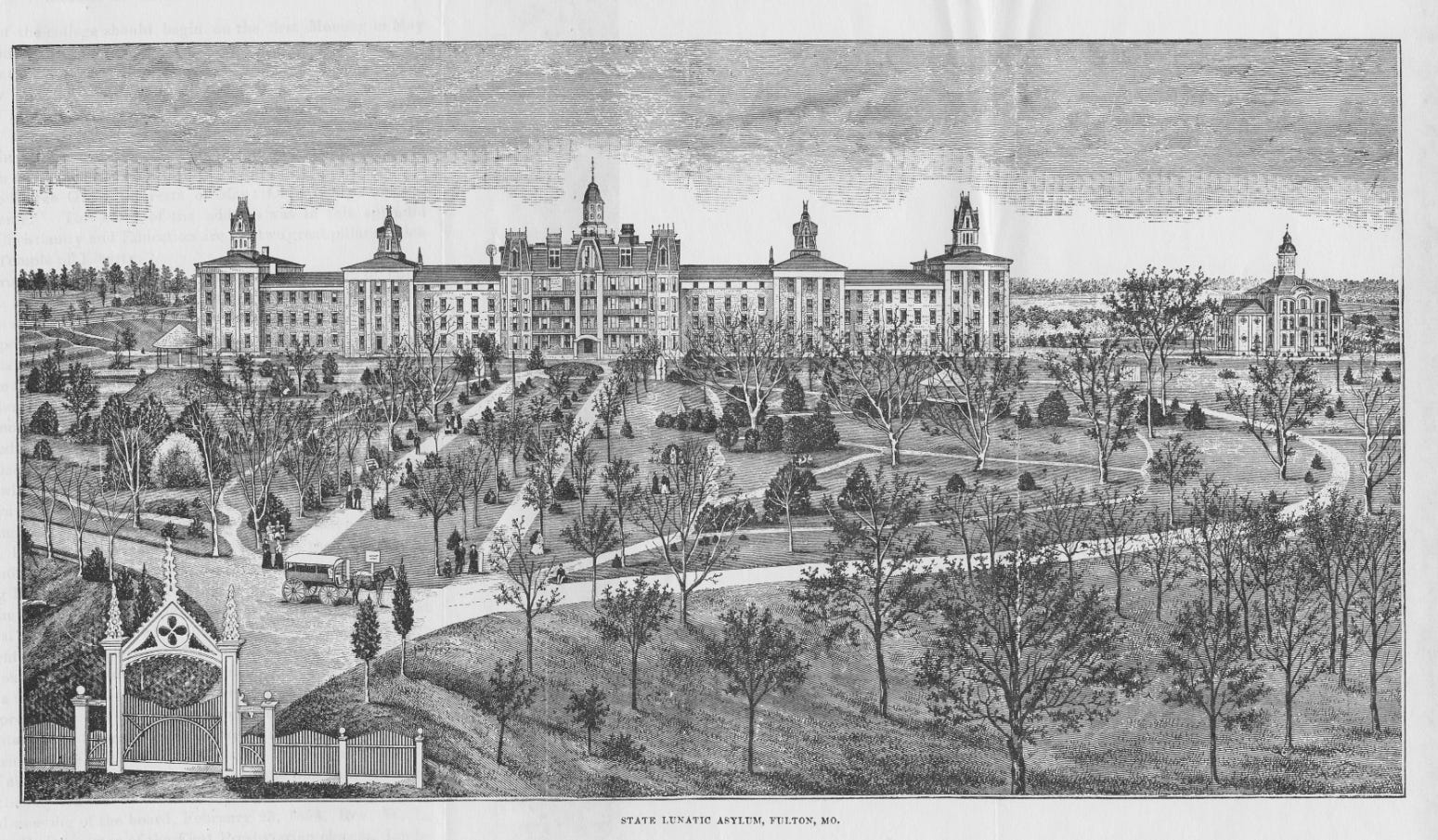
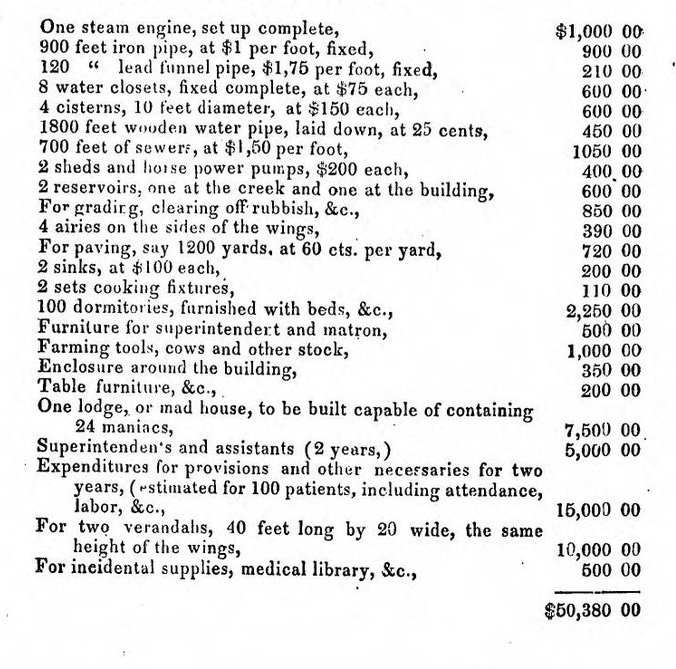
This asylum was authorized by the MO General assembly in 1847, at which time they made the counties who wanted it compete by putting up bids. This happened in many states—the county who was willing to put up the most cash and best land for the institution usually got it. Having a prestigious institution in your county was good for the economy, and many counties competed. Callaway county won with a bid if $11,500 and 500 acres of land. Solomon Jenkins was contracted in April of 1849 to build it after he gave them a plan and a price of $47,450. By January of 1851, Jenkins reported his total costs had reached $50,000. He submitted a detailed expenditures analysis to the legislature, and argued that although it was over budget, they had gotten off cheap, because New Jersey had spent $150,000.
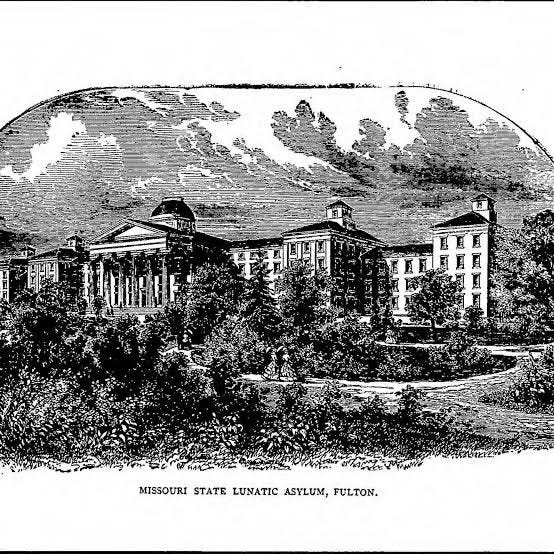
It can seem backwards that counties bid money and land to win an asylum, until you ask what an asylum was to a frontier county's economy. It was the anchor institution: years of construction contracts, then a permanent payroll of attendants, cooks, farmers, and tradesmen; a guaranteed year-round market for local produce, coal, and brick; and the prestige that attracted the next state institution. Towns fought for asylums for the same reason towns today fight for a university campus or an army base. That's why Callaway County put up cash and five hundred acres, and why it took Cherokee fourteen ballots to win its bid. Competition was real because the money was real.
The primary source documents of all these bids and expenditures are at the Missouri State Archives in Jefferson City. I found the following records: Report of the Commissioners to Locate a Lunatic Asylum, January 3, 1849, Senate Journal Appendix, 15th General Assembly (1848/1849), and the 16th General Assembly (1850/1851) Appendix, pp. 134-137.
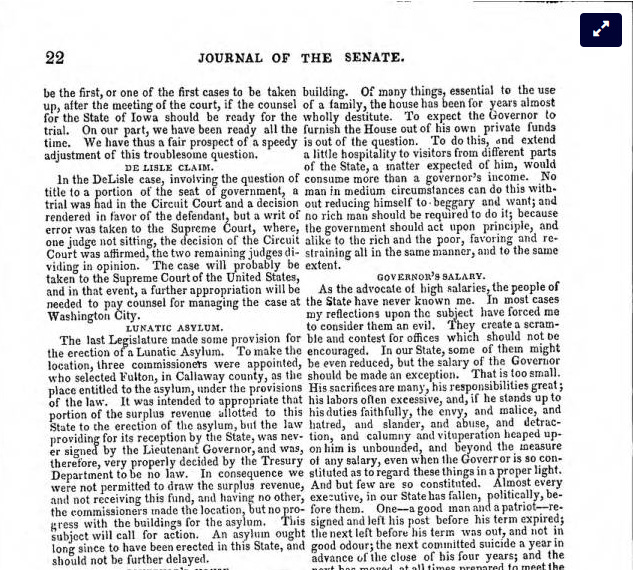
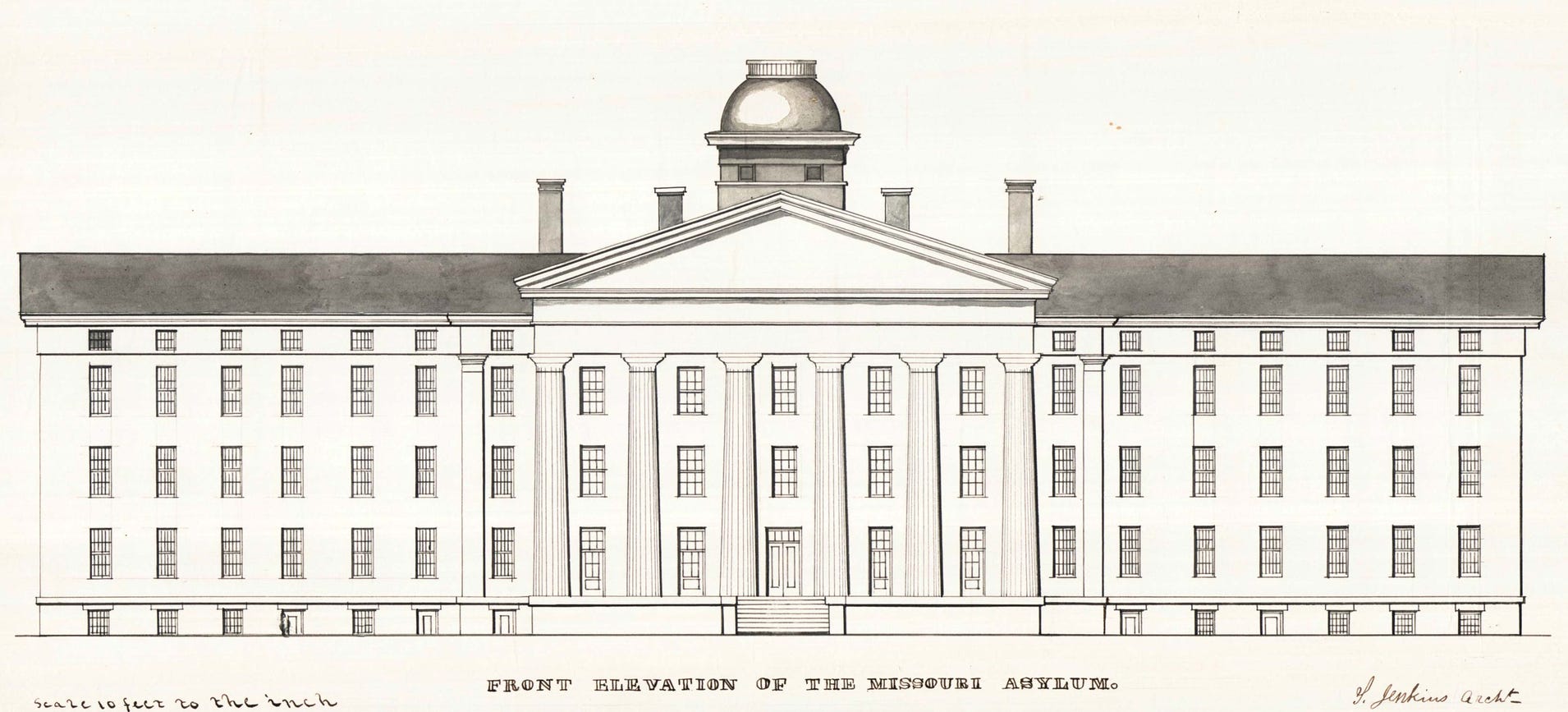
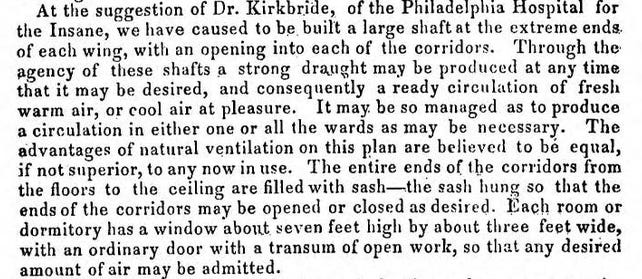
This is what finding receipts looks like, and it’s something you have to do before you have any credibility when making claims. Notice that the MO Legislature adopted Kirkbride’s suggestion. This was not a federal mandate. This was not federally funded. They had to come up with this money from the taxpayer, as it says in Report of the Commissioners to Locate a Lunatic Asylum, January 3, 1849 “. . .the people of the State are willing to be taxed to build a commodious house, comfortable in every respect, to take care of their fellow human beings who are suffering under one of the greatest scourges that can afflict the human race.”
Missouri lawmakers were not even interested in dealing with insane people until the 1844 suicide of Governor Thomas Reynolds. That event is what moved the needle and brought about the state’s first ever asylum. A dead governor got this funded, not a national plan or federal handout.
Keep in mind that the legislative clerks and secretaries who recorded these documents are under oaths of office to perform their duties truthfully and faithfully, if that counts for anything to you. I have found it very difficult to persuade the entrenched believers in the Tartaria reset that “logistics” and “resources” can be accounted for, even when showing literal accounting ledgers. It’s hard to do much better than primary sources when it comes to history. When I hear “they couldn’t have built that,” I am open to it, just show me how that conclusion is reached. I will read your comments, and I want to know if there’s anything unexplainable, the notion fascinates me as much as anyone else. But so far everything I’ve looked at seems quite well explained, when looked at closely enough. A good next step for us might be to look at building techniques and technologies of the 18th-19th centuries more generally, and how they evolved.
Independence, Iowa (1868-1873)
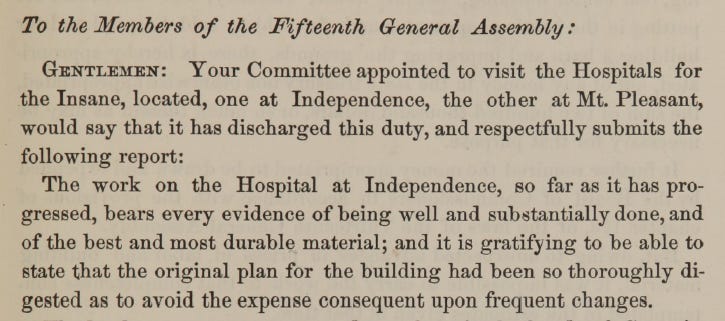
Although we have addressed the “nationwide effort” concept, the asylum at Independence, Iowa, will do it again. The statement that “you can’t find any record of construction or the architect,” also turns out to be incorrect. In the 12th General Assembly of the Iowa Legislature, I found where Senator W.G. Donnan introduced a bill which passed in April of 1868, for the Independence asylum.
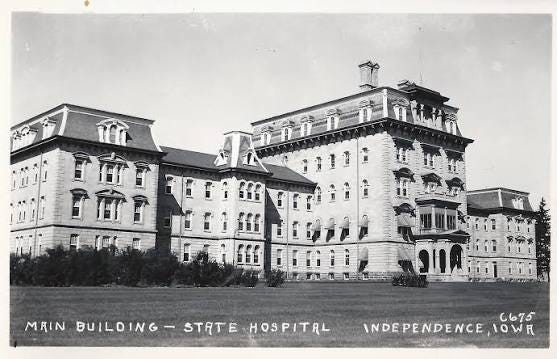
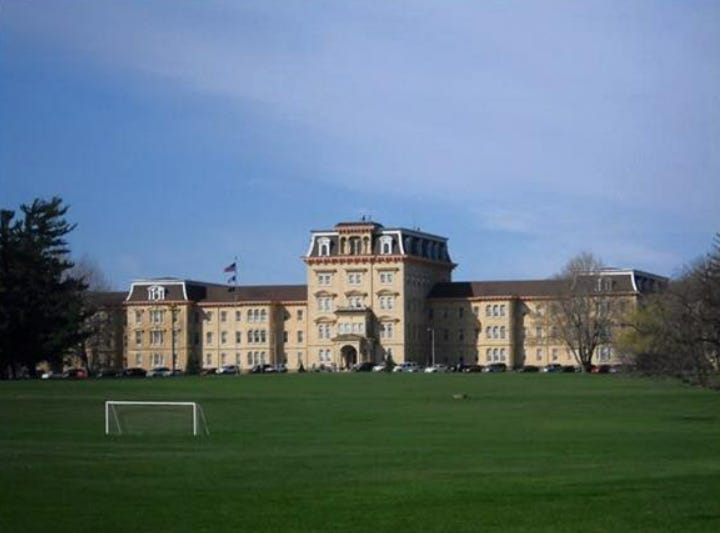
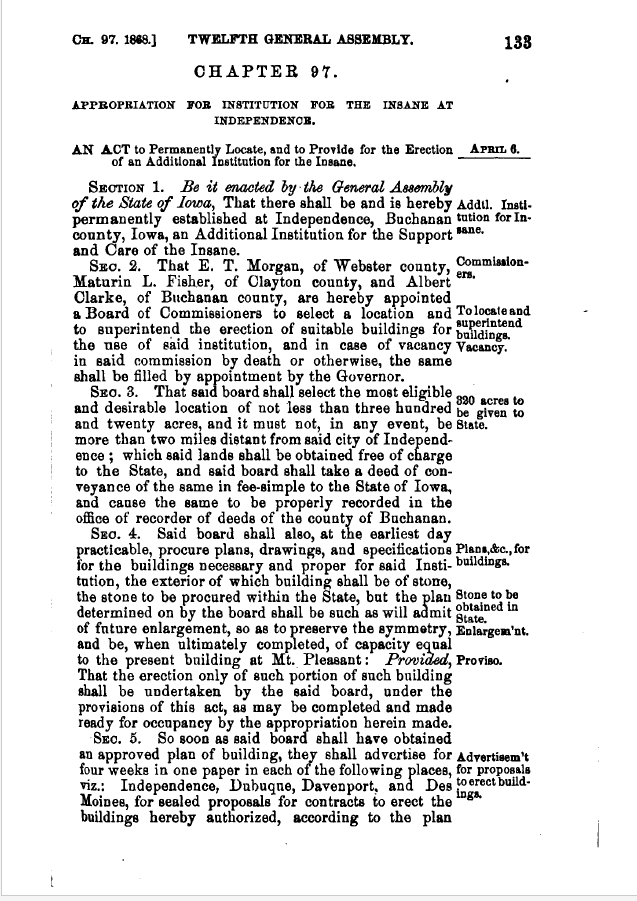
The approbation was for $125,000, and required the citizens of Independence to donate this land to the state at no cost, which they achieved by a common practice of the era called public subscription. This is essentially crowdfunding of the day—local businesses and wealthy individuals would donate to the cause, in some cases there were direct benefits to the donors.
I did a laborious search for newspapers in the region from that time period and found more evidence. In April of 1868, not long after the bill was passed, the Buchanan County Bulletin announced a meeting at the court house about the asylum plan. “The more the question of the location of the Insane Asylum is at this point is considered, the more apparent does it become to the minds of our people, that we cannot afford to lose it: that the money to procure the 320 acres of land demanded by the State must be raised at all hazards: that we shall be recreant to every principle of interest, progress and pride, if we fail to do it!”
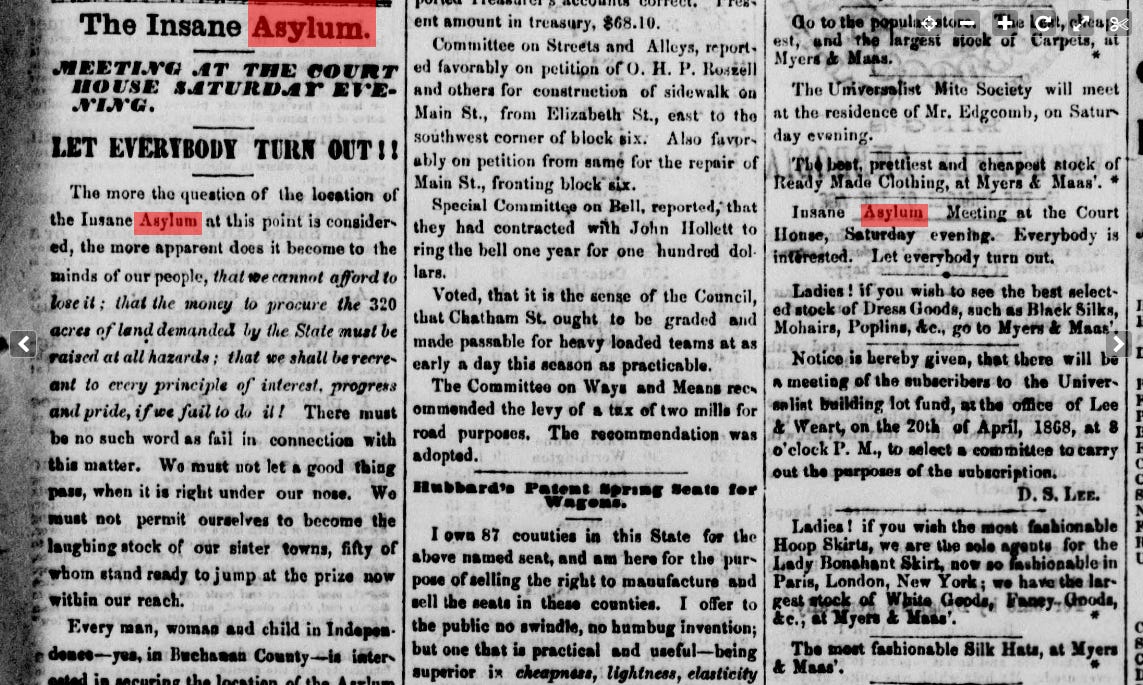
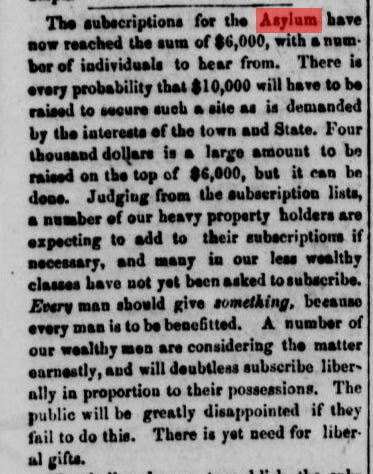
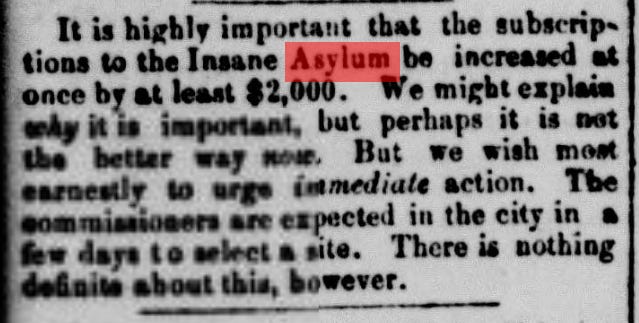
The real kicker was when I found the list of donors in the May 8th 1868 paper. I don’t know how to be more thorough than that. Could you really imagine this was a faked record? The best part is at the bottom where the paper says "It is a noteworthy fact that those of our farmers near the city who have been asked to subscribe, have exhibited most praiseworthy liberality... But very few of our business men and capitalists have refused to contribute." That's a small-town paper naming and shaming, gently, the people who hadn't given yet, in the same issue that lists everyone who had. That's real social pressure, in print, in 1868, over a public building.

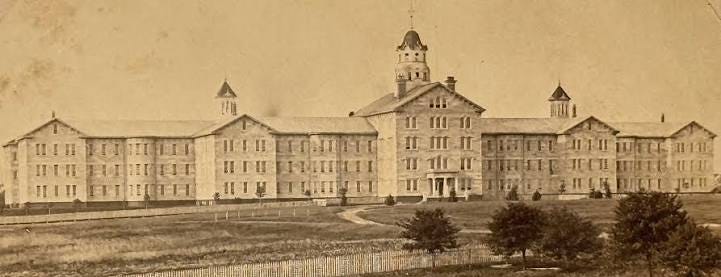
Another interesting historical footnote: the 1914 Buchanan County history (linked below as a PDF) thanks “Mr. E. Little who loaned us those valuable old (Buchanan County Bulletin and Guardian) Guardian files, the only files in existence prior to 1870.” It also says that “for a lapse of several years there are no newspaper files to consult to substantiate facts, they having been destroyed in the big fire of 1874.” You’d think if there was some kind of intentional destruction of records to hide this big asylum in Buchanan county, “they” would have made sure to never let this E. Little archive see the light of day—but it’s only thanks to this man’s private collection that I was able to even find the donor list, which is actually quite a find—search engine attempts for such a list came up with nothing, and I spent a long time trying to find this lost information.
Lucius also says you can’t find a record of the architect for the Independence asylum, but we already did: Stephen Vaughn Shipman designed this and four other Kirkbride asylums. The architect is right on the Wikipedia page, but beyond that, there are construction records in various tomes.
Lucius says “you can’t find any records of the construction.” I found so many receipts about the construction of this building that I felt overwhelmed with trying to decide what to show you and at what point it’s overkill. Let me give you some highlights from a few books documenting the history of Buchanan county that talked about the workforce on this project. I attached them as PDFs if anyone cares to double check my following discoveries.
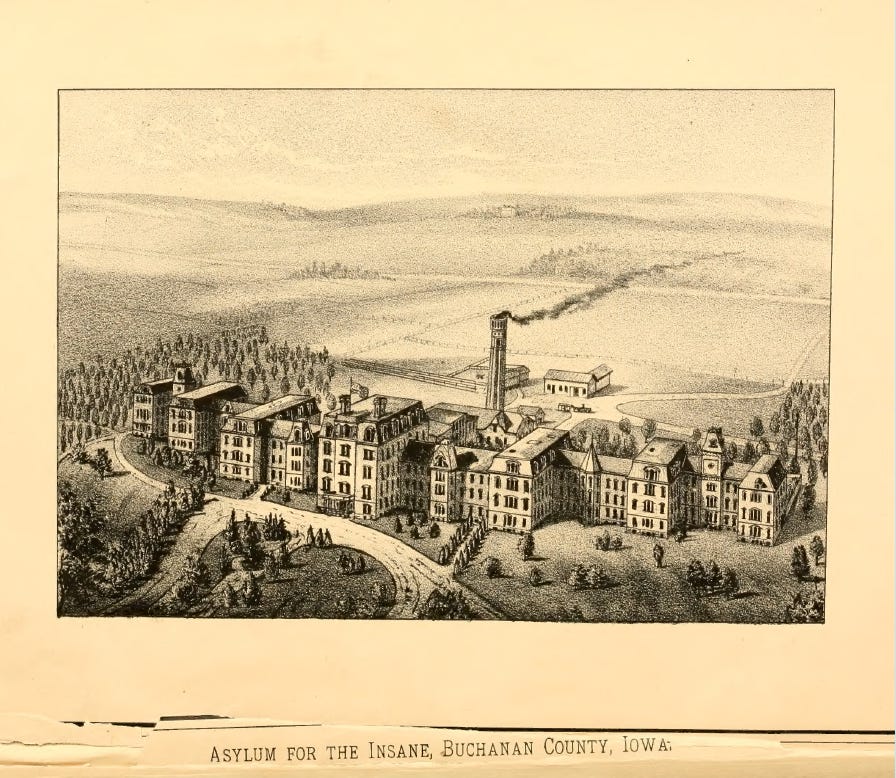
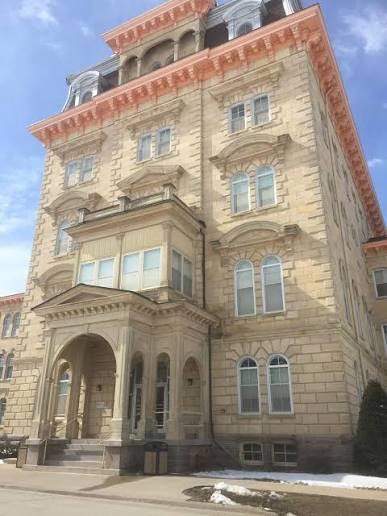
Alexander Boyack, born 1829 in Forfarshire, Dundee, Scotland, came to America at 23, to Independence in 1854. He opened a stone quarry and “hauled the first load of rock to build the new magnificent asylum before the ground was surveyed for its erection.”
George Netcott, Jr., born 1842, learned the mason’s trade in England, arrived 1872, joined his father George Netcott Sr. (who came in 1867) at Littleton. “His first work was on the original smokestack of the Iowa Insane Hospital.” He later founded the George Netcott Brick Yards in 1880. Cross-reference that with the 1881 history’s description of the chimney: 130 feet tall, octagonal, 250,000 bricks. Netcott helped lay them.
Charles Fest, stonemason, native of Germany, “assisted in the erection of the insane asylum at Independence.” Later farmed in Newton township, returned to his trade in 1883, died in Germany in 1894 while visiting. His daughter Louisa married a Mr. Bolton in December 1878.
Another document, called REPORT OF COMMISSIONERS FOR THE ERECTION OF BUILDINGS FOR AN INSANE ASYLUM, AT INDEPENDENCE, TO THE GOVERNOR OF THE STATE OF lOWA is linked as a PDF in my notes here.
The report from January 1870 says “the land procured for the site of the hospital is unbroken prairie without a building, a fence or a tree upon it.” The 1881 history repeats it and gets a little snarky about it: "The tract was unbroken prairie, without a tree or shrub (to use the words of one of the commissioners, who seemed to think that a recommendation).
With so many corroborating reports, I can’t get behind the thesis is that these were pre-existing compounds, repurposed. Iowa’s commissioners, writing to the Governor in 1869, say there wasn’t a building, a fence, or a tree on it. And Boyack’s biography independently confirms he hauled rock there before the ground was even surveyed.
Still, the question of “how do you build something this big, this fast, on open prairie” is a question worth asking. As we just saw, The Independence site, in the commissioners’ own words, was “unbroken prairie without a building, a fence or tree upon it.” I have seen Tartaria genre content question brick accounting many times—where’s the brick coming from, how did they get it there, etc. Lucius questions bricks in this video but its directed towards the Napa California facility. I include this because actually found the brick answer for the Independence build.
Superintendent George Josselyn, December 1, 1869:
“The contractor has succeeded in making on the west end of the hospital farm, where excellent brick clay has been found, some 800,000 brick, of which 580,000 have been laid in the building, leaving about 220,000 on hand for use in the spring. He is also contracting for a sufficient quantity of wood to be delivered at the brickyard this winter, to burn the remaining amount of brick necessary to fill his contract, which will be about 600,000 more.”
They dug the clay out of the hospital’s own farm and counted the bricks. That helps with the “logistics” question significantly, doesn’t it? They made bricks on-site.
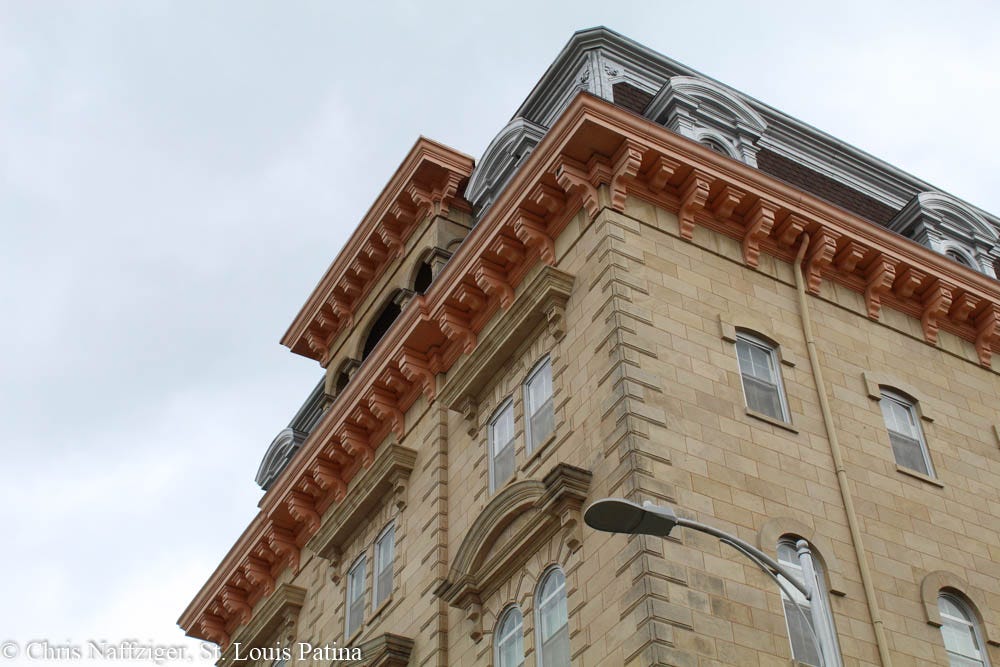
I actually paused the recording at this point to verify that it was possible to have brick in the amounts needed for the accounting figures, because eight hundred thousand bricks sounded like a lot to pull from one site, and I did not want to repeat a claim without checking it myself.
The answer is yes, easily, and the reason is almost anticlimactic. Eight hundred thousand fired bricks works out to something like two thousand cubic yards of raw clay once you account for shrinkage and water loss, which is a pit about a quarter acre wide and five feet deep, spread across years of construction. That is nothing against what is actually in the ground there. The Iowa Geological Survey’s own regional reports describe the glacial mantle across this part of the state as running seventy five to a hundred and fifty feet thick, made up of glacial till and loess, both standard brickmaking material, and Iowa had more than three hundred brick and tile works operating by the 1920s because of exactly that. Better still, the specific glacial formation under Independence has a name, the Winthrop Till. The state’s own description of it is a loam to light clay loam averaging around twenty five percent clay, which is textbook brick clay, sitting right where they built. I also found that it was common practice in that day to begin brick making after the foundations and basements of a new building had been dug out. It seems they were sometimes able to multitask, and use that earth for brick making, and on-site brick making was pretty common practice.
Not everything visible on that building is brick. The architectural survey record for the site is explicit that the main building’s exterior is smoothly cut, light colored limestone, with a base of native granite worked from glacial boulders, the same boulders still turning up in Buchanan County farm fields today. So you have three local materials stacked together, granite from the fields, limestone for the facing, and on site brick for the structural work, the wings, the chimneys, and the smokestack.
The REPORT OF COMMISSIONERS linked above gives a line by line ledger of expenses.
Here’s some highlights:
David Armstrong of Dubuque County, contractor, first contract $88,114.00, signed November 7, 1868, paid across ten progress estimates ($961.31, $710.44, $3,264.54, $3,084.53, $3,158.30, $3,861.89, $3,134.48, $1,823.54, $3,276.48, $2,974.53)
S.V. Shipman, architect, Madison, Wisconsin, paid $3,600.00 — commission of ¾ of one percent on an estimated building cost of $480,000
Total to Dec 1, 1869: $35,744.90 against the $125,000 appropriation
Committed total: $100,296.89, leaving $24,703 unappropriated
Individual items down to 5 lbs nails, 30 cents; one pump, $17.25; a roll of tracing cloth, $16.00; telegraphing the architect, $1.65
Advertising proposals paid to the Dubuque Times, Davenport Gazette, State Register, and the Conservative office
Armstrong volunteered to upgrade the foundation from Farley/Anamosa stone to granite at no additional charge. The commissioners: "It is a source of satisfaction to know that the hospital will stand on a foundation of imperishable granite."
Possibly the best thing in the document is this:
“The British colony of New South Wales, at the antipodes, containing a population of less than half of that of Iowa, instructed her commissioner, before adopting a plan of her hospital for the insane, to visit all the chief institutions of the kind in Europe and America.”
The Iowa commissioners knew about the New South Wales study tour and cited it as their justification for doing the same. In his video, Lucius shows Cumberland Hospital in Sydney and calls the resemblance to American asylums "really really bizarre." Iowa's commissioners explained it to Governor Merrill in 1869, in writing, by name of colony.
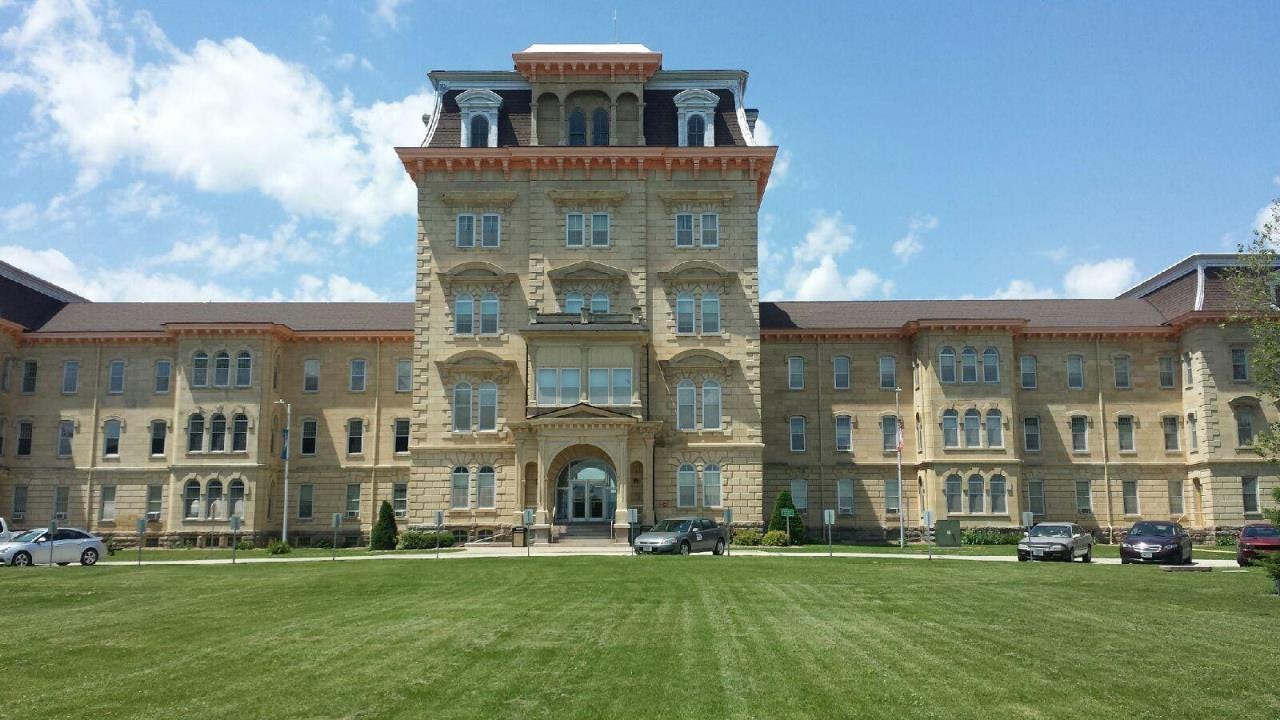
If there is a genuine hidden history for this site, it’s concealed in these expense ledgers. This was a very expensive build. It’s said that the money ran out and work halted for a time. The asylum opened with the north wing only half built. The final cost was nearly seven times over the appropriation, racking up to a total of $845,000.
There’s may be hidden story of corruption and embezzlement behind these costs, but maybe not. Unless my search result answer was wrong, $845,000 in 1868 is somewhere around 20 million in 2026. Still a huge amount of money, but a cursory search for 2026 buildings with that price tag turned up a lot of stuff much less impressive than this Independence asylum.
Cherokee, Iowa Asylum
This is assertion without a single specific behind it. Which records could he not find? What should one expect to be able to find or not find?
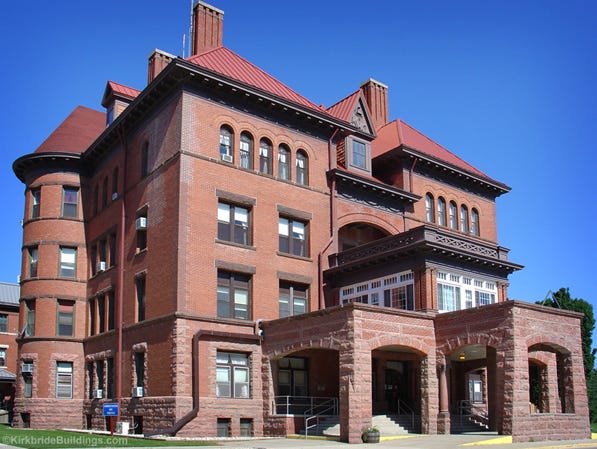
Architect Henry F. Liebbe of Des Moines.
Cherokee residents campaigned from 1894; competing towns included Sheldon, LeMars, Fort Dodge, Storm Lake, and "Pocahontas Center"; it took 14 ballots in the legislature; the legislature appropriated $12,000 to purchase the site; opened August 15, 1902 as Iowa's FOURTH asylum. The building inventory is documented: "1810 windows, 1030 doors, 46 outside doors, 550 rooms, 200 closets, 23 dining rooms, 30 bath rooms, 57 toilet rooms... 12 acres of floor surface, 93,000 yards of plastering."
Vanilla Skies, Painted Clouds
The road wasn’t paved, which is normal for roads prior to the 20th century. No great mystery there. And the infamous vanilla skies (bum bum baaaa!) Joking aside, the skies do often look unnatural in this era of photos: flat, blown-out bright white, sometimes with painted on clouds. That’s really a thing, the genre isn’t inventing it, but I think the inferences they draw from that are unlikely. Before the technical explanation, I’ll point out this vanilla skies framing device is a regular cast member for the reset genre. Below is a screenshot from a short form video in the genre, where the video claims the reason “they” whited out the skies in old photographs was to conceal the existence of airships, dirigibles, blimps, etc. While I disagree that any occurrence of white skies is proof of anything like that, I could entertain the notion that oil companies smeared and memory-holed competing aerial technology to maximize their profits with planes and the fuel they require. I may look into that more later to see if that’s got any potential truth to it.

Why white skies? Photographic emulsion is silver halide crystals (mostly silver bromide, some silver iodide), and those crystals are naturally sensitive to blue and ultraviolet light and almost blind to everything else. In 1873, German chemist Hermann Wilhelm Vogel figured out how to dye-sensitize emulsions to also catch green and yellow, and that dyed emulsion is what got the name orthochromatic. It still could not register red at all. Sky is blue and loaded with UV, land and foliage are not, so on an orthochromatic plate the sky massively overexposes to a blank white or pale gray while the ground exposes normally. That mismatch, correctly exposed foreground next to a featureless sky, is the entire “vanilla skies” effect, and it’s a predictable, universal artifact of the chemistry with that era of photography.
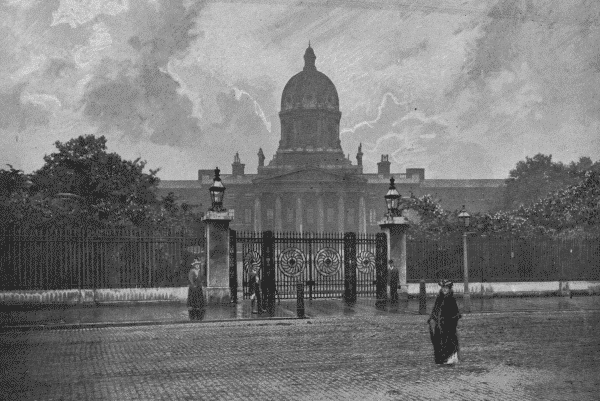
They probably did get a Bob Ross to do some clouds on this photo. It’s an established practice in photography of a certain period. I plan to go over this more thoroughly in a separate video, but for now, here’s what you can look into if you want to understand why there are so many hand painted skies.
Two period photography techniques were combination printing, where a photographer would shoot the landscape and a separate cloud negative, then print both onto one piece of paper. Gustave Le Gray pioneered this for his 1856-57 seascapes, specifically because a single exposure couldn’t capture both a lit sky and a lit sea at once. The other was simple retouching by hand, painting clouds directly onto the negative or the finished print.
Both were documented, taught, and openly discussed as normal studio practice, not concealed as fraud. Henry Peach Robinson’s manual Pictorial Effect in Photography (1869) walks through combination printing as standard technique.
Panchromatic emulsion, sensitive across the full visible spectrum including red, arrived in the lab around 1904 and reached the commercial market around 1906. So “flat white sky” isn’t evidence of anything wrong with a specific photo, it’s a dating tool. Any photo with that blown-out sky is telling you it predates roughly 1906, or was shot on ortho stock by choice afterward, which is the opposite of suspicious, it’s internally consistent with everything else.
I’ll give Lucius credit for when he says image provenance matters around an hour into his livestream. That’s true. But uncertain image provenance goes both ways, and no image he’s provided, properly documented or not, has any evidence in it of any of the theories he puts forward, and he’s not really digging in to provenance for the viewers. Later in the members’ section, I’ll show you why the provenance of this particular Bob Ross photo lends even more explanation to its weird texture.
No railroads to Cherokee
They originally didn’t have a railroad going to Cherokee. We have to ask, what’s the time frame for “originally”? The asylum opened to patients in 1902. It’s very easy to find out that the first railroad depot in that town opened in 1870. Unless that’s a made up “mainstream history” detail too, Cherokee had thirty years of railroad access before this photo was taken.
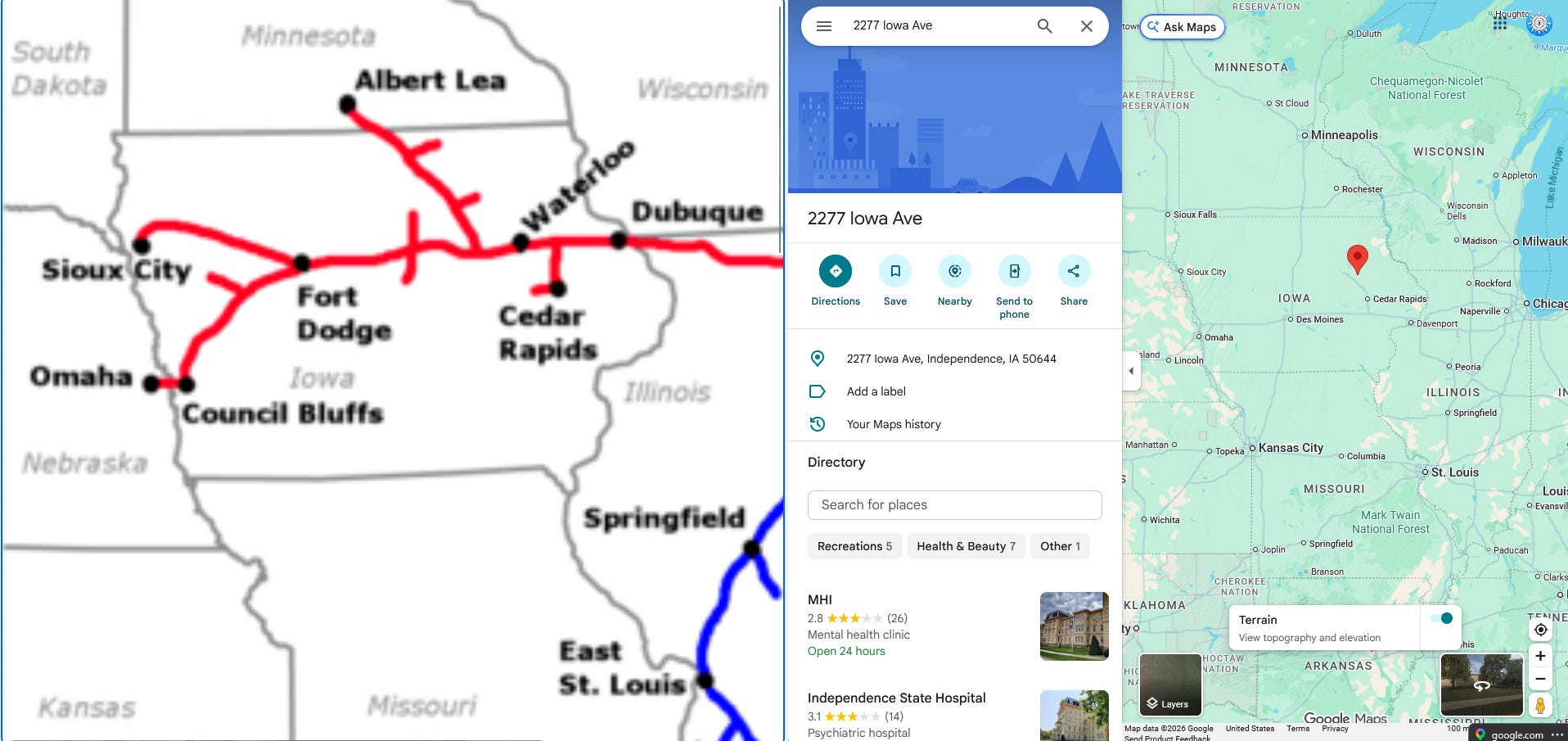
Here’s the location of the asylum vs the map of the railroad lines. There’s no doubt the asylum was right on the red line.
As for the remoteness of these asylums in general, being away from dense population centers and on large acreages, that was itself the crux of the doctrine Kirkbride preached, environmental determinism. In his book he prescribed a rural site of at least 100, ideally 250+ acres. The asylum should grow its own food and make a work therapy out of the farming process for patients who were able to participate. Clean food, clean air, clean water, rural setting, and a nice building. It’s what we now call Terrain medicine. We’re going to talk about that in much more detail in the members’ half of the episode.
The batwing layout
I don’t understand this one. If the whole point of an alleged fabricated historical narrative about these buildings is supposed to be convincing, shouldn’t be “supposed to make sense?” And of course, it does make sense if you understand the ideology of the alienists of this time. Even though modern people see gothic architecture + old timey black and white photos + insane asylum and likely get the heebie jeebies, consider how horror movie aesthetics may have informed that perception. In the 19th century, this stuff was the pinnacle of architectural beauty and excellence, not in any way disconcerting. That being said, it may be that the decades of Kirkbride asylums existing across America was itself a factor into the Gothic architecture = horror movie association. It could very well be an origin for that.
Regardless, the design logic is fully documented. The 1851 AMSAII "Propositions" (26 propositions on construction and organization, published in the American Journal of Insanity, vol. 8) and Kirkbride's 1854 book explain it. The echelon/setback ("batwing") arrangement existed so every ward received cross-ventilation and sunlight from multiple sides. This was a ventilation-engineering solution under pre-germ-theory miasma medicine, where fresh air and light were literally the medicine. Kirkbride emphasized the therapeutic effect of "cheerful, well-lighted halls and parlors." The Gothic/Tudor styling was a deliberate rejection of the prison aesthetic and an appeal to the domestic, collegiate, and picturesque. Verandas and balconies supported supervised outdoor "airing," which was prescribed treatment.
Similar Asylums Around the World
The last segment of his livestream I want to address is about the international development of insane asylums throughout the 19th century. This needs to be addressed to put the suspicious asylums topic truly to rest.
Throughout the video he periodically brings up buildings beyond the United States, and 63 minutes in he says, “the Kirkbride plan was not limited to the United States, it was across the lands.” That’s in contradiction to what he said at 12 minutes into the stream: “all these compounds have a very similar appearance to them and that includes the ones that are not located in the United States and therefore ostensibly were not subjected to the Kirkbride plan.”
His overall assumption seems to be that the Kirkbride plan is a fishy historical explanation because there are asylums all over the world that are similar in appearance to the Kirkbride model. But he’s inconsistent about how he states this, as you just heard. A viewer might easily come away from his presentation thinking the international asylums are Kirkbrides.
Examining this will come in four steps. First, we have to look at the overall aesthetic and facade of these buildings to find the roots of it. If the aesthetic is older than Kirkbride and of European origin, that will matter significantly. Second, we should look for evidence of the international transmission of architectural concepts and treatment ideologies, there should be a paper trail for this. Thirdly, I can say from the outset that the examples Lucius brings up in his video are definitely not actually “Kirkbrides,” they are of various layouts other than the ubiquitous shallow v-shape from United States asylums. This is something I can demonstrate and I will provide evidence. Lastly we will look closely at asylums in Australia and New Zealand, because from a surface level analysis without knowledge of the history of those nations, their asylums look and sound least plausible to a modern audience. We’ll attempt to prove their having been built by 19th century colonists, as far to the hilt as possible.
The visual similarity of 19th century asylums in many countries is real. Overall, grand institutional buildings of all sorts from the mid to late 1800s genuinely look alike, even across borders. I think the mistake is in the inference put forward by the reset theory that it proves Tartaria or some other unnamed precursor civilization. Beyond asylums, I haven’t falsified anything, and so in the broader sense, the theory is still an open question for me. But for asylums specifically, we can go deep on this one. If you’ve been with me this far, you’ve seen the spurious and template-driven nature of the claims made by Lucius and similar channels. If we can so thoroughly dismantle their propositions on asylums as we’ve done so far, it seems likely to me that each other pillar of the Tartaria house of cards will be as easily demolished, and each one we take out will provide momentum for the rest, because of so many repeated errors or misunderstandings that are shared between different branches of reset theory.
The Shared Aesthetic Ancestor
The staggered wings coming off a larger central block that is the common “asylum look” denominator for the 19th century descends from the pavilion plan hospital design, which features long, narrow wards with windows on both sides for cross-ventilation and natural light. These were the first hospitals to connect separate buildings (pavilions) with each designated to different hospital functions. Pavilion hospitals originate with the British and French, and although it wasn’t called as such, their design has ideological roots with terrain medicine (pre-germ theory and allopathy).
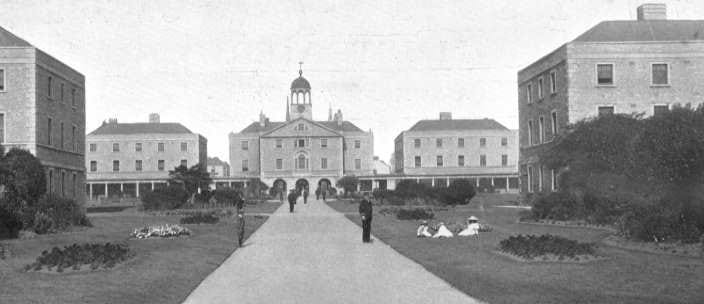
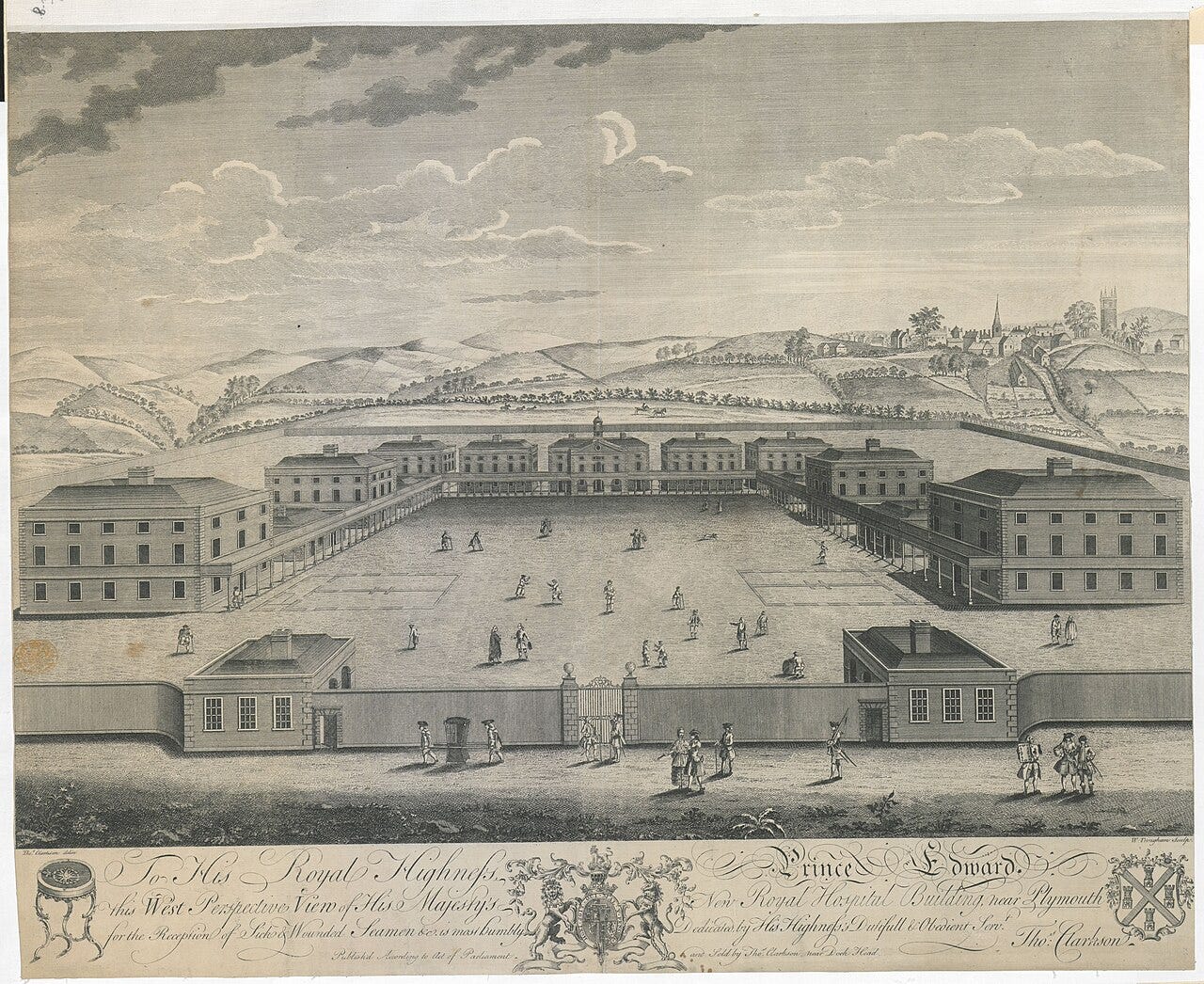
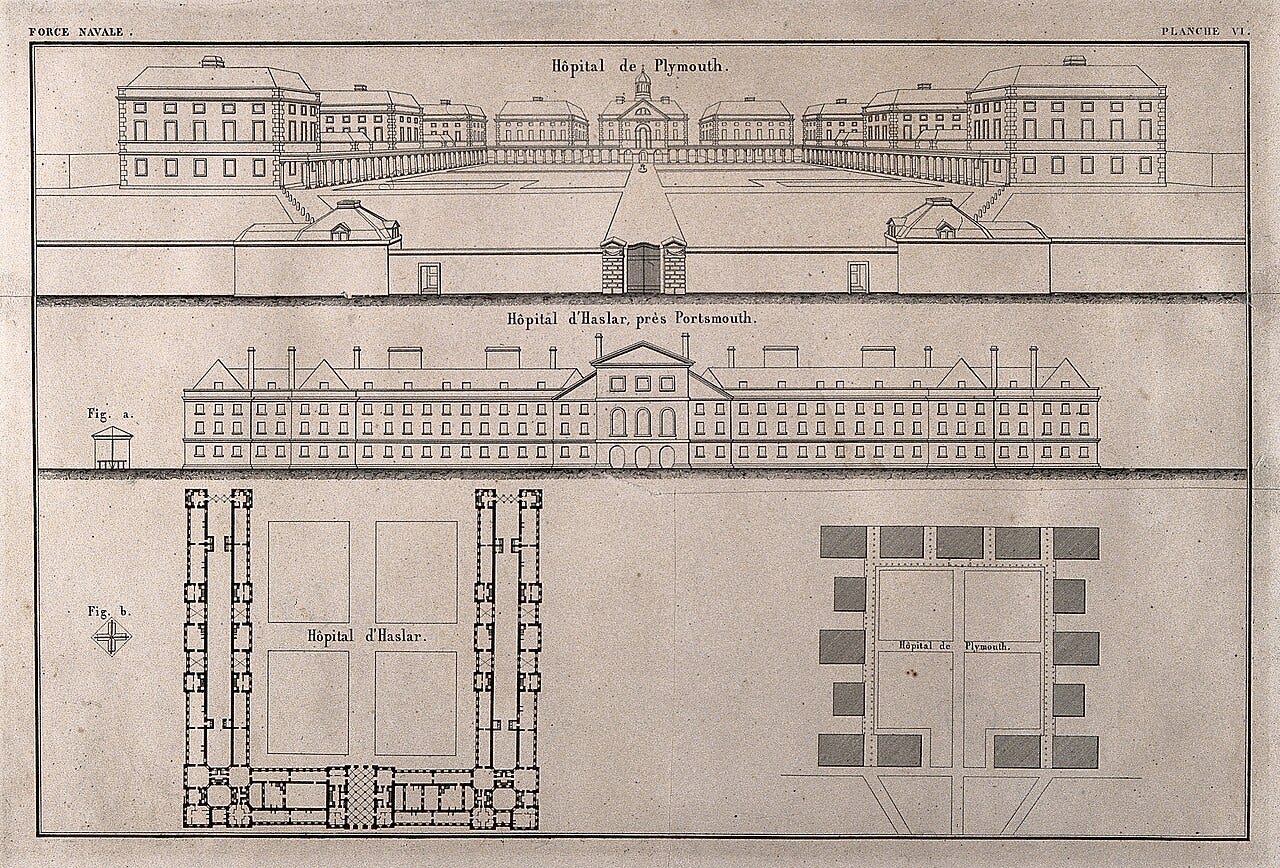
There is real resemblance between the buildings we’ll look at in this section, from Europe and European colonies, even in structures built decades before Kirkbride. We can find a well documented professional consensus that a specific kind of building could help cure madness. The question these professionals argued was exactly what shape that building should take in its floor plan. Kirkbride didn’t originate the idea, he codified the American version of it. There is a chain of books that predate his On the Construction, Organization, and General Arrangements of Hospitals for the Insane, which was published in 1854.
The Birth of "Moral Treatment” and Asylum Architecture
From Wikipedia:
Philippe Pinel (20 April 1745 – 25 October 1826) was a French physician, precursor of psychiatry and incidentally a zoologist. He was instrumental in the development of a more humane psychological approach to the custody and care of psychiatric patients, referred to today as moral therapy. He worked for the abolition of the shackling of mental patients by chains and, more generally, for the humanization of their treatment. He also made notable contributions to the classification of mental disorders and has been described by some as "the father of modern psychiatry".
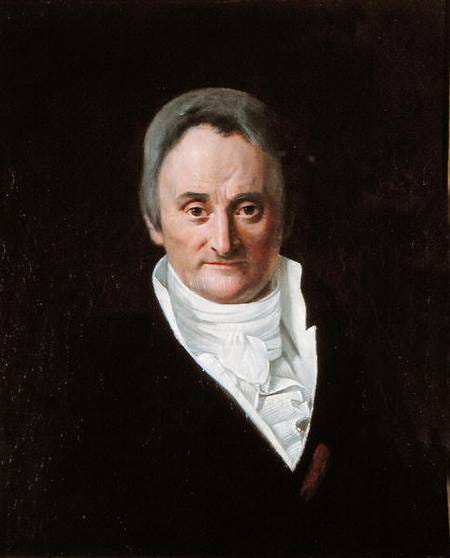
Moral treatment was an approach to mental disorder based on humane psychosocial care or moral discipline that emerged in the 18th century and came to the fore for much of the 19th century, deriving partly from psychiatry or psychology and partly from religious or moral concerns. The movement is particularly associated with reform and development of the asylum system in Western Europe at that time. It fell into decline as a distinct method by the 20th century, however, due to overcrowding and misuse of asylums and the predominance of biomedical methods. The movement is widely seen as influencing certain areas of psychiatric practice up to the present day. The approach has been praised for freeing sufferers from shackles and barbaric physical treatments, instead considering such things as emotions and social interactions, but has also been criticized for blaming or oppressing individuals according to the standards of a particular social class or religion.
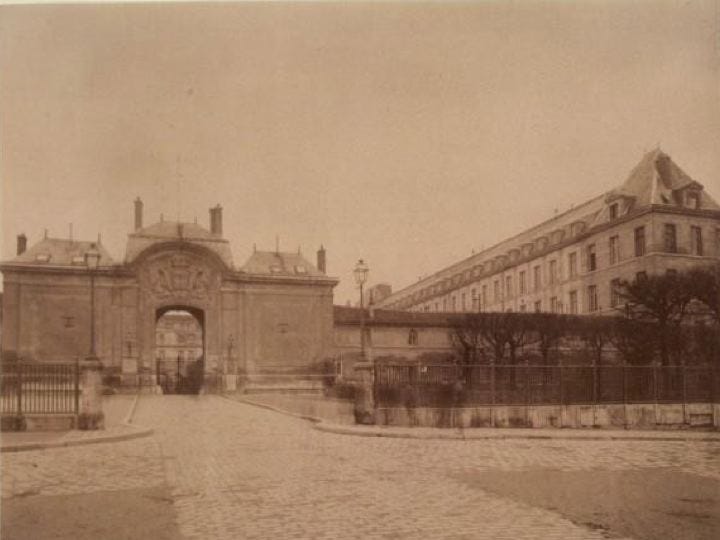
Moral treatment developed in the context of the Enlightenment and its focus on social welfare and individual rights. At the start of the 18th century, the "insane" were typically viewed as wild animals who had lost their reason. They were not held morally responsible but were subject to scorn and ridicule by the public, sometimes kept in madhouses in appalling conditions, often in chains and neglected for years or subject to numerous torturous "treatments" including whipping, beating, bloodletting, shocking, starvation, irritant chemicals, and isolation. There were some attempts to argue for more psychological understanding and therapeutic environments. For example, in England John Locke popularized the idea that there is a degree of madness in most people because emotions can cause people to incorrectly associate ideas and perceptions, and William Battie suggested a more psychological approach, but conditions generally remained poor. The treatment of King George III also led to increased optimism about the possibility of therapeutic interventions.
It’s an interesting syncro-mystical resonance that Philippe Pinel’s surname is so close to pineal. I like that one better than the Story middle name for Kirkbride. Let’s look at what he wrote in A Treatise on Insanity, first published in 1801.
“All civilized nations, however different in their customs, and manner of living, will never fail to have some causes of insanity in common ; and, it is natural to believe, that all will do their utmost to remedy the evil.
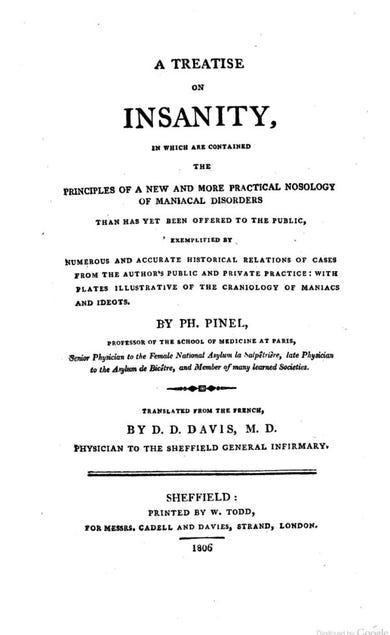
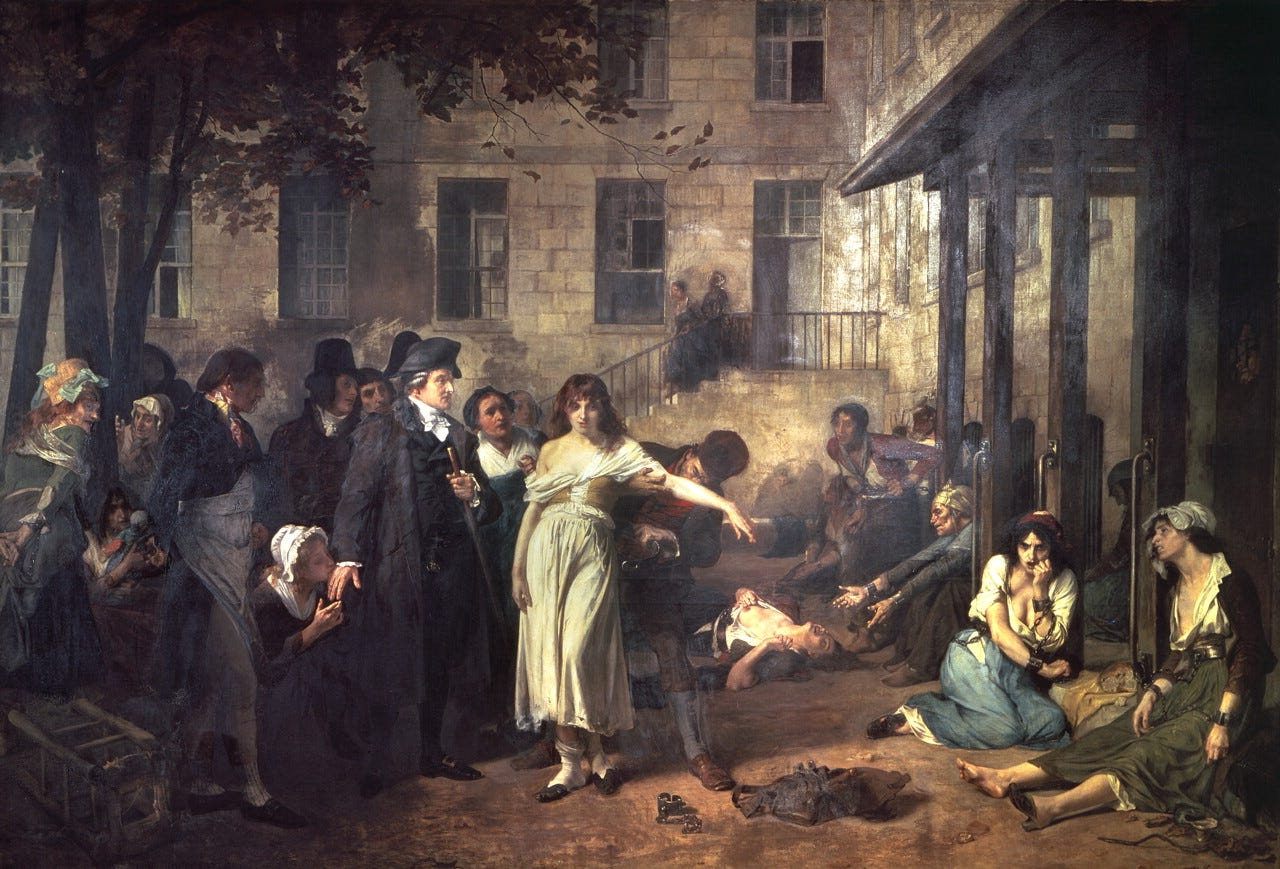
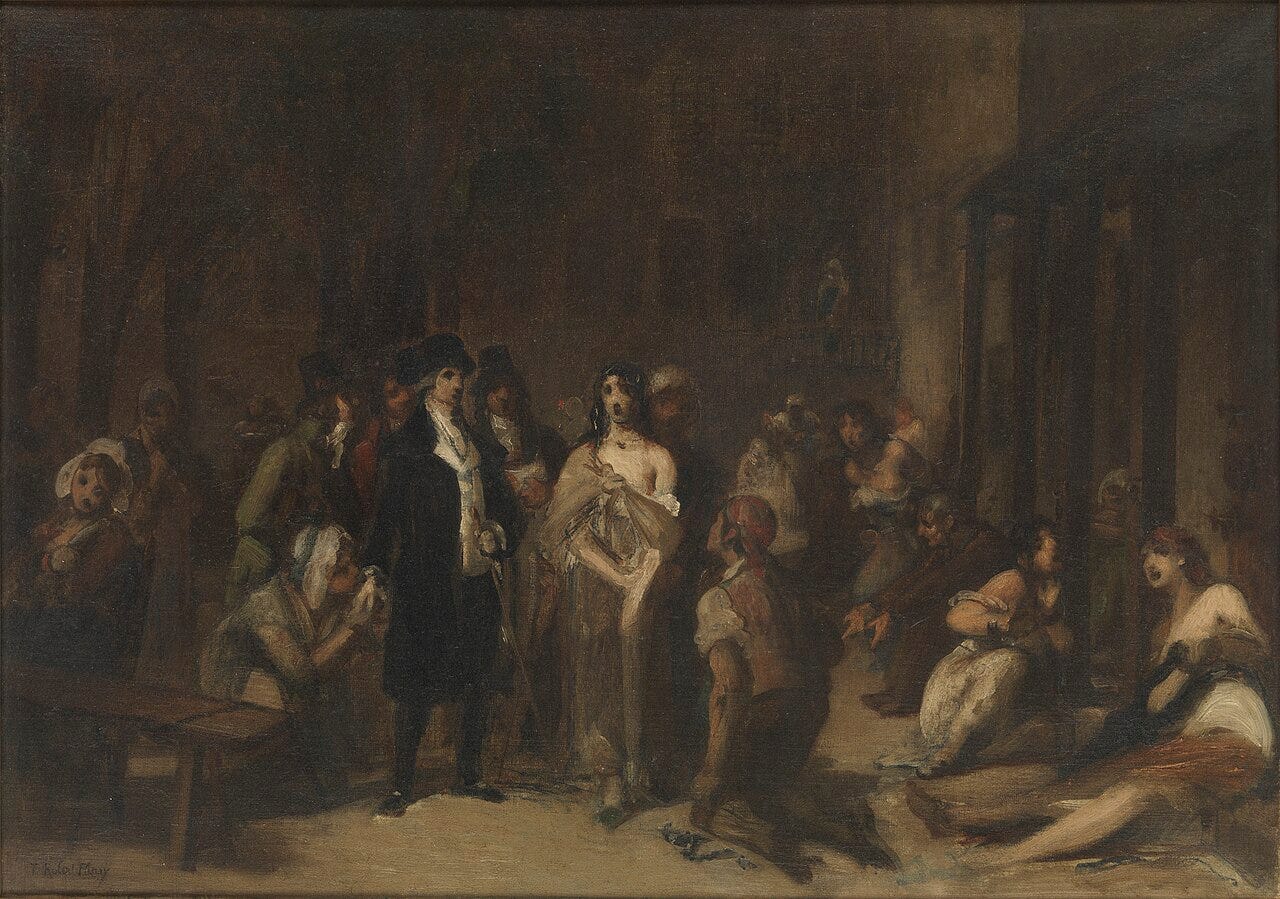
About that time (1783) I was engaged to attend, in a professional capacity, at an asylum, where I made observations upon this disease for five successive years. My opportunities for the application of moral remedies, were, however, not numerous. Having no part of the management of the interior police of that institution, I had little or no influence over its servants. The person who was at the head of the establishment, had no interest in the cure of his wealthy patients, and he often, unequivocally, betrayed a desire, that every remedy should fail.
I determined to turn my attention, almost exclusively, to the subject of moral treatment. The halls and the passages of the hospital were much confined, and so arranged as to render the cold of winter and the heat of summer equally intolerable and injurious. The chambers were exceedingly small and inconvenient. Baths we had none, though I made repeated applications for them; nor had we extensive liberties for walking, gardening or other exercises. So destitute of accommodations, we found it impossible to class our patients according to the varieties and degrees of their respective maladies.”
Across the way in England, a similar revolution was taking place thanks to the work of the Quaker William Tuke. The York Retreat was founded in 1796 by William Tuke himself, prompted by the death of a Quaker woman, Hannah Mills, in the York Asylum. His son Henry Tuke (1755–1814) helped establish it, and William’s grandson Samuel Tuke (1784–1857) wrote the influential 1813 Description of the Retreat, which popularized the term ‘moral treatment.’ (Samuel is also the author of the 1815 asylum-architecture book we looked at earlier.)
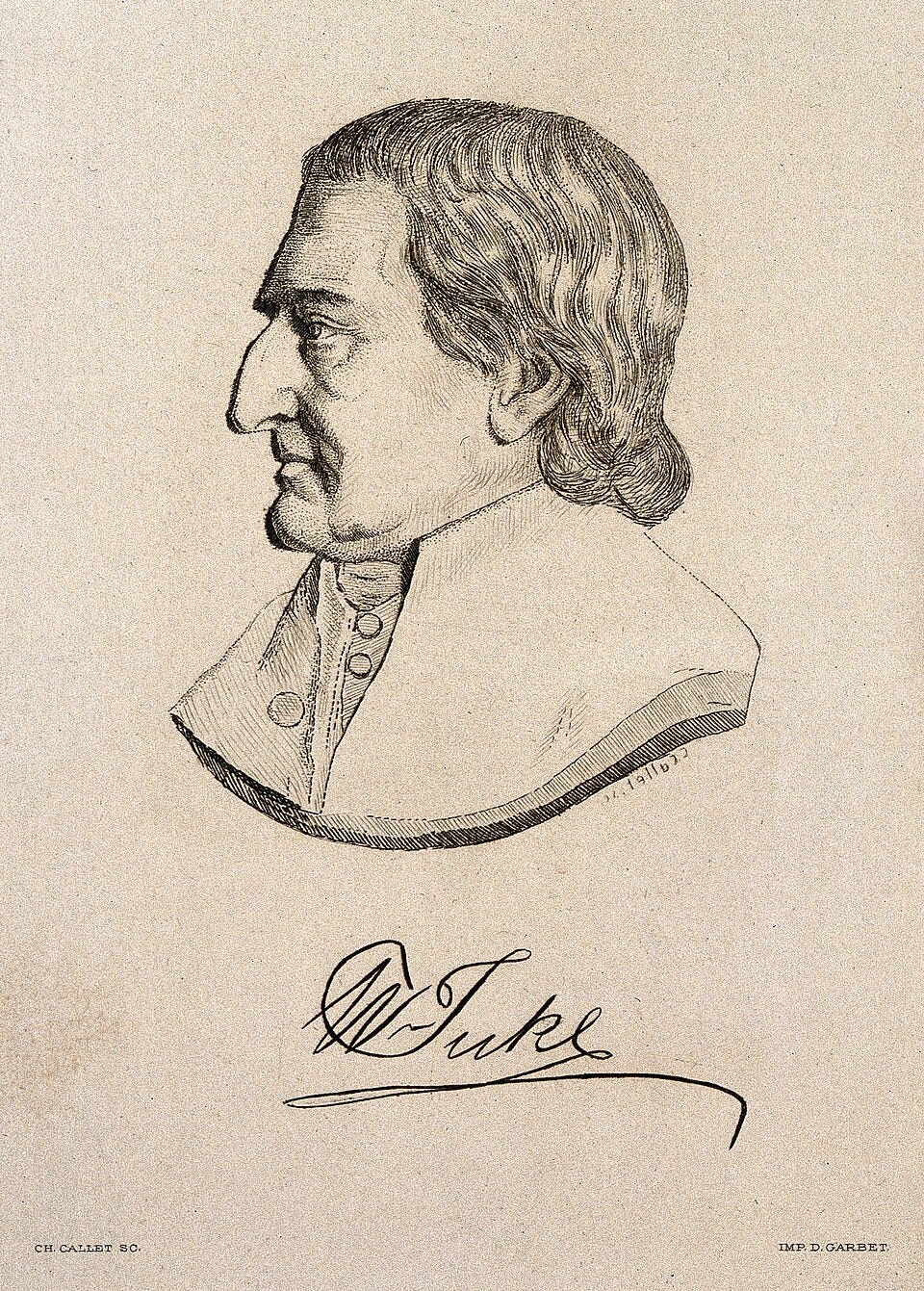
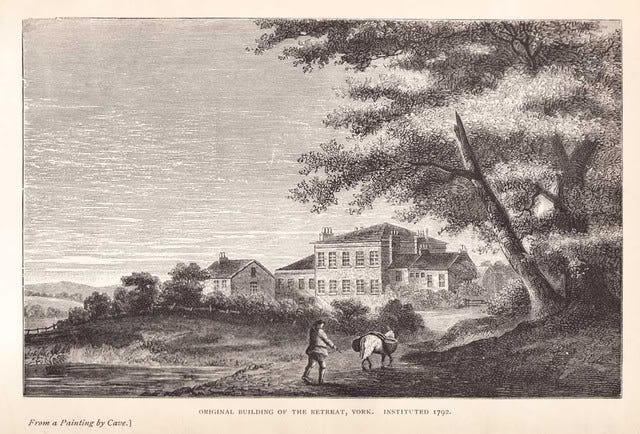
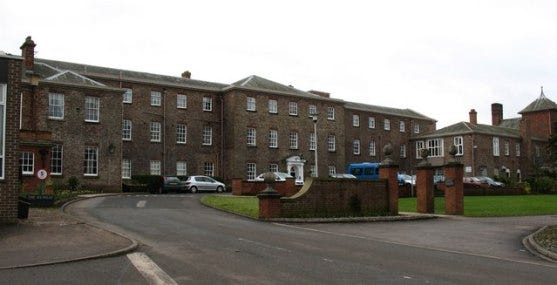
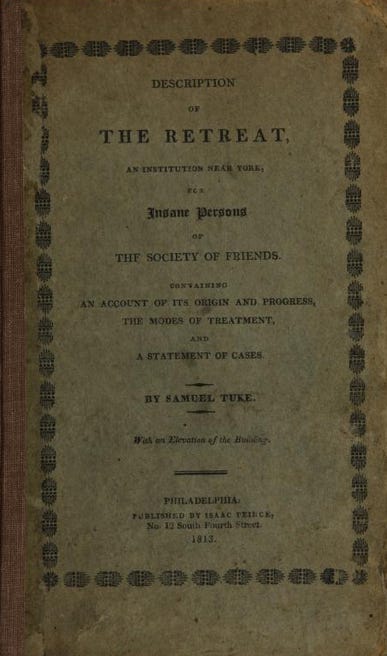
The history given by Samuel in the beginning of his account on the York retreat discusses what led his grandfather to his charitable path of helping the mentally ill—in a nutshell, a woman from the Quaker community died unexpectedly in a York asylum, and there seemed to be evidence of abuse leading to her demise.
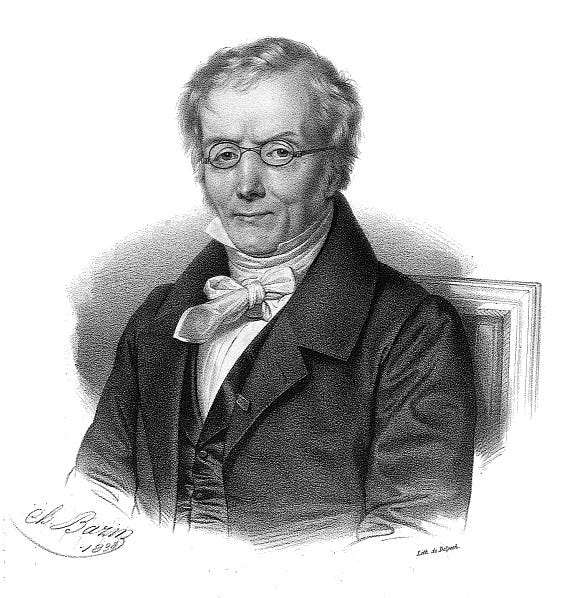
Back in France, Philippe Pinel’s student Esquirol ran a government-commissioned survey of every single asylum in France, and eventually published his magnum opus, Des Maladies Mentales in 1838. By 1845, E.K Hunt published an English translation of Esquirol’s book. Hunt was educated in Philadelphia, and from what I can tell, he still lived there at the time he published this translation, meaning the book was published in the very same city where Dr. Kirkbride lived.
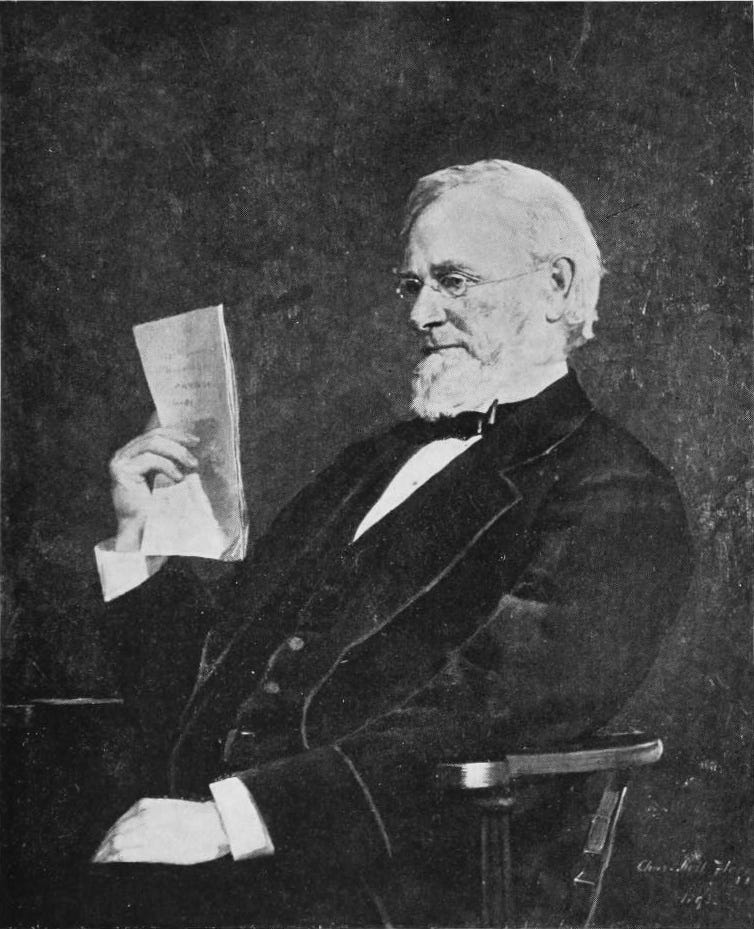
The Hunt translation was incomplete and actually left out the architectural talk, focusing on nosology (classification) and treatment, but it’s likely Kirkbride could have read the French. That such an impactful work was translated in his vicinity, is credit to the notion that he was influenced by Esquirol, and when we look into the latter’s writing, we see ample evidence for that.
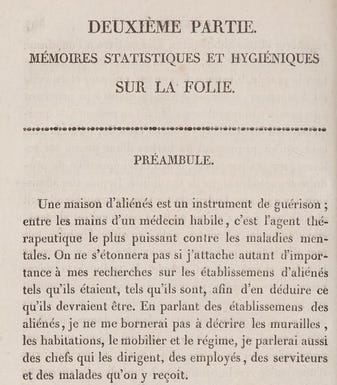
Esquirol states the doctrine outright, as the organizing thesis of his chapter on asylum establishments: "Une maison d'aliénés est un instrument de guérison ; entre les mains d'un médecin habile, c'est l'agent thérapeutique le plus puissant contre les maladies mentales" (Des maladies mentales, Tome II, Paris: Baillière, 1838, p. 398). In english, ”A house for the insane is an instrument of cure; in the hands of a skillful physician, it is the most powerful therapeutic agent against mental illness.”
If the building itself is the most powerful therapeutic agent against mental illness, it follows that the number one priority would be ensuring the best possible structure is built. I imagine the return on investment was conceptualized as worthwhile, since housing and caring for people is expensive. The more quickly and efficiently the insane are cured, the less is spent on each patient, theoretically helping the expensive building eventually pay for itself; on top of the fact that these facilities were designed to be as self sufficient as possible, with farms, water supplies, and later even the ability to generate their own electricity.
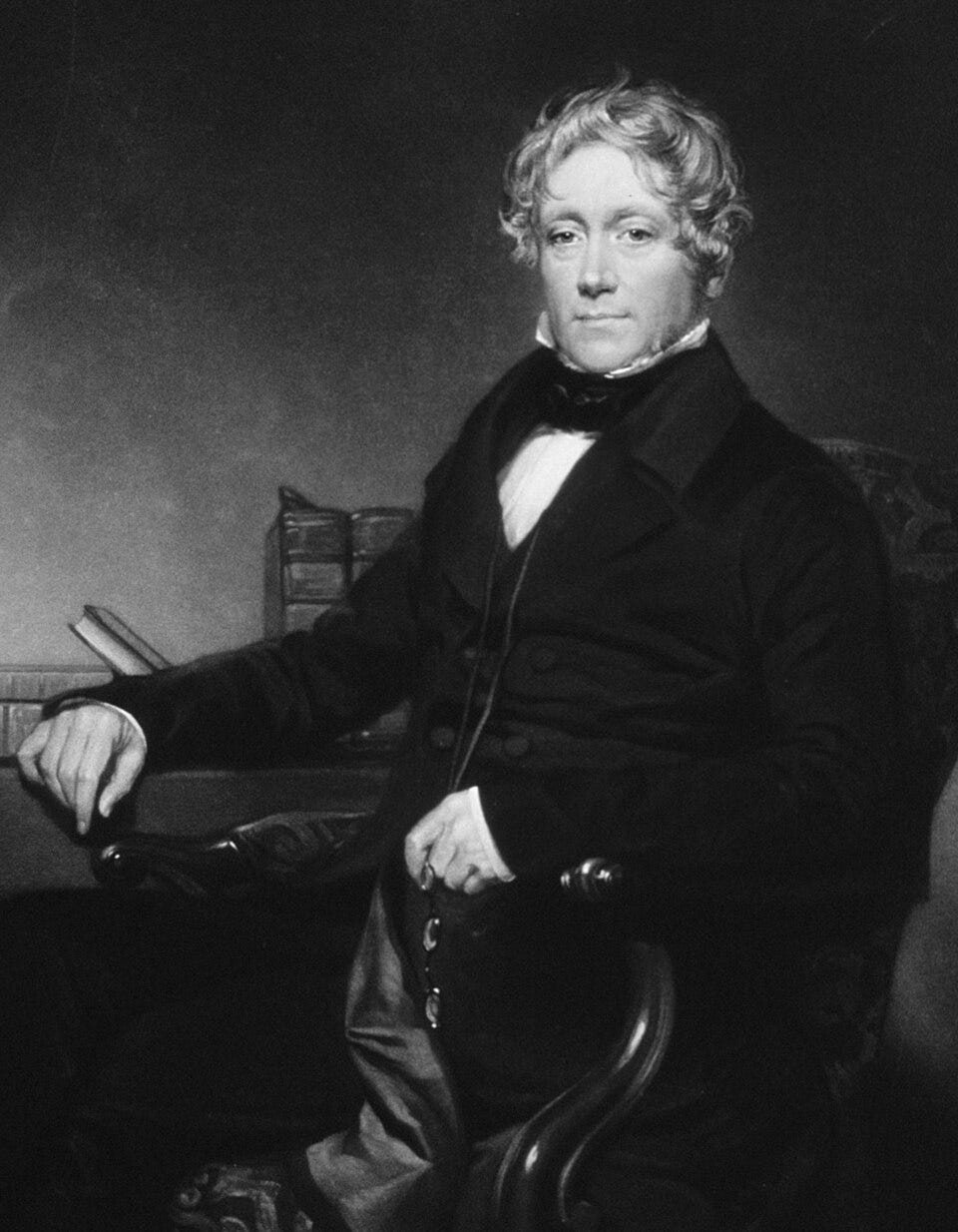
The next step before Kirkbride’s book was John Conolly, the physician who abolished “mechanical restraint” at Hanwell, UK. In 1847 Conolly published The Construction and Government of Lunatic Asylums and Hospitals for the Insane, and this book even has architectural plans in it. He openly draws on Tuke’s York Retreat and Pinel. This is basically the English version of Kirkbride’s book: same subject, same purpose, seven years earlier.
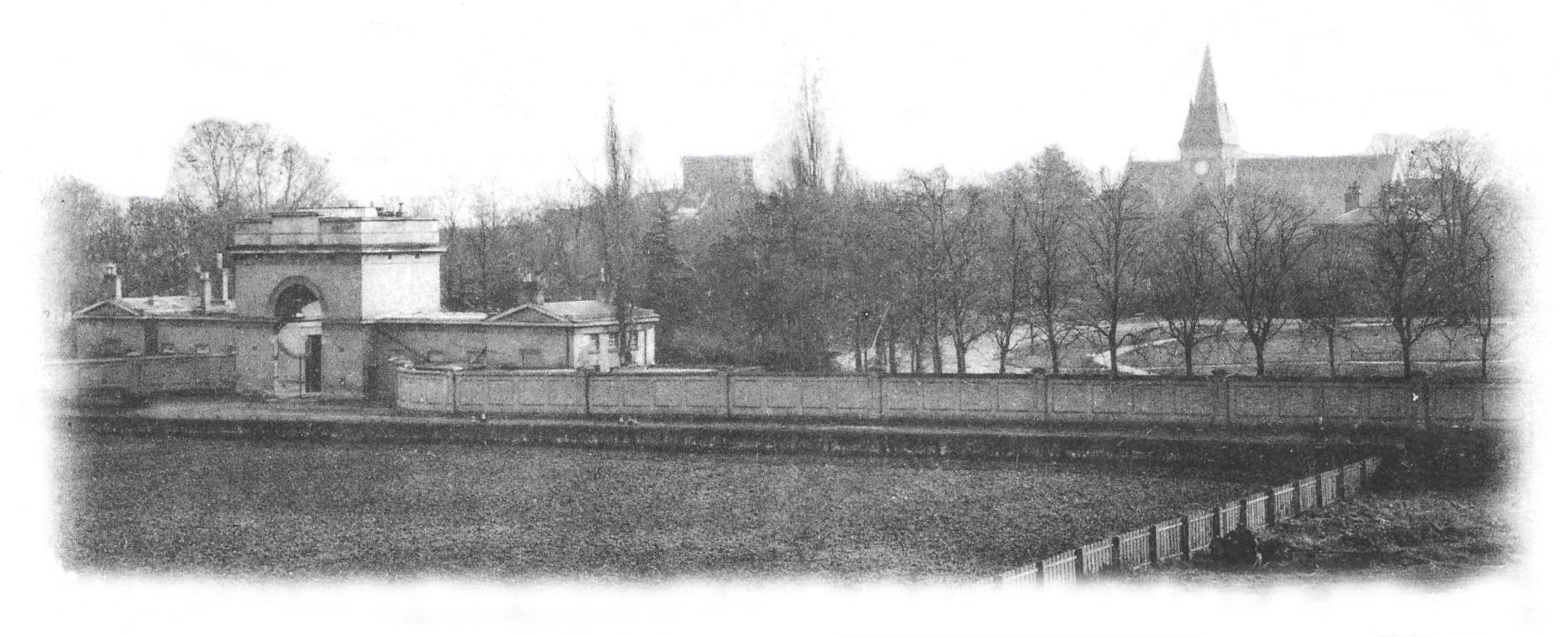
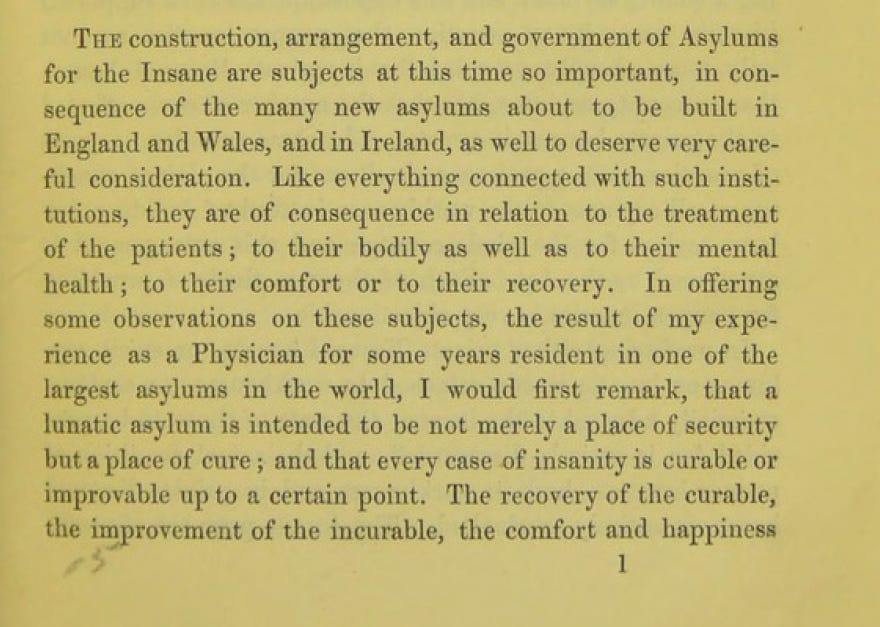
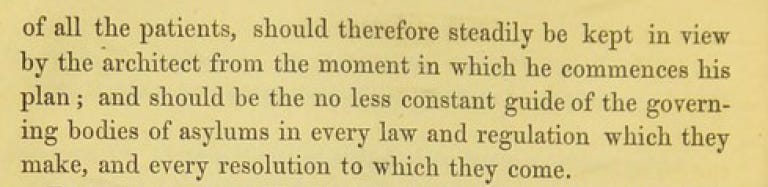
The construction, arrangement, and government of Asylums for the Insane are subjects at this time so important, in consequence of the many new asylums about to be built in England and Wales, and in Ireland, as well to deserve very careful consideration. Like everything connected with such institutions, they are of consequence in relation to the treatment of the patients; to their bodily as well as to their mental health; to their comfort or to their recovery… The recovery of the curable, the improvement of the incurable, the comfort and happiness of all the patients, should therefore steadily be kept in view by the architect from the moment in which he commences his plan…”
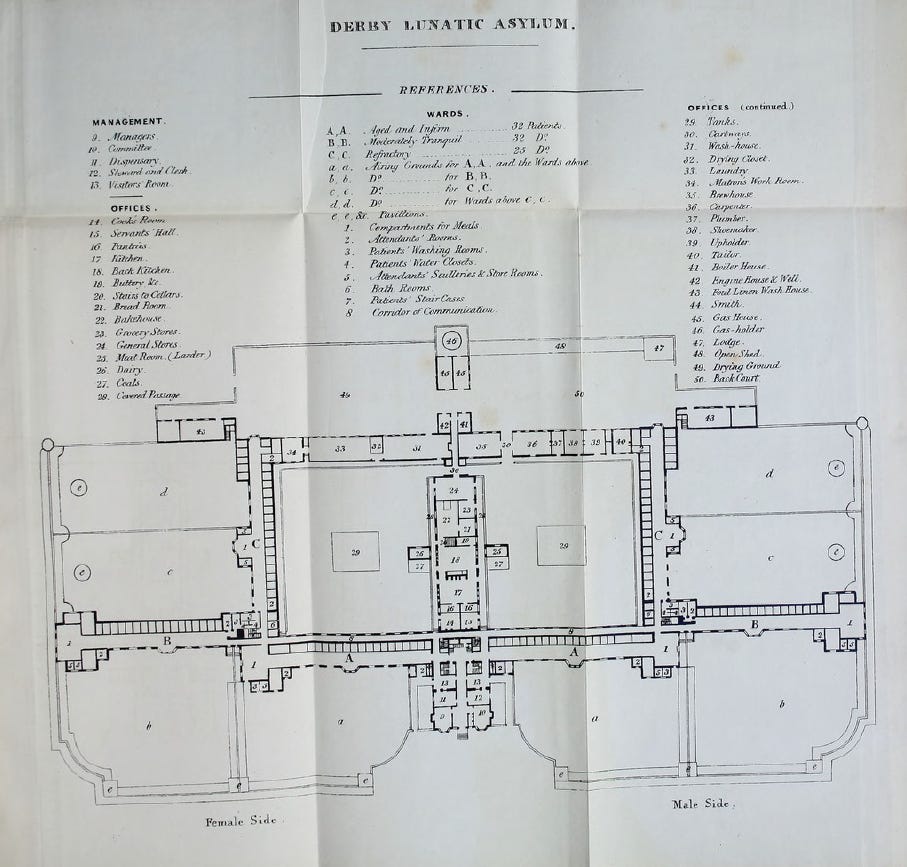
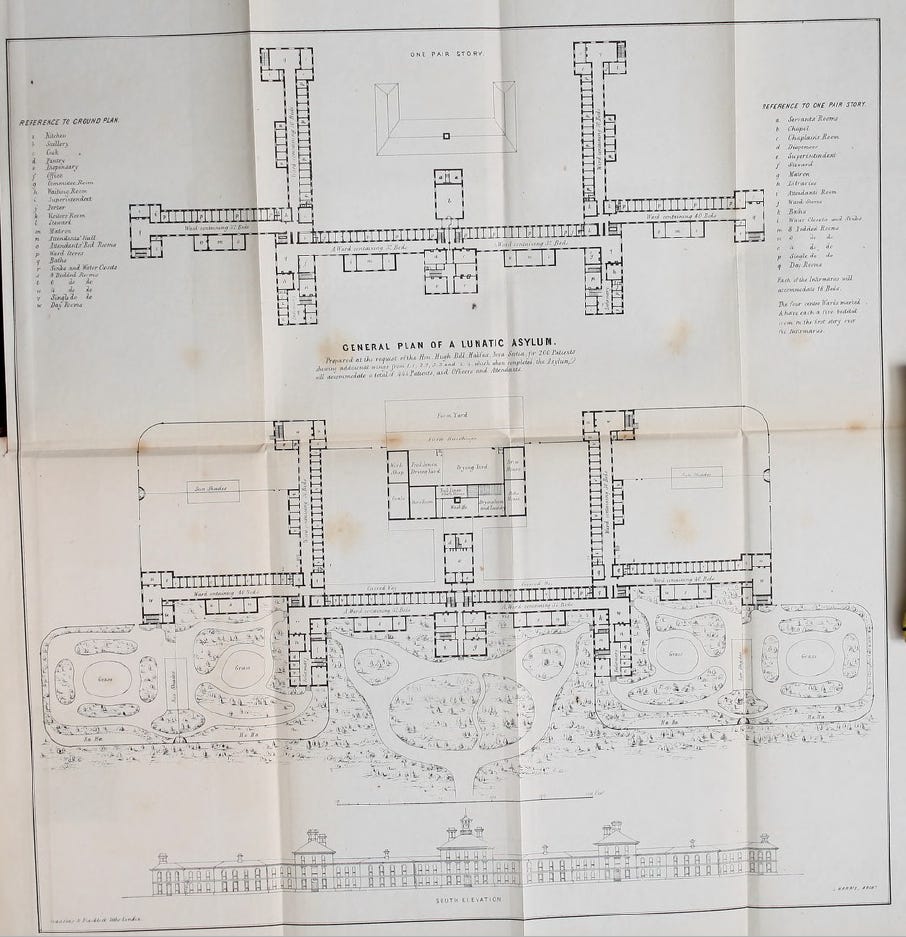
You can see that from the front view, (second plan, bottom), this greatly resembles the Kirkbride asylums in the U.S., from the top down view, it does not. Kirkbride and his cohort made sure to change this format to the shallow-V shape, because they believed it improved the quality of air, lighting, and window-views for patients, all of which were seen as incredibly important to successfully curing insanity. They’re similar, but not identical, and come from different schools of thought within the same professional milieu.
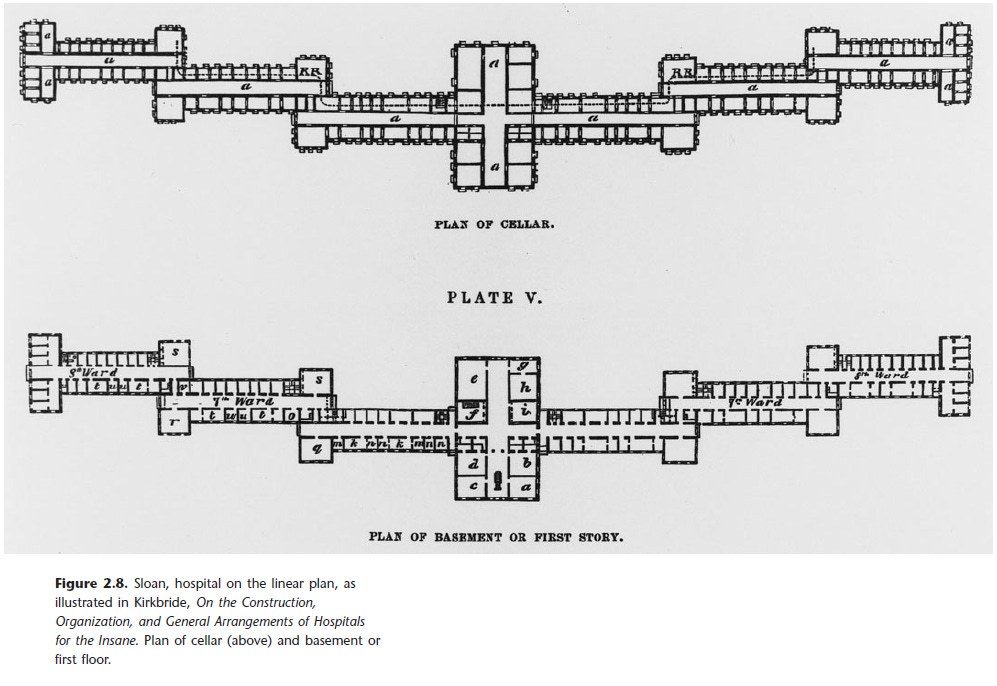
Lucius actually provides this answer in his stream and then discards it. At 58:28, he says: “Europe does have a lot that resemble the Kirk Brides although they’ll call it Victorian architecture… they just happen to look the same but that’s why we poke fun at the names… it’s Victorian architecture it’s gray School Revival architecture it’s this architecture it’s that architecture…”
I think when he said “gray school,” he must have meant Greek School. These buildings do share an aesthetic, they are labeled “Victorian” “Greek Revival” or “Gothic Revival,” but Lucius treats this shared style as a wink from a phantom, history-editing, elite organization, without ever addressing the long publication history of this design tradition.
The Transmission of the Tradition
There’s a well-documented paper trail that shows how the asylum-builders worldwide influenced one another. Just like we saw with the architect Burton, who toured several asylums in the United States to plan the one for Utah, many doctors traveled abroad to tour foreign asylums, sometimes on government commission. They published detailed reports naming buildings that inspired what they planned to build.
At 47:32, Lucius concedes this to a degree, saying “the whole point of looking at these other asylums… Canada we can explain it a little bit because it’s right next door to the United States so maybe they got some ideas from Kirkbride and they decided to do the same layout possibly…”
This is true, and too his credit, Lucius half-answers his own question here. He allows that Canada could have borrowed from Kirkbride because it's next door. That's exactly right. The only thing missing is that the same ordinary mechanism, doctors and architects reading each other's work and touring each other's buildings, reaches all the way to Australia, and it left a paper trail.
First we’ll look at Napa, California, which is one of the asylums Lucius brings up as suspicious. On commission from CA Governor Haight, Dr. Edmund T. Wilkins personally investigated a whopping 149 institutions across two continents, which he delivered as a report to the Governor. This became the basis for Napa’s design.
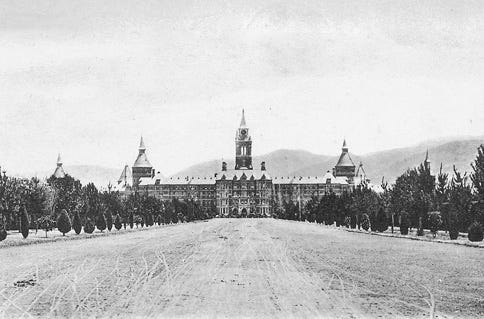
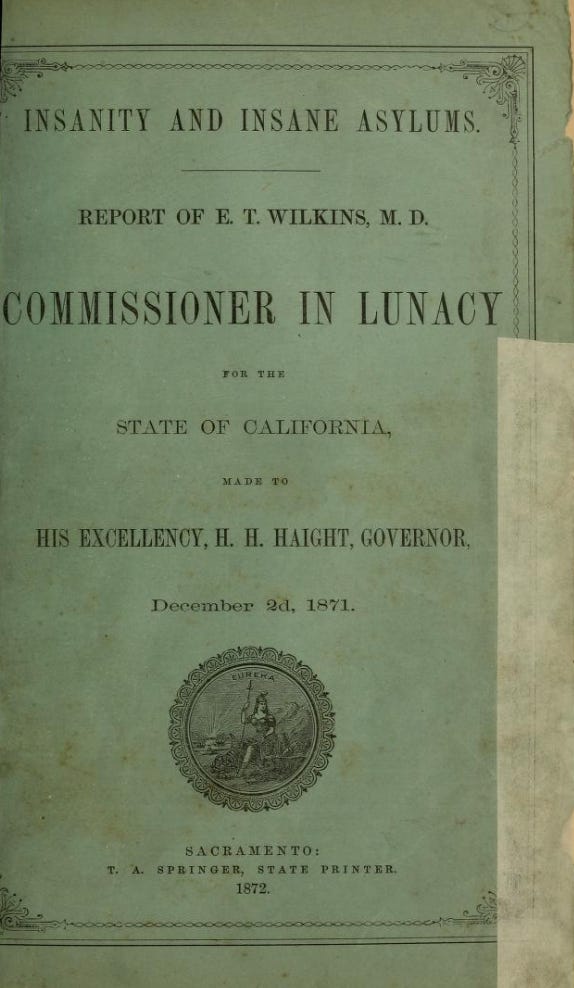
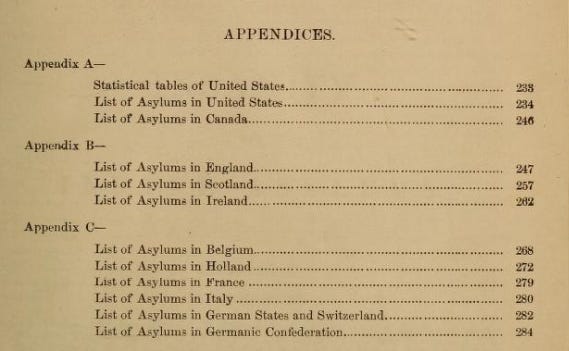
A similar report exists for the asylum in Sydney, Australia. Dr. Frederic Norton Manning was a leading figure in the establishment of a number of lunatic asylums in the colonies of New South Wales and Victoria, and participated in inquests and reviews of asylums throughout the colonies.
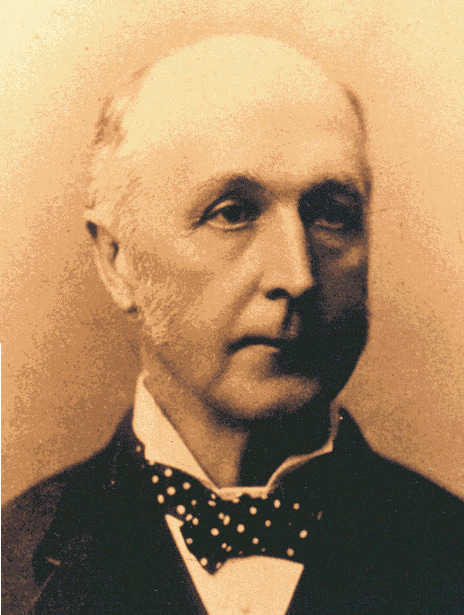
Manning toured asylums in the UK and the US and reported on it in an 1868 publication. I’ll show you a partial list below of the asylums he’s reporting on.
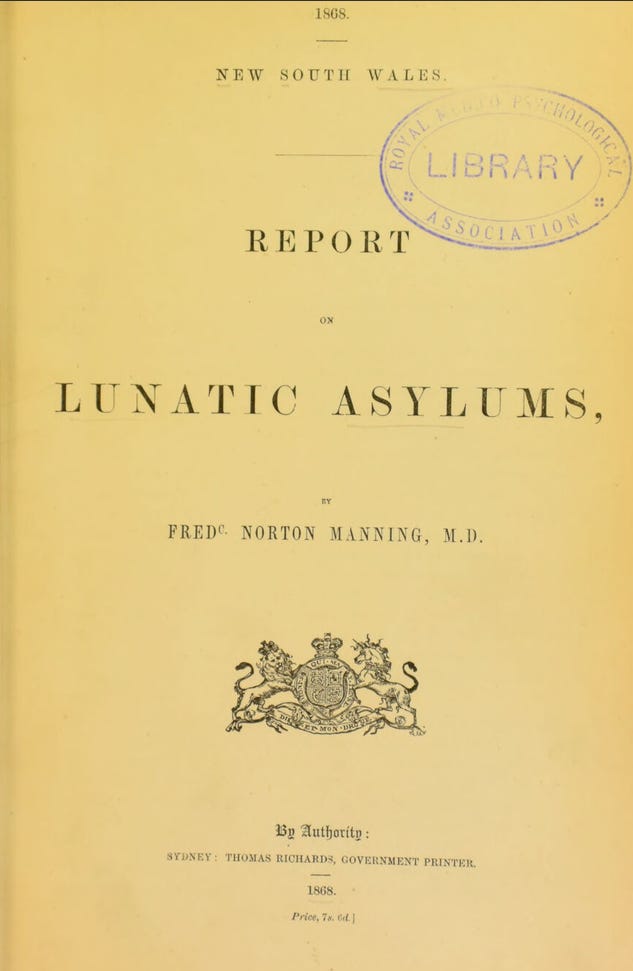
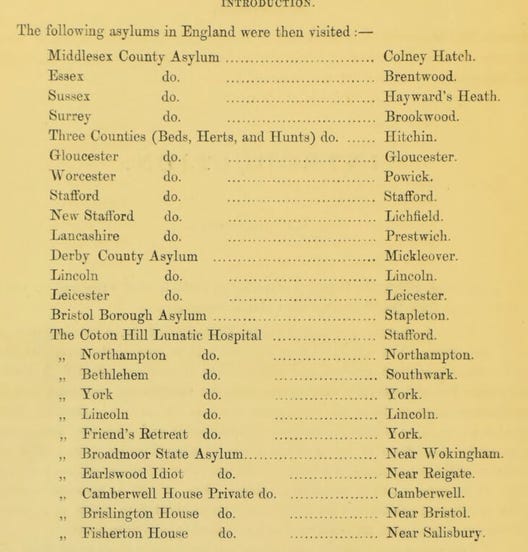
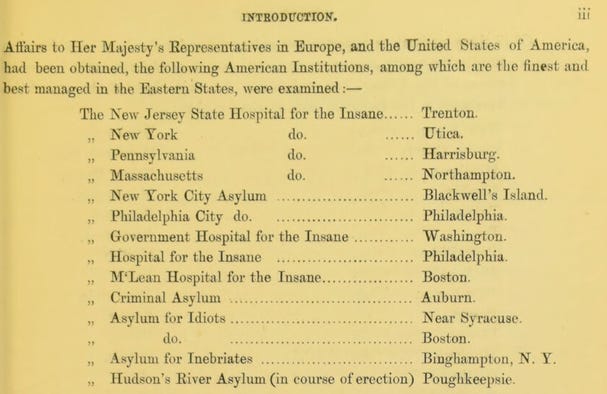
We have already discussed the American Pliny Earle’s A Visit to Thirteen Asylums, an 1841 book, and recall that Earle specified that what he saw abroad was not adequate to the standards of the AMSAII, America’s alienist association, where he and Kirkbride held founder’s seats. That he disliked foreign asylum layouts further dismantles the conjectures of Lucius that there was a uniform international template.
The point of showing you this should be clear: a conspiracy to hide old world architecture would require, among many other fabrications, multiple extensive reports on file with the British Parliament, US governments, medical associations, and regular libraries. The transmission of the architectural aesthetic (not always exact layouts) is the documented truth, not as exciting as Tartaria, but in a way, very interesting. It shows how dedicated and serious these men were about performing their duties as doctors and architects.
Looking at Lucius’ International Examples
Lucius shows several international buildings pretty rapid-fire with scattered incredulous speculation throughout his video, which is the typical production format for his genre. Several of those shown follow British asylum models, which makes sense because they’re English or Colonial builds, and connect directly back to the John Conolly lineage we discussed. Lucius frequently hedges his identification statements of the photos shown by naming more than one location or just saying he’s not sure via devices like “if memory serves…” This rhetorical framing either intentionally makes it look like he’s looked deeply into things and found little documentation, so he’s relying on his own well researched memory, or he is actually just confused and unsure because he’s done so little study on these buildings.
Bedlam in Bethlam
At 49:51 he shows Bedlam, also called Bethlam, from the United Kingdom, and says “this is uh Bedlam United Kingdom probably the most famous mental Asylum…” Yes, this is one of the most historically famous asylums, and has a 700 year history, and then goes on his Bob Ross clouds tangent we addressed earlier.
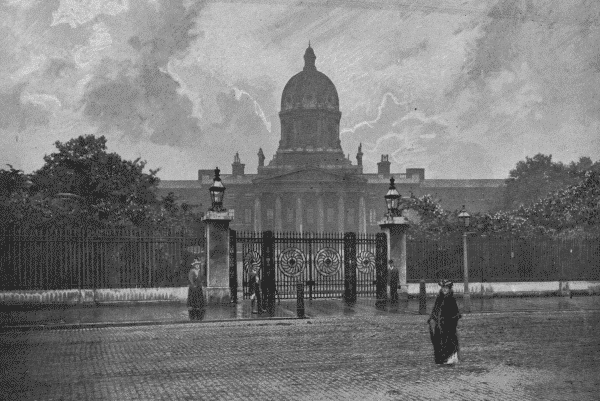
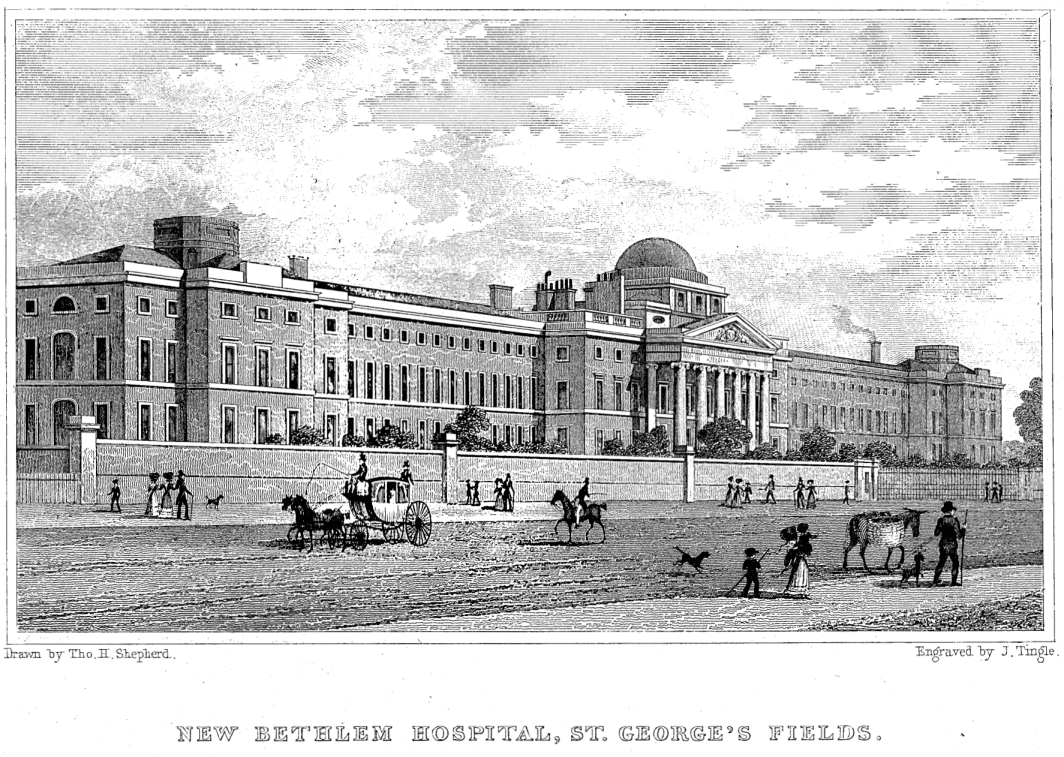
He seems to have intentionally selected the worst possible photographic candidate of the site, and followed it up with an early 19th century drawing. The beauty of this move is he showed the phased construction history of Bethlem without mentioning it. The latter image probably dates to around 1815, when the St. George’s Fields facility was finished, and the first image shows the dome, added by architect Sydney Smirke between 1844 and 1846. Regardless, the loose associations he’s leading unaware viewers to make between this asylum and Kirkbride architecture is unfounded, even the dome phase of the building predates Kirkbride. A fun side note, Bethlam hospital was originally known as St. Mary’s of Bethlehem, which became slurred by common speech into Bethlam, and then Bedlam, and incidentally is the origin of “bedlam” as a way to describe madness and chaos.
But this “Bob Ross” photo we looked at before struck me as strange when I found it was dated to 1896, that seemed out of alignment with near-20th century photography technology, so I looked into it more closely.
What I found was the image captioned “Entrance gates to Bethlem Hospital, 1896,” traces it to the book: The Queen's London: A Pictorial and Descriptive Record of the Streets, Buildings, Parks and Scenery of the Great Metropolis in the Fifty-Ninth Year of the Reign of Her Majesty Queen Victoria (Cassell & Company, London, 1896). This was a large-format volume of roughly 370 London views, each one specifically documented by booksellers as a photograph, captioned in the original with credits like "Photo by Cassell." That answers the question of why this doesn’t look like a photo. The Queen’s London produced its images via the halftone process, which involves screening a photograph through a fine dot or line pattern so it could be printed on a letterpress alongside type. That process was standard for exactly this sort of publication in 1896, and you can see the fine dots when you look closely at the picture. Possibly the image we have now has undergone multiple generations of rescanning and format conversion—the one that Lucius showed was a .gif file, which tends to introduce even more dithered texture to a photo. So my instinct was right, this wasn’t exactly 1890’s photography, it’s not a straight photograph, it’s a halftone reproduction for print, scanned and turned into a .gif with God knows how many other steps between. I pulled some other pictures from The Queen’s London to show more examples of the effect, and they’re legitimately cool pictures of the Victorian heyday.
Cumberland Hospital, Sydney
He brings up a modern photo of Cumberland Hospital in Sydney, and says “you’ve got the same construction cues though down here I think this is in Sydney if memory serves… the main admin building that still survives to this day.” The same construction cues, he says, to which I’d ask, which cues? It’s a single story, for one. That seems relevant, compared to the multistory Kirkbrides.
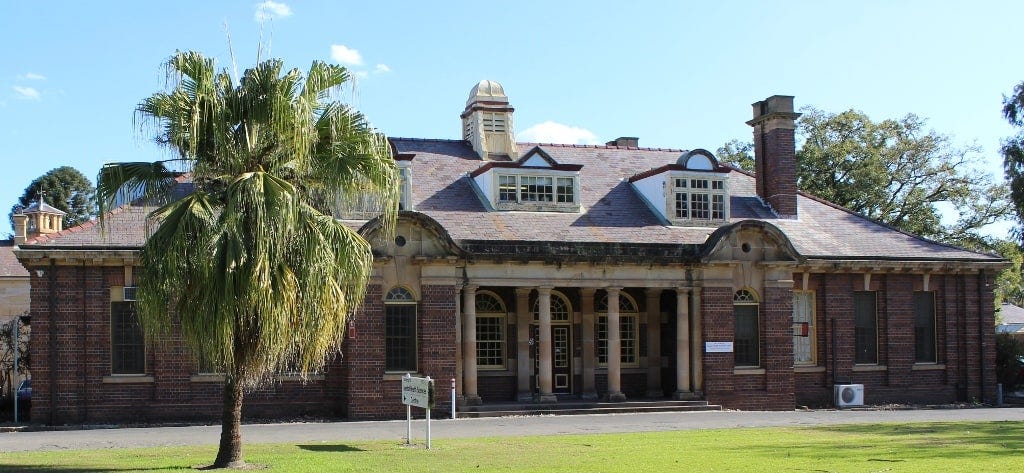
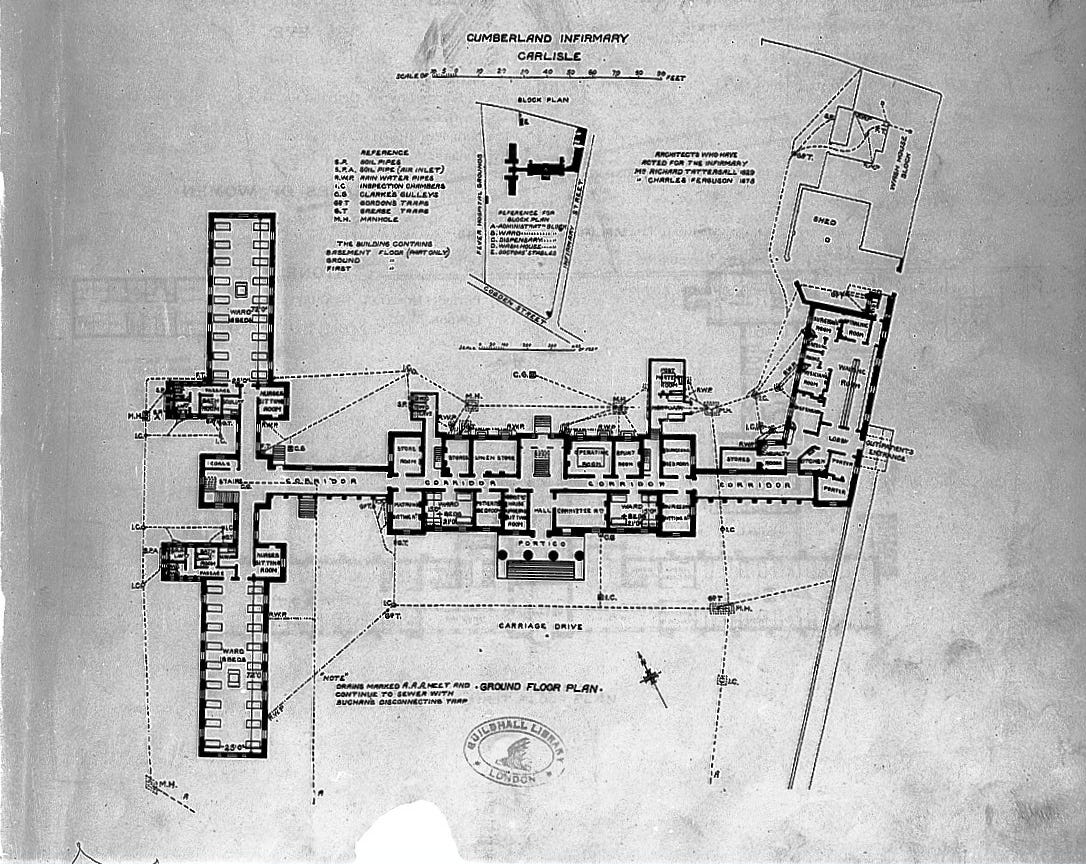
The floorplan from 1893 also looks nothing like a Kirkbride V. The funny thing about Cumberland is, he showed us a “repurposed building” without seeming to know it. This just wasn’t a Tartarian building. It was originally the Parramatta Female Factory, a convict-era complex built from 1818 to 1821, and converted to the Parramatta Lunatic asylum in 1848. The thing I can’t believe Lucius never mentioned because it’s a great point for his side is that the architect, Francis Greenway, was a convict sent to Australia for forgery! Seems like a lost opportunity for him. And it's worth actually pulling that thread, because it answers a real question: since when do convicts have the skill to raise a stone building like this? “Transportation,” as the shipping of convicts was called, never ruled out the skilled. Courts shipped forgers, clerks, masons, and blacksmiths alongside everyone else, and the colonial system deliberately sorted convicts by trade and assigned the skilled ones to government works. Greenway was a professionally trained architect who designed the building his fellow convicts then built. Rockwood, the Canadian asylum we looked at, was built the same way for the same reason: Kingston Penitentiary ran a contract-labor system from 1849 specifically to train inmates in trades, and those same trained gangs quarried the limestone and raised the walls. The more rare expertise, design work, is exactly the part with a named professional attached, in both countries.
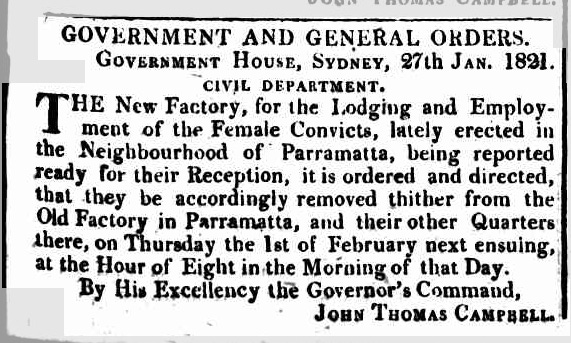
There is a great paper trail on this one, and even a location of the quarry for the stone, incidentally, it was just down the street at Fleet Street Quarry in North Parramatta. No big mystery on funding this when they had free slave labor in the form of convicts to build this thing, and it wasn’t even that big. If there’s something to be suspicious about with convict labor, it’s the question of how they would have had the skills to do it.
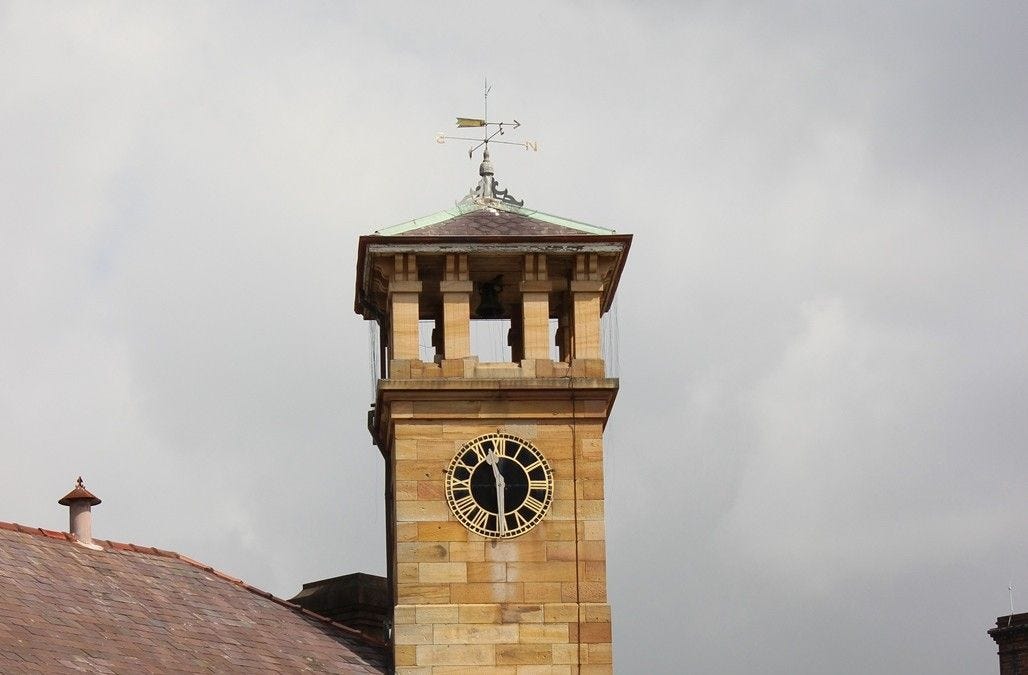
Lucius later brings up the famous clock tower here, which was one of five gifted to the colony by King George IV in 1821. It may seem strange that it wound up at an asylum, but that’s because it wasn’t given to an asylum, it was given to the preceding female factory there, which was one of the largest labor centers in the colony at the time. A clock tower for an asylum seems unnecessary, but for a big important factory center, it seems reasonable to me. Just pointing this out because Lucius shows it, and explains nothing about how it got there, just frames it as more ambiguous “evidence.”
A few more of Lucius’ best examples
A few more, rapid fire. He shows the Richmond/Grangegorman complex that opened in 1814, decades before Kirkbride, which in my estimation appears to be a loose adaptation of Jeremy Bentham’s late 18th century panopticon concept. This complex was a penitentiary and asylum next to one another. Lucius’ best shot at it was to point out the clock tower here uses IIII instead of IV for 4 o’clock, which was a horological convention that appeared on countless old European clocks, and has no standing as Tartaria or reset evidence.
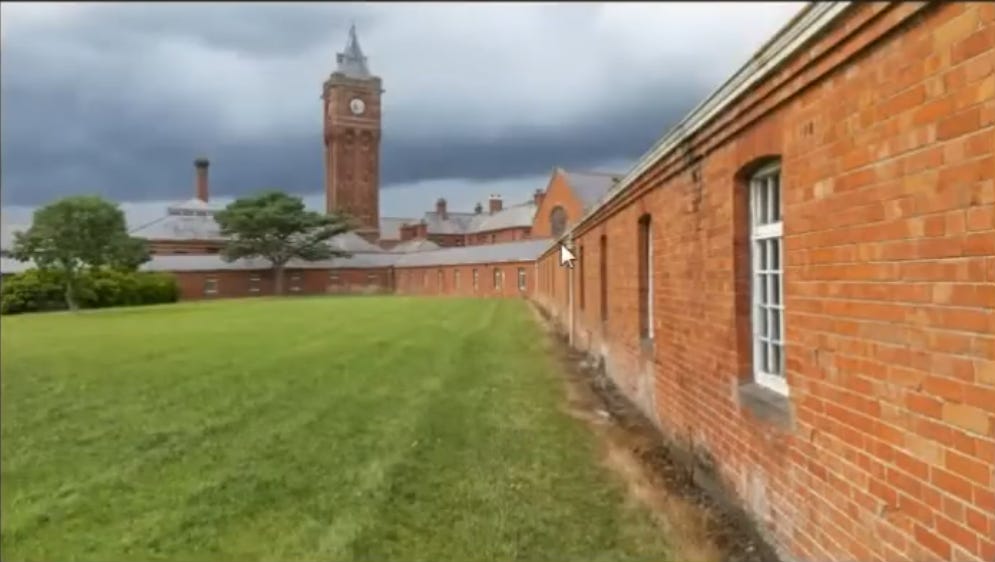
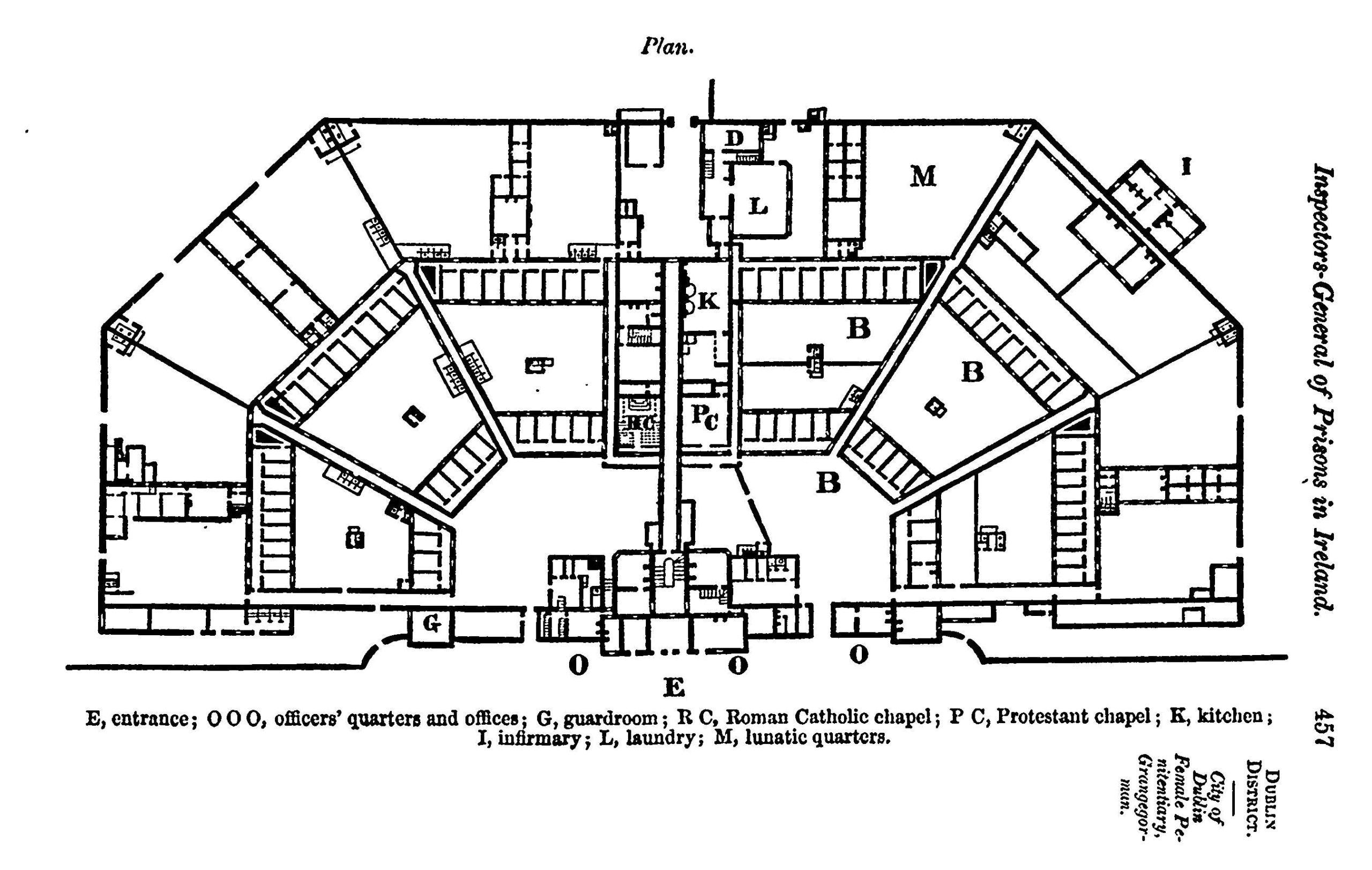
He also brings up “Lawrence Asylum,” which he correctly ID’s as in Ontario, but it’s actually called the Rockwood asylum in Kingston Ontario, built at the head of the St. Lawrence river, a drain pathway for Lake Ontario. Construction began in 1859; patients occupied the main building from 1862, with work continuing to about 1870. Less than 400 miles from Philly, Rockwood was no doubt influenced by Kirkbride, but it’s really still not the same layout, as you see in this 1919 aerial photo.
Rockwood built its asylum the same way Parramatta did, with convict labor from the nearby Kingston Penitentiary, using limestone quarried at the prison. Frontier institutions tended to be built with the labor and materials the state already controlled.
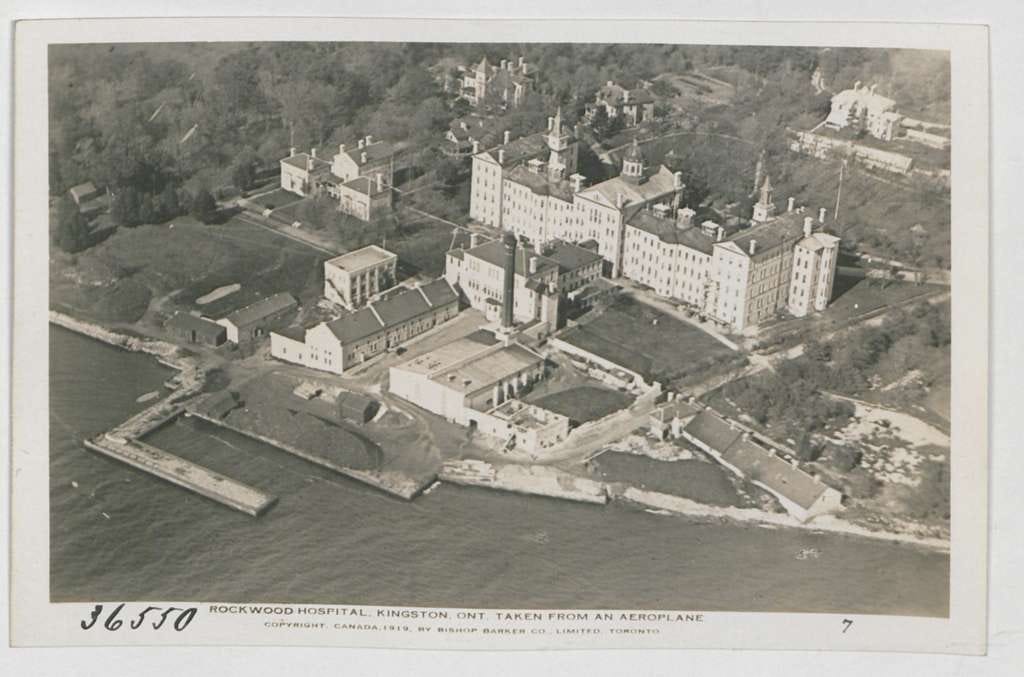
Below is a rendering of Sainte-Anne Insane Asylum in Paris, published in an architectural journal a year after the building opened in 1867. Being in Paris, its lineage is French, not Kirkbride. Lucius’ exact words on it are, “I’m trying to remember… I think this is another Paris one…” He also mentions that it appears to be self-sustaining. That is probably true, and a cool detail, absolutely aligned with the moral treatment / environmental determinism ideology. But it’s not a worldwide plan any more than the Kirkbride movement was a “national effort,” it’s various facilities taking a swing at what they think is the best version of their era’s most up to date intelligence on the problem of housing and curing insane people.
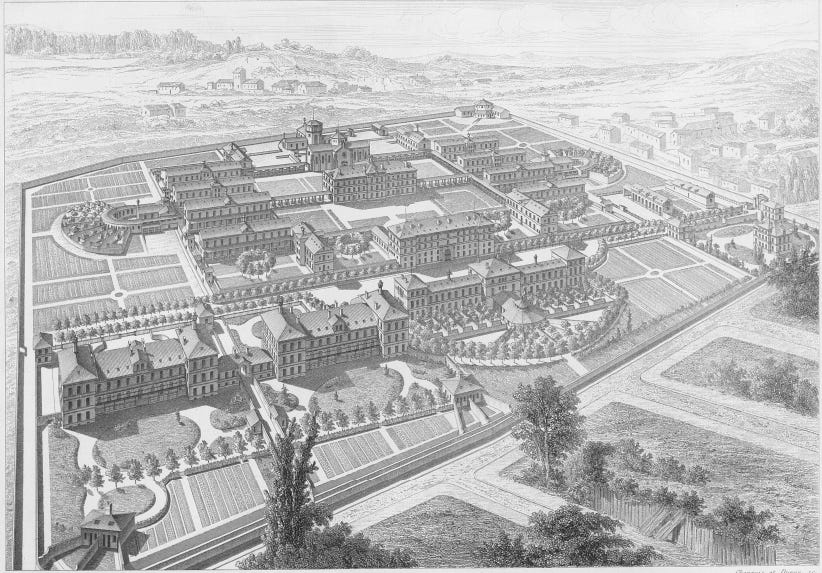
At 52:22 Lucius shows the below image, labels it “another Paris one,” notices it seems “huge,” and then goes on a long Batman tangent with his live chatters and moves on. Very serious research. This is the hospital at Bicêtre, where Pinel is credited with striking the chains off the insane in 1793. The print we see was made by Jacques Rigaud, who died in 1754, which puts the print itself in the first half of the 18th century, roughly 55 years before Kirkbride was even born. Showing a 19th century American architectural plan spreading “across the lands” as he says by providing a French “vue d’optique” dating to the mid 1700s is about as clean of a self-defeat as I’ve ever seen, the image is older than the plan for which he’s calling it evidence by a hundred years.
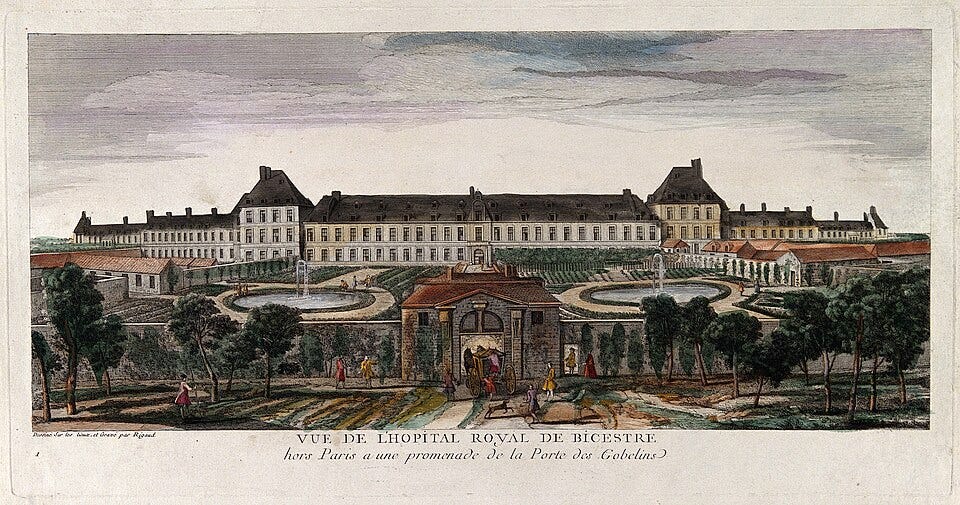
The point of showing these, apart from being interesting in and of themselves, is that Lucius’ own examples turn out to be an English Conolly-plan, a 700 year old ancestor (Bedlam), a convict-era repurposed building, and a Canadian facility that is literally on the opposite riverbank to the United States, his “one worldwide plan for asylums” claim is defeated by the very evidence he shows. Self defeat happens so often with these Tartaria videos that it’s starting to look like a feature, not a bug.
And of course it should go without saying that the Kirkbride plan spreading across the world would require the buildings shown to have been, well, built. That’s fundamentally incongruent with the inherited architecture theory, so you can’t have both.
Australia & New Zealand
Even though I think I’ve done a very thorough job showing that the probability of these asylums having really been built in the 19th century significantly outweighs their proposed secret old world origins, in the spirit of steelmanning the reset theory and being as thorough as possible, I must exercise due diligence with the Australia and New Zealand asylums. Such remote colonies with presumably low populations sound least plausible to me, if I put myself in the reset mindset. Grand stone asylums in young colonies at the farthest edge of the imperial map? It’s genuinely surprising, because these are some of the largest and most expensive houses for the insane in 19th century history.
Callan Park, Sydney and the literal “Kirkbride” building
In 1873, the colonial government of New South Wales bought the 104-acre Callan Park estate in Sydney Harbour to relieve overcrowding at the older Gladesville asylum, which originally opened in 1838 as the Tarban Creek Lunatic Asylum. By 1881, census records counted 751,000 in the whole colony, with 225,000 in Sydney.
The new hospital was designed, in the government’s own words, “according to the enlightened views of the American Dr. Thomas Kirkbride.”
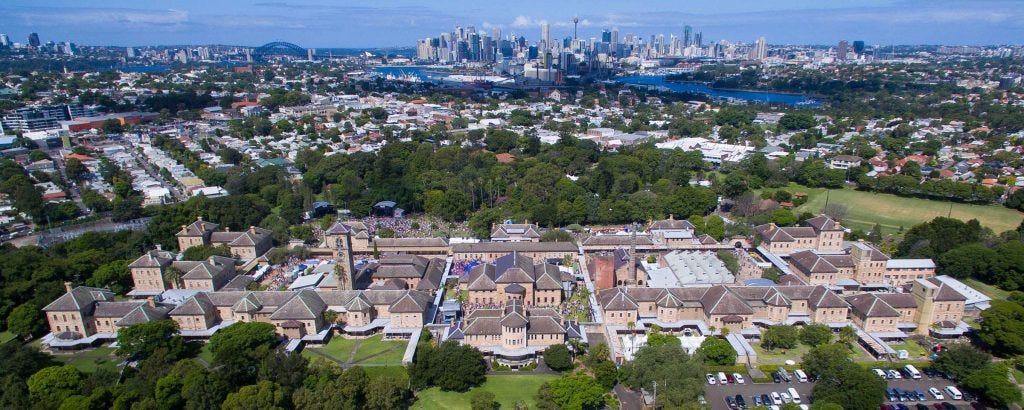
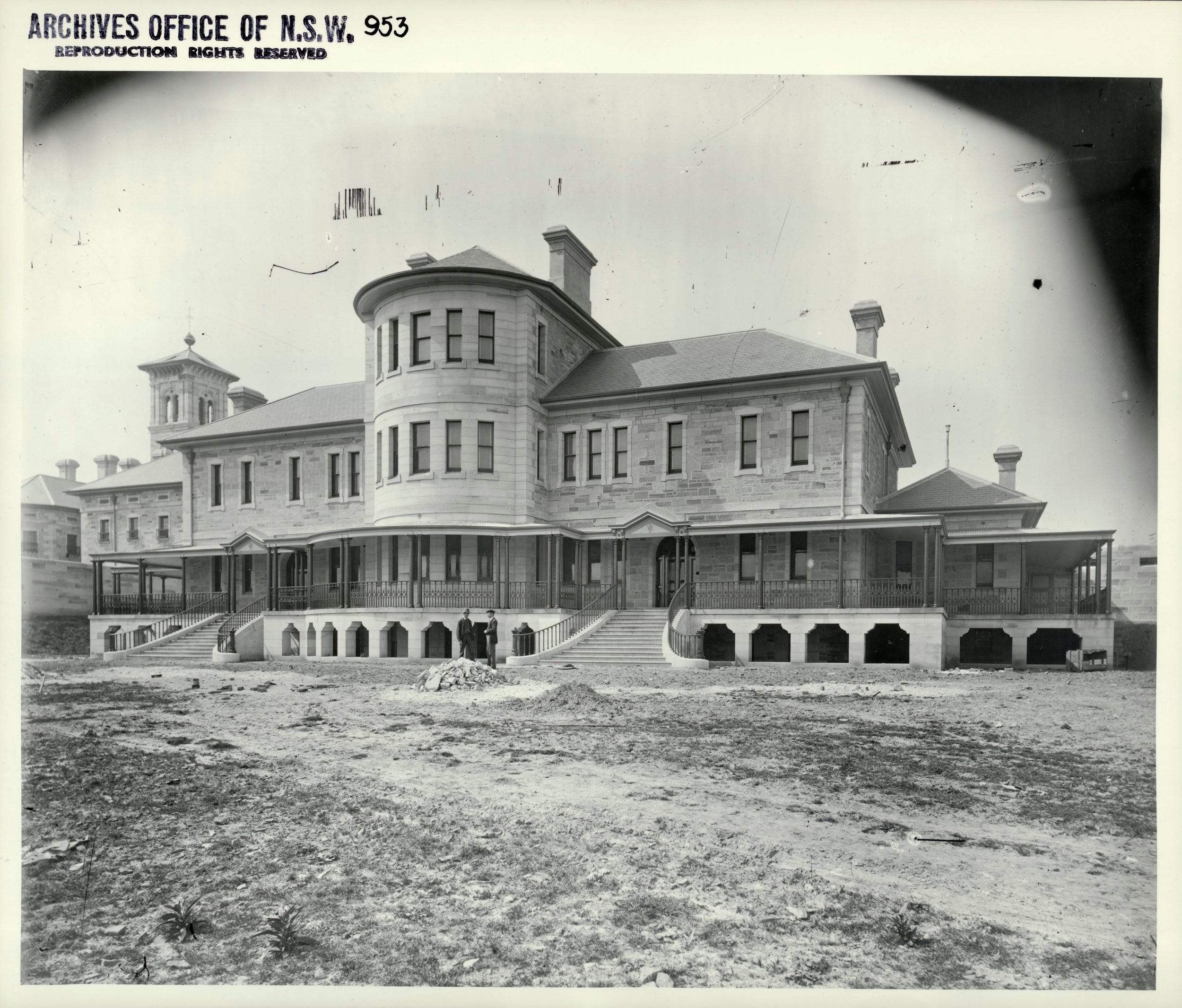
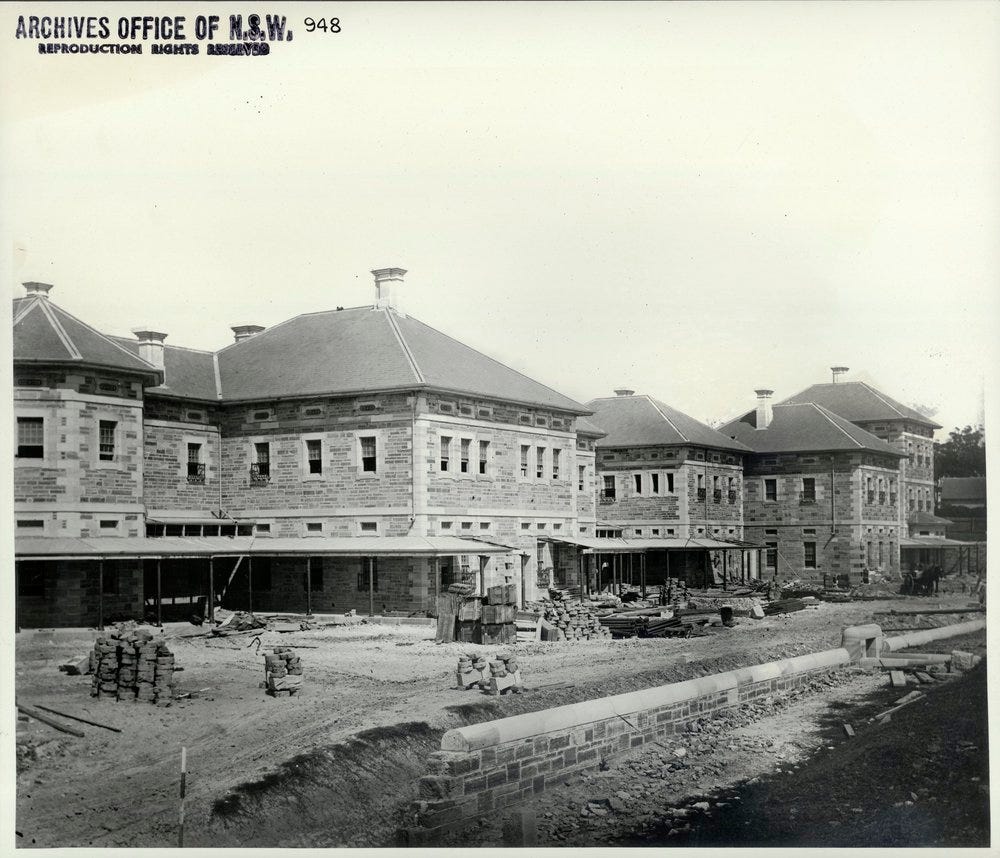
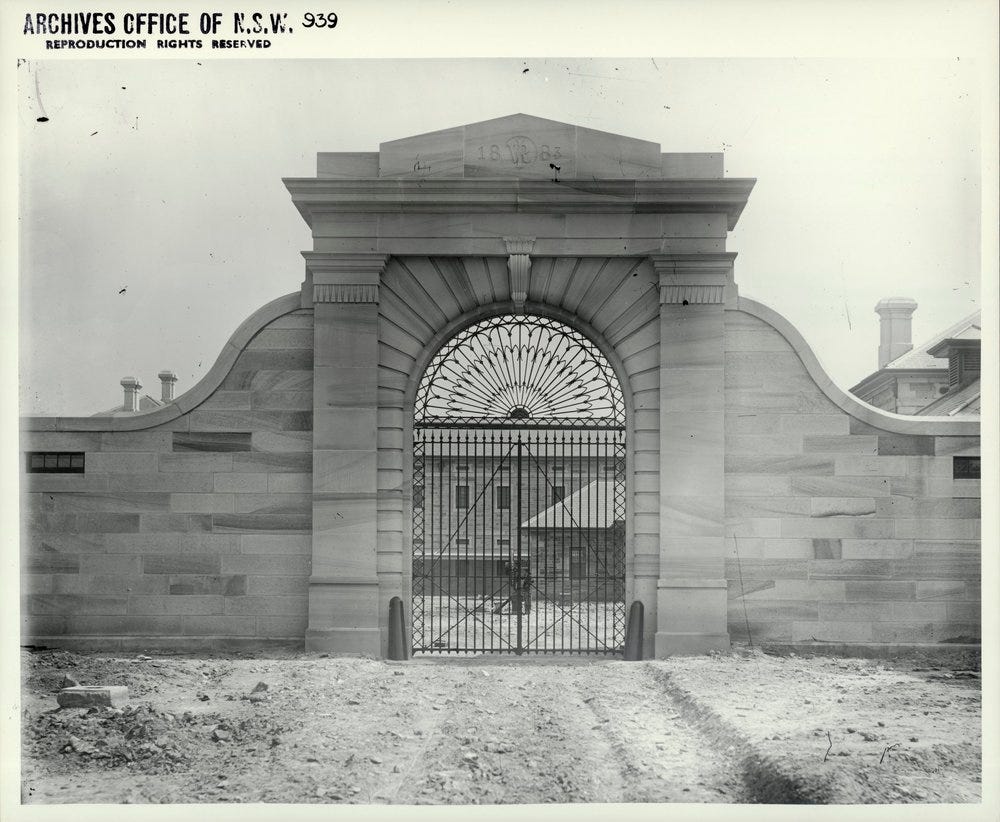
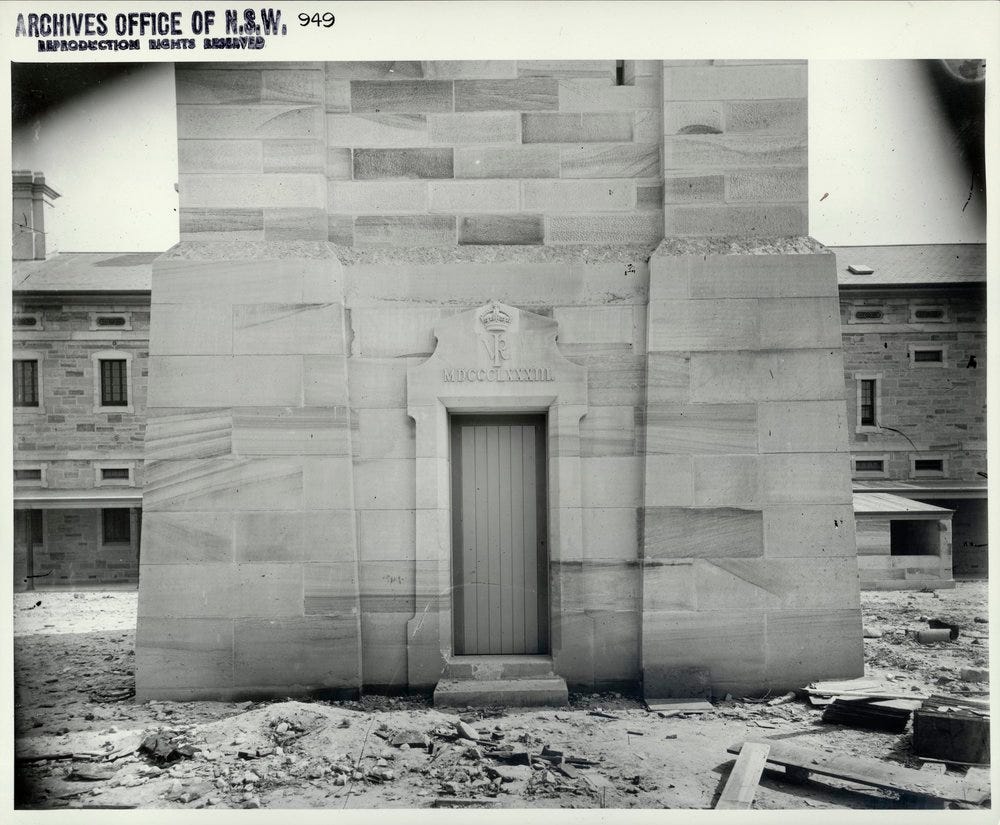
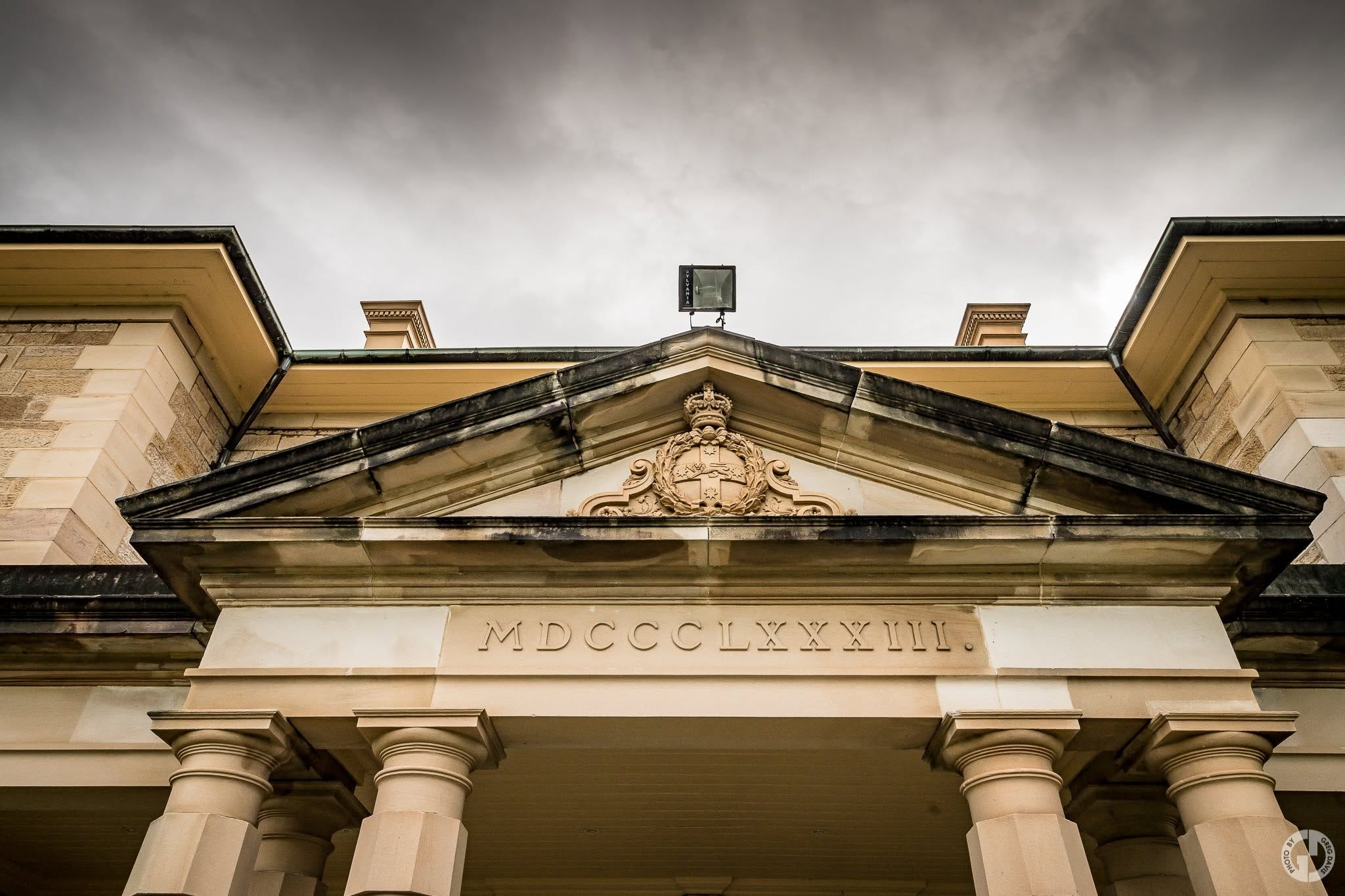
You can see MDCCCLXXXIII in the stone in the final image, which is 1883. This complex is said to be the join work of Architect James Barnet, and the Inspector of the Insane, Dr. Frederic Norton Manning. We already talked about Manning and his asylum tour. Manning was most impressed by Chartham Down Hospital near Canterbury in Kent, and used it as his model because he wanted the pavilion layout: separate ward blocks enclosing open airing courts.
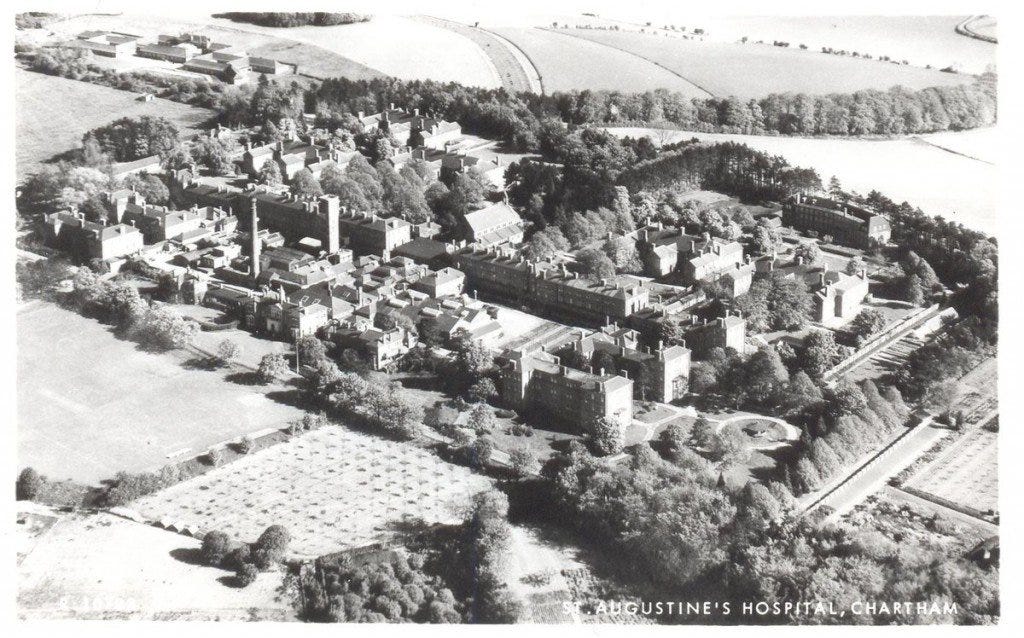
Barnet and Manning built roughly twenty neo-classical sandstone buildings, quarried on site, in a single construction contract running from 1880 to 1885. It was the largest and most expensive public-works project the colony had undertaken to that point, and the recorded price tag was £250,000. A colony with fewer than a million people shelled out its single largest construction budget in its history on an insane asylum. Something like this ought to be documented, because otherwise it’s a very strong candidate for suspicious through the Tartaria/Reset perspective.
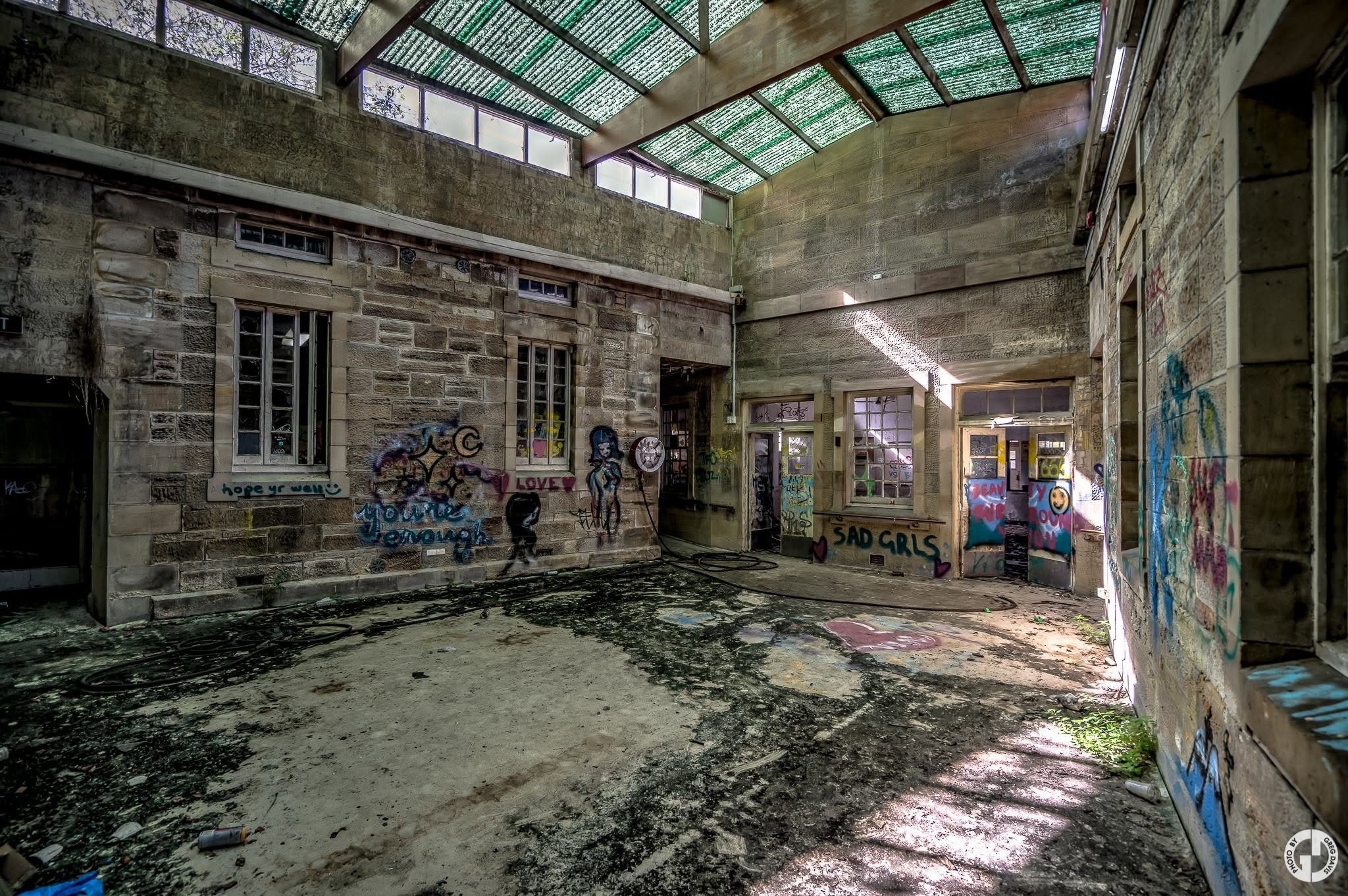
When it was finished in 1885, the complex was named the Kirkbride Block. We finally found an international “Kirkbride.” However, even though it was named for him, it was never a true Kirkbride, it was a pavilion layout, not a shallow-v.
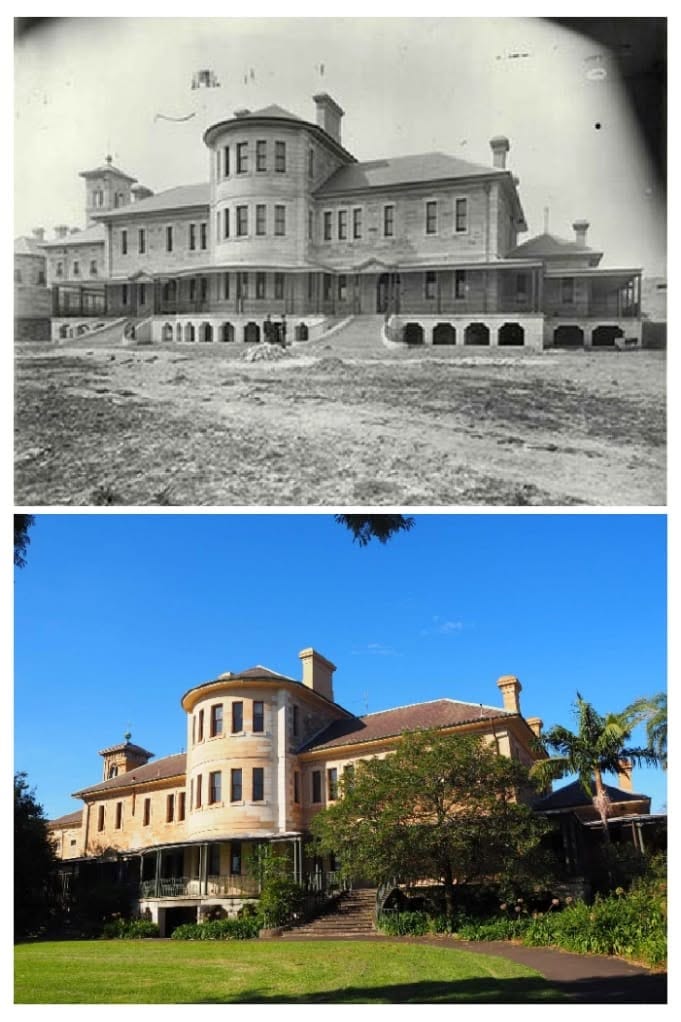
The same general explanation applies to why spend so much: the building was the medicine, same ideology. The cost wasn’t decorative or frivolous, it was clinical. The other thing to consider is the history of the colony from an economic perspective, which American audiences are unlikely to know about.
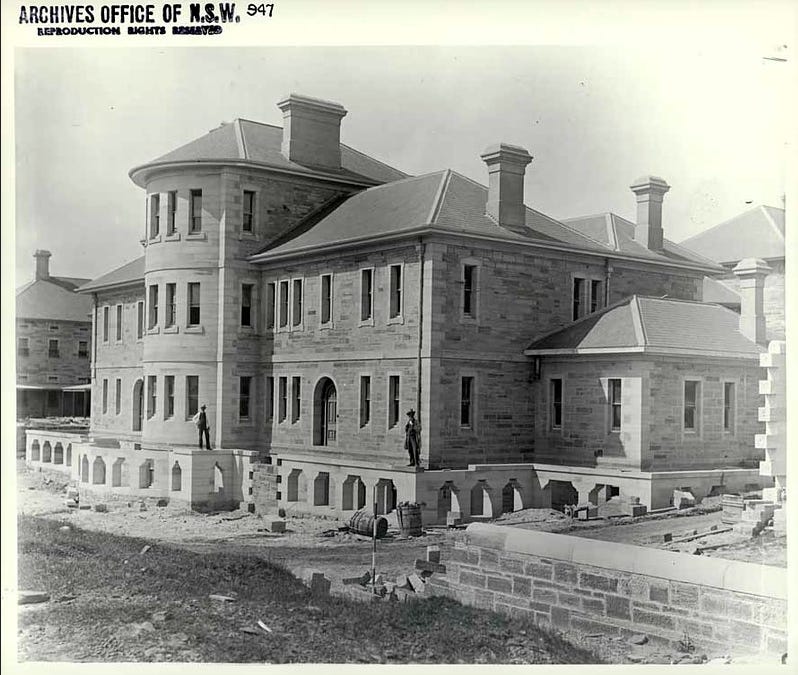
“While the colony of New South Wales was established in 1788 as a penal settlement, it rapidly developed viable capitalist activities and soon experienced a pastoral boom as global wool prices rose rapidly in the early 1830s. Between 1825 and 1859 colonies were established in Western Australia, South Australia, Victoria, Tasmania, and Queensland. The colonial economies were structured around export production, primarily of wool, and were geared to meet the needs of British manufacturing. The boom was financed primarily by British banking capital and flourished as a result of readymade British markets that were pleased to accept imports from the new colonies in place of existing European imports.
The period from the 1860s through to 1890 has been referred to by historians as the First Long Boom. This period was characterized by resumed expansion of wool exports to Britain, by rapid population growth fueled particularly by British non-convict migration, and by high levels of capital flows from British banking and financial sources. A rapid expansion of colonial cities produced an increasingly wealthy urban bourgeoisie that benefited from the growing trade and financial relationship with imperial Britain.”
AUSTRALIAN ECONOMIC BOOMS IN HISTORICAL PERSPECTIVE | Ray Broomhill
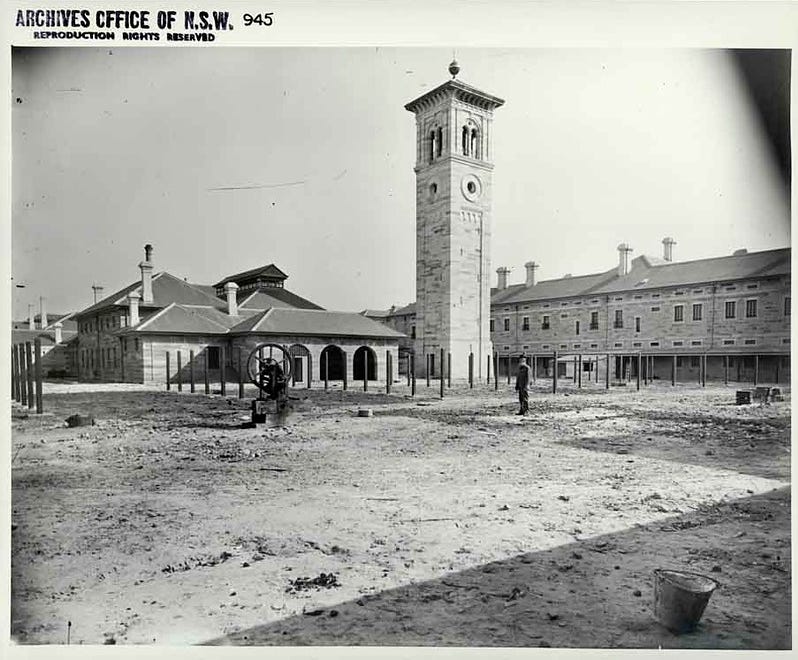
Australia was an export economy with a growing manufacturing base that had endless market opportunities for their wool and precious metal commodities, and that “boom” wealth was hitting its peak when the asylum was constructed. You might ask why a society like this needed asylums, if they were so prosperous.
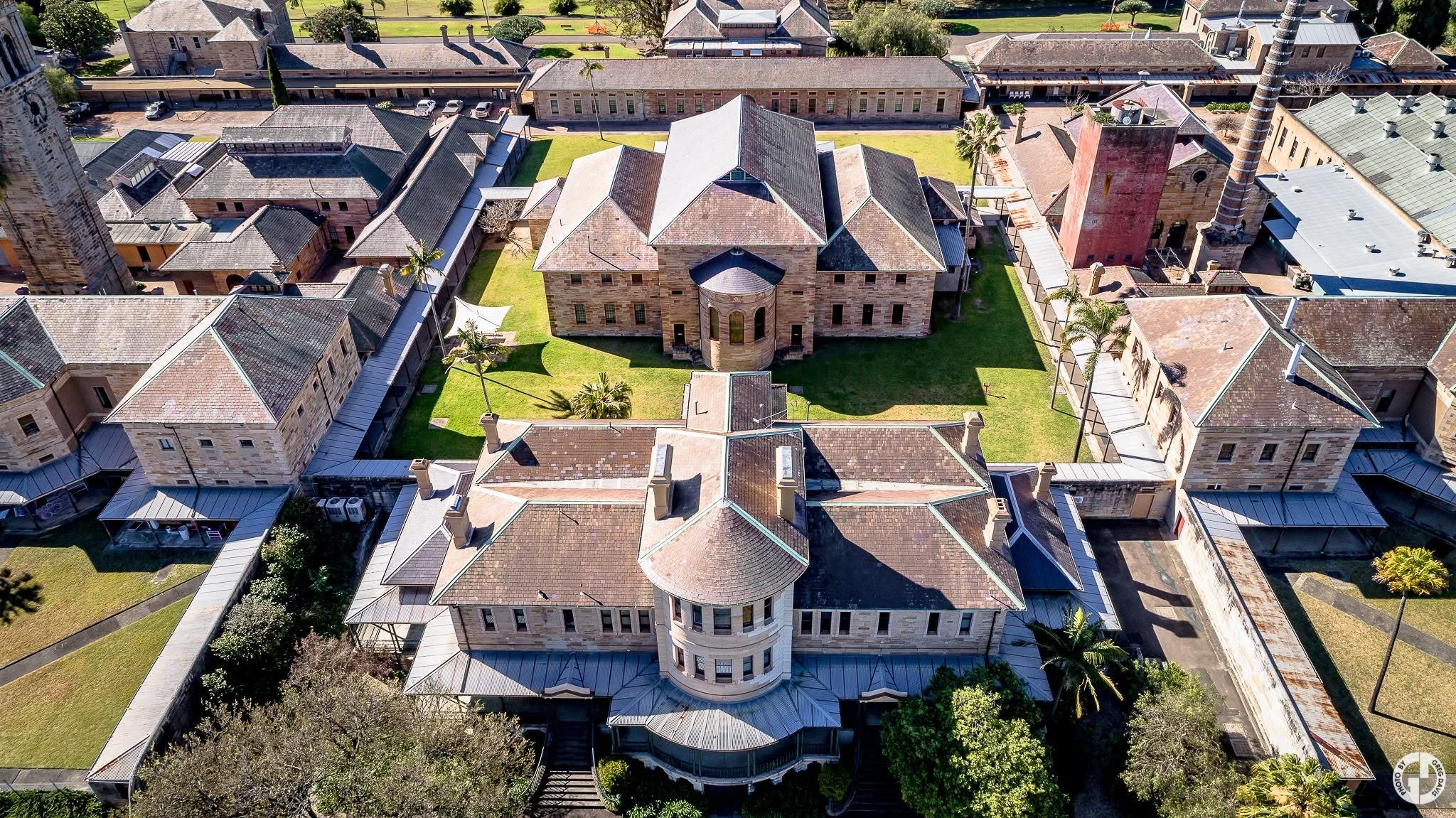
Waves of immigrants during the gold rushes did not always succeed, and many wound up destitute with no families to help them and no means to get back to where they came from. The shattered expectations, depression, and widespread alcoholism made many of these immigrants socially incompatible, with no social programs to aid them apart from being chucked into prison or asylums. And that same lack of support would apply to settlers too, not just the fortune seekers. Some medical theorists of the day hypothesized that being unused to the harsh climate of the colony caused “hereditary weakness” and physical breakdowns in settlers who couldn’t adapt. Whether or not they were correct, the fact that this belief was written about does corroborate the terrain ideology that put such people in an expensive and well landscaped asylum. Victorian society throughout the empire placed heavy emphasis on hard work and virtuous living. Those who failed to succeed or deviated from rigid social conformity were viewed as having a “moral deficiency” or “lunacy.”
So this was a wool-and-gold colonial economy flush with boom money, and a young society anxious to prove itself civilized, with an overcrowded older asylum at Gladesville that had to be relieved. Add in the fact that Callan Park was also built as a teaching hospital for the University of Sydney's medical school on the Edinburgh model (so it was more than just an asylum complex), and the price tag on the "biggest civic project ever" seems more reasonable.
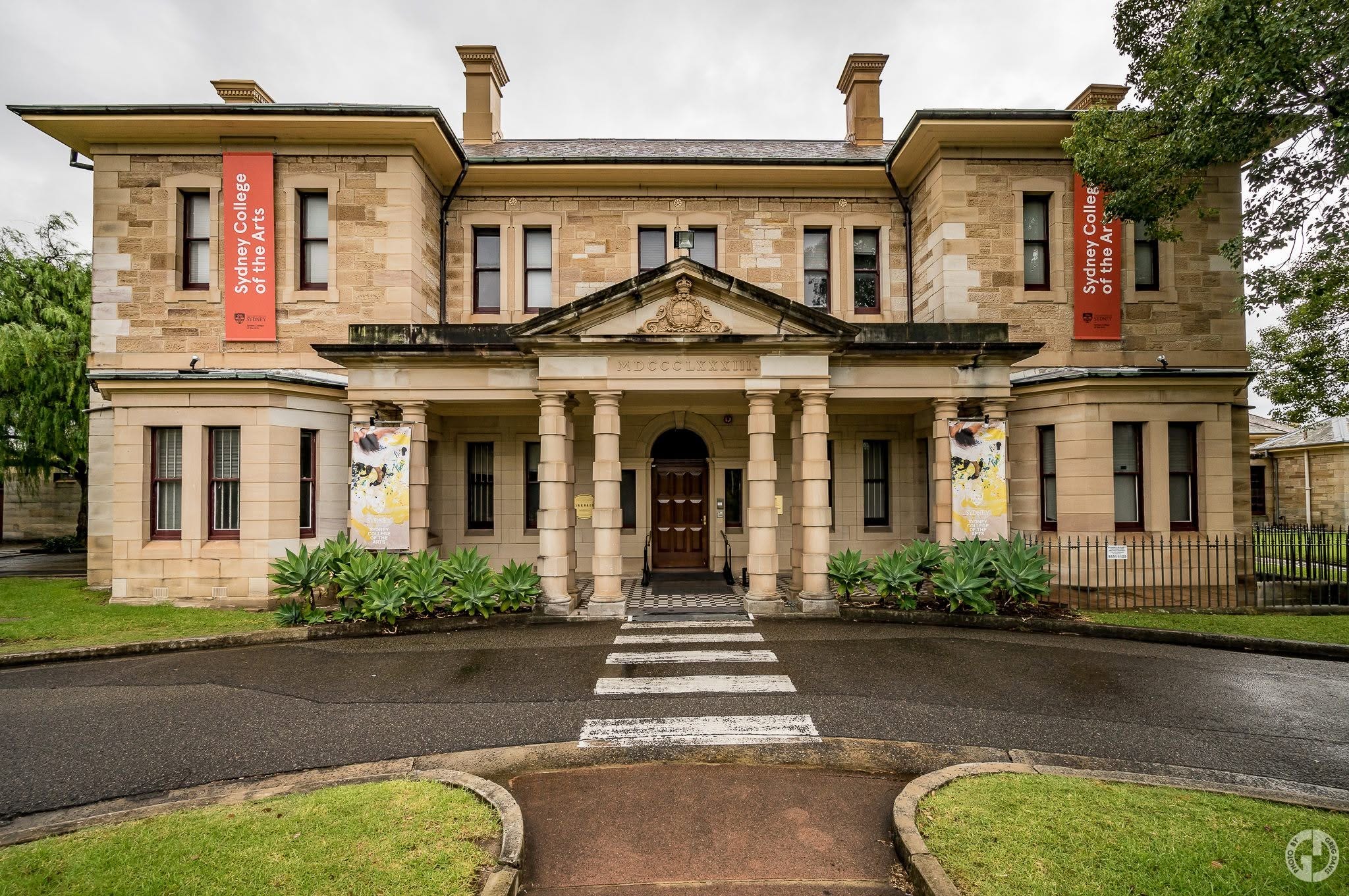
We already discussed Manning’s reception of the ideas that inspired this building and showed the archival copy of his report from touring foreign asylums. Remember when we talked about Iowa’s asylum project in Independence and the 1869 commissioners who advised the governor? In one of their reports, they write: “the British colony of New South Wales… instructed her commissioner… to visit all the chief institutions of the kind in Europe and America.” Iowa knew about the New South Wales study tour and cited it by name. An Australian toured the world’s asylums and Iowans knew about it. These are the kinds of links that I find convincing in the discovery process. If you’re interrogating multiple suspects for a crime, you keep pressing them until their stories don’t add up. If they answer every question and their details corroborate, you have no case against those suspects. That doesn’t mean they’re innocent, but you didn’t prove them guilty. When Tartaria researchers point to a lack of records, they never show those records, or consider how many there are and how well they sync up with each other.
Strangely enough, the Kirkbride Block was originally designed to hold 666 patients across ten ward blocks (five male, five female). I wouldn’t put it past the designers to have stated that number intentionally for some ritualistic reason, but it’s not a falsifiable idea, just a point of interest. To reiterate again, I never intended to take a position that these asylums were purely good and noble, and there was no corruption or dark stuff going on in them. I’m only interested in if they were really built by 19th century people, or already existed. The 666 number never actually held up in practice, by 1890 the asylum was seriously overcrowded at over a thousand patients, and that crowding issue just kept getting worse over the decades. An extermination camp wouldn’t have that problem, they’d just exterminate the excess, wouldn’t they?
To get concrete for a moment, the complex was built of sandstone mainly quarried on site. You can see a close up of what the facade currently looks like below. Sydney is built on top of, and out of sandstone—famously so, so the logistics question for the most difficult part of a build like this, the stone, isn’t as difficult as it seems at first. They had it right on site, which means the only expense is extracting and cutting it, not purchasing or transporting. With such a bulk of their raw material easily procured, they probably were able to budget more for other things. The landscaping was designed by Sydney’s director of Botanic Gardens, Charles Moore.
As for who built it, the old problem of convict labor doesn’t apply here—the transportation of convicts to Australia was ended four generations before this was built, meaning it was built by free, skilled, and paid laborers. I couldn’t find any actual workman’s diaries, but there is a dense record of other construction documentation: the Public Works Department tender and contract system, the NSW State Heritage Inventory and Conservation Management Plans documenting the build, period newspaper coverage, and the paper trail of the design itself (Dr. Manning’s international tour).
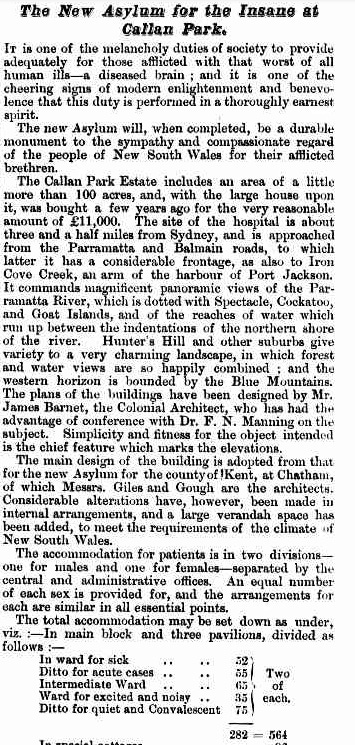
New Zealand
Looking at asylums in New Zealand from this period also feels somewhat anachronistic from the Tartaria lens. Below are the Sunnyside and Seacliff institutions.
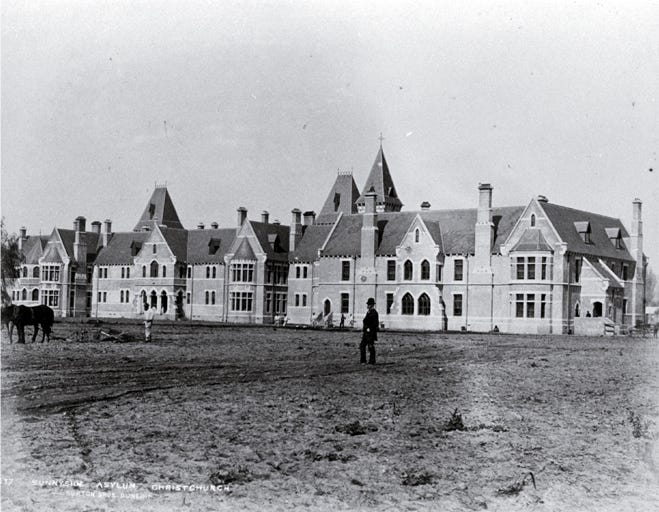
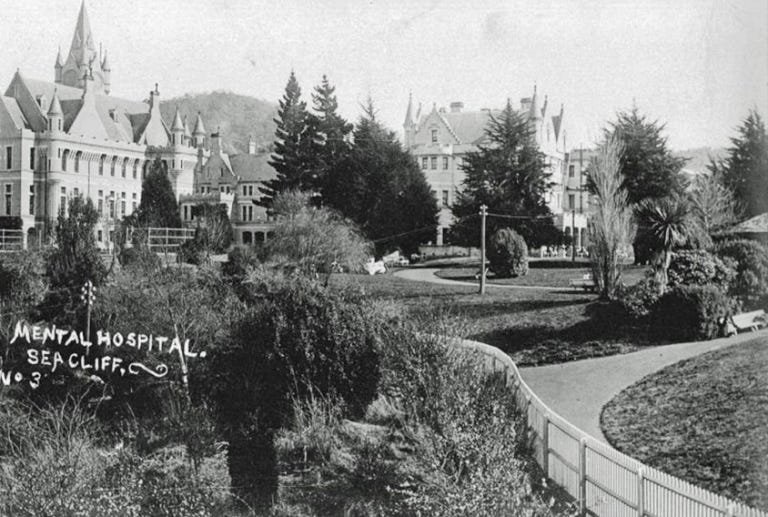
New Zealand apparently built many asylums, most of them fairly small and domestic. Looking at Seacliff, we get a similar story as Callan Park: it was the biggest building in the colony at the time it was built. According to the country's own national encyclopedia, in the 1860s and 1870s provincial governments established small purpose-built asylums, usually on the edge of the provincial capitals, to encourage community involvement and farming activities. Karori, near Wellington (1854), Dunedin and Sunnyside, Christchurch (1863), the Whau, Auckland (1867), Seaview, Hokitika (1872), and Nelson (1876), followed by the next generation of buildings in more remote areas and much larger: Seacliff, near Dunedin (1879), and Porirua, near Wellington (1887) (Te Ara Encyclopedia of New Zealand). That's roughly a dozen documented institutions, on the record, across sixty years. But again, most were not large: Sunnyside started out with only 17 patients, and the building shown above for Sunnyside was an 1891 construction.
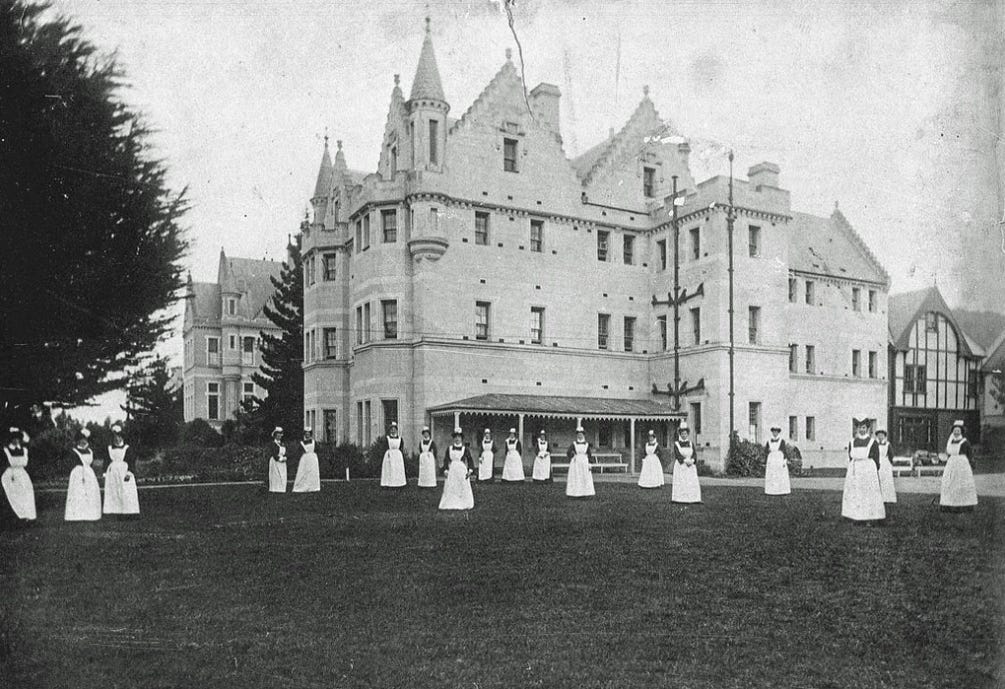
Population-wise, there are said to have been half a million non native settlers in 1881, many of whom came for gold.
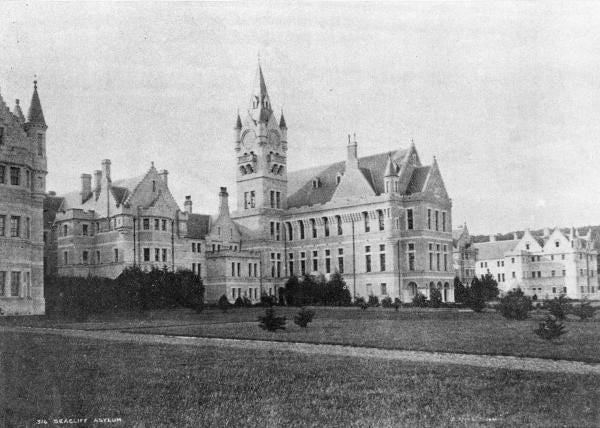
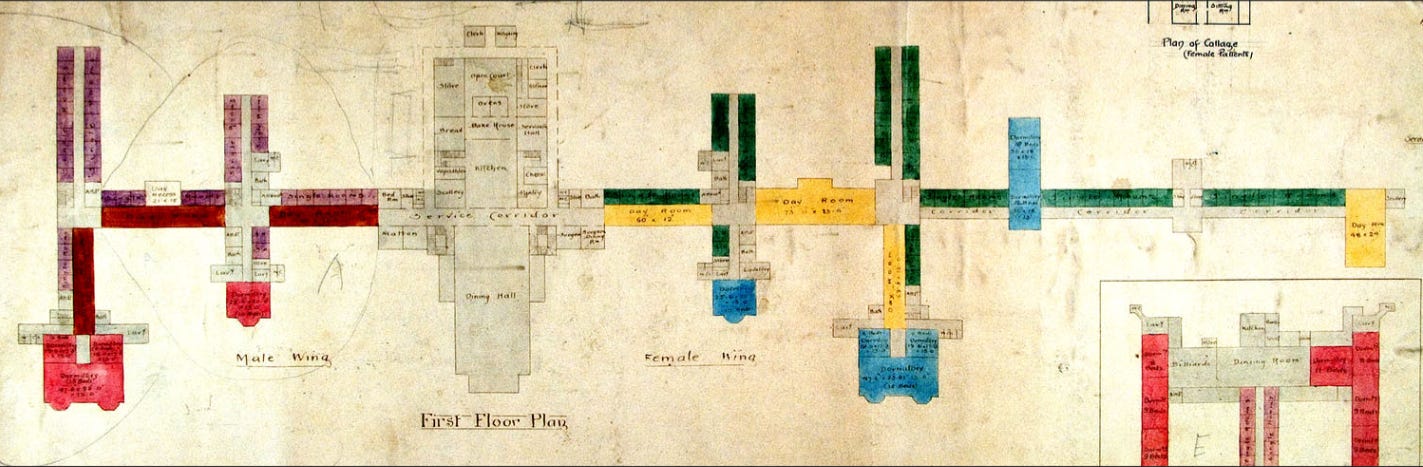
Seacliff had a much smaller price tag, but still quite high at $78,000. Work began in 1878 in "dense trackless forest," even though the Director of the Geological Survey criticized the site location, because he felt that the hillside was unstable, and by 1885 the instability was formally noted to "threaten complete destruction."
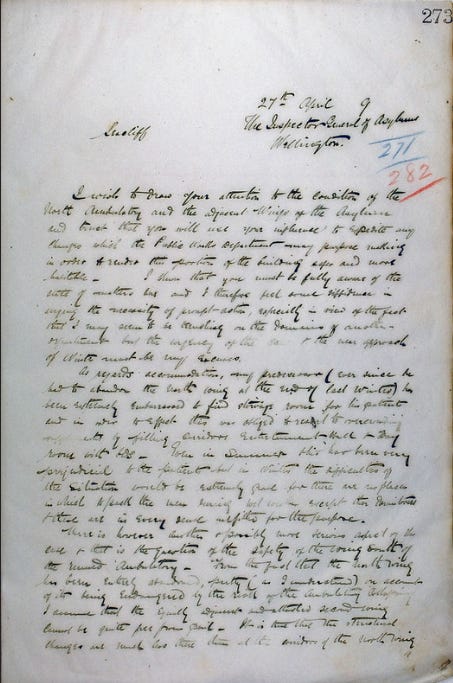
It was built partly by patient labor, which answers "who built these" and explains the structural failure at the same time. When it opened, the main building was still being constructed, largely by unskilled patients already living at Seacliff, and the structural problems that followed were tied to the lack of professional builders involved in their construction.
After an 1887 landslip wrecked the north wing, an 1888 commission was convened, and all involved in the construction, including the contractor, the head of the Public Works Department, the projects clerk of works and Lawson himself gave evidence under oath. The inquiry found the architect Lawson ultimately responsible, and 'negligent and incompetent,' which ruined his career. That is a first-hand account of construction, under oath, preserved in a government inquiry.
So New Zealand is not one strange building you have to explain away. It's a documented, decades-long, English-derived institutional program, with named architects, government reports, and sworn testimony about how the stone was laid.
Conclusion: “For Entertainment Purposes Only”
Why do some of the most popular channels in the Tartaria/Reset genre copy the same boilerplate disclaimer, about being non-factual and for entertainment purposes only?


I’ll leave it up to you to think about.
Sources:
This Series
Prior Asylum episode — Inner Whirled 26: Tartaria & 1800s Insane Asylums
Primary — The Kirkbride Plan & American Asylum Architecture
Kirkbride, 1st ed. (1854) — On the Construction, Organization, and General Arrangements of Hospitals for the Insane
Kirkbride, 2nd ed. — On the Construction… Hospitals for the Insane (Trenton NJ passage)
Notman drawings (1848/49) — The American Journal of Insanity (HathiTrust)
Alienist and Neurologist — Journal volume (Archive.org)
Primary — Moral Treatment & Its European Lineage
Pinel (Eng. tr. 1806) — A Treatise on Insanity
Samuel Tuke (1815) — Practical Hints on the Construction and Economy of Pauper Lunatic Asylums
Esquirol (1838) — Des maladies mentales considérées sous les rapports médical, hygiénique et médico-légal, Tome 2. Paris: Baillière. The “instrument of cure” doctrine is at p.398. Digitized by the Wellcome Collection (Wellcome b-number b33287612), viewable via Archive.org.
Esquirol (Eng. tr. 1845) — Mental Maladies: A Treatise on Insanity, trans. E. K. Hunt Hunt’s translation omits the architecture chapters — relevant to your point about the doctrine’s transmission.
Doctrine corroboration — British and Foreign Medical Review 9, no. 17 (Jan 1840): 145 (PMC)
John Conolly (1847) — The Construction and Government of Lunatic Asylums and Hospitals for the Insane. London: John Churchill. Conolly abolished mechanical restraint at Hanwell; the treatise circulated his ward plans. Full text on Archive.org and Wellcome Collection.
Primary — U.S. Legislative, State & Federal Records
Pierce veto (May 3, 1854) — Veto Message on the indigent-insane land bill
New Jersey (1846) — Votes and Proceedings of the 69th General Assembly — Kirkbride consulted
New Jersey (1845) — 69th General Assembly — prior-year need documented
Missouri (Jan 3, 1849) — Report of the Commissioners to Locate a Lunatic Asylum
Missouri Senate Journal — 15th General Assembly Appendix (1848/49)
Missouri Senate Journal — 16th General Assembly Appendix, pp. 134–137 (1850/51)
Missouri DMH — History of Mental Illness (Gov. Reynolds context)
Iowa (1869) — Report of the Joint Committee… Hospitals for the Insane, Independence & Mt. Pleasant
California (1871) — Wilkins, report on insanity & the insane asylum (149 institutions)
Primary — Newspapers & County Histories (Independence, IA)
Buchanan County Bulletin — Apr 17, 1868 — courthouse asylum meeting (LOC)
Buchanan County Bulletin — May 1, 1868 (LOC)
Buchanan County Bulletin — May 29, 1868 — subscription appeal (LOC)
Fergus Falls — Minnesota Historic Property Record: Fergus Falls State Hospital (PDF)
Independence, IA — Report of Commissioners for the Erection of Buildings for an Insane Asylum (PDF)
Buchanan County (1881) — History of Buchanan County, Iowa (PDF)
Buchanan County (Chapman) — History of Buchanan County, Iowa (PDF)
Brick Making and Iowa Geology
Iowa Geological Survey regional Quaternary/bedrock reports (glacial mantle thickness; Winthrop Till Member description)
Iowa DNR, “Iowan Surface” geology page (glacial boulders across Buchanan County)
“The Clay Brick and Tile Industry” history (300+ Iowa brick/tile works by the 1920s)
SAH Archipedia, Iowa State Hospital for the Insane entry (limestone exterior, granite base)
Patient Experience & Recovery Statistics
Pliny Earle (1887) — The Curability of Insanity
Pliny Earle (1841) — A Visit to Thirteen Asylums for the Insane in Europe (Library of Congress)
Patient memoirs — Kent State University — Insane Asylum Memoirs archive (incl. Ruutz-Rees / Morristown) Verify the exact Ruutz-Rees memoir citation against this collection before quoting.
Quaker burial discipline — Swarthmore College — Philadelphia Quaker burials (gravestone testimony of simplicity)
Photography & Image Provenance
Bethlem gates (1896) — The Queen’s London (Cassell, 1896) — Victorian London text archive
Bethlem provenance — Harriet Richardson, “Building Bedlam” — Historic Hospitals
Bethlem provenance (cont.) — Harriet Richardson, “Building Bedlam Again… Monks Orchard” — Historic Hospitals
Sainte-Anne (Paris) — C.-A. Questel, “Asile d’aliénés de Sainte-Anne… Vue à vol d’oiseau,” Revue Générale de l’Architecture, 4th ser., vol. 34 (1877), pl. 36. An architect’s own presentation drawing, published a decade after the 1867 opening. Viewable via Gallica (BnF).
Bicêtre (Paris) — Jacques Rigaud (c.1681–1754), “Vue de l’Hôpital Royal de Bicêstre… Porte des Gobelins.” Hand-colored vue d’optique. Rigaud died in 1754 — the print predates Kirkbride’s birth by ~55 years. Public-domain scan via rawpixel.
Buffalo State / Richardson — Historic images of the Richardson Olmsted Campus (Wayback)
The Mass Graves
Asylum Hill Project — Official project site (Mississippi State Lunatic Asylum, Jackson)
PBS — Mysteries of Mental Illness, “The Asylum Hill Project” (records reveal how they died)
SuperTalk Mississippi — $3.7M to exhume graves (graves originally marked; wood rotted)
Jackson Free Press — 7,000 bodies (individual coffins; pellagra & syphilis findings)
Live Science — ~7,000 estimate; ground-penetrating radar
Atlas Obscura — Central State Hospital, Milledgeville (25,000; markers thrown into woods)
The Moonlit Road — Central State Hospital (1960s inmates tossed numbered markers; locations unrecorded)
Visit Milledgeville — Central State Hospital campus (1997 restoration; national memorial movement)
Deseret News — Utah 485 patients; 2018 monument; ages/causes documented
History of Massachusetts — Danvers State Hospital cemetery (numbered ≠ unmarked; identities partly known)
Milledgeville (scholarly anchor) — Mab Segrest, Administrations of Lunacy: Racism and the Haunting of American Psychiatry. New York: The New Press, 2020. Strongest single source for the Milledgeville cemetery-restoration history if you want it peer-reviewed.
The Honest Dark Record — Wrongful Commitment & Abandonment
Elizabeth Packard — Committed 1860 on a husband’s word; declared sane by jury 1864; reform laws followed
Nellie Bly (1887) — Ten Days in a Mad-House — Blackwell’s Island exposé; forced a grand-jury investigation
Greystone Park (Morristown) — Built for hundreds; 7,700+ patients at early-1950s peak; deinstitutionalization & decay
Canada — Rockwood Asylum (the Convict-Labour Parallel)
Museum of Health Care — Curative Architecture: The Healthful Design of Rockwood Asylum (daily convict gangs from 1859; penitentiary limestone)
Providence Care Archives — The Rockwood Lunatic Asylum is Established (convict labour; occupied 1862)
Stones Kingston — Penitentiary Stone Quarry (quarry methods; contract trades from 1849; inmate gangs built Rockwood)
Australia — Callan Park / Kirkbride Block
NSW & Sydney population (1881) — Census of the British Empire 1881 — State Library of NSW
NSW Census 1881 — Full report (population tables)
Asylum Projects — Callan Park Hospital for the Insane (capacity, ten wards, on-site sandstone)
Friends of Callan Park — History (materials: sandstone, slate, timber floors, copper downpipes)
Dictionary of Sydney — Callan Park Mental Hospital (Manning; Chartham Down drawings 1876; £12,500 site)
7 Day Adventurer — The Kirkbride Experiment (£250,000; largest colonial project; 33 buildings; Garton citation)
Lost Collective — Callan Park (“cemetery for deceased intellects”; ha-has; capacity vs. 1930 overcrowding)
University of Sydney — Faculty of Medicine Museum — Callan Park as teaching hospital (Edinburgh model)
Callan Park (capacity detail) — Maori Rock Carvings / Callan Park (designed for 666; 1,078 by 1890)
Inner Sydney Voice — “The ghosts of Callan Park” (the anonymous-graves folklore)
Callan Park (heritage overview) — Wikipedia — Callan Park Hospital for the Insane (Hawkesbury sandstone; heritage listing)
Kirkbride Block photos — Wikimedia Commons — “Kirkbride Block” category
F. N. Manning (1868) — Report on Lunatic Asylums — Wellcome Collection
F. N. Manning (bio) — Manning, Frederic Norton — Australian Dictionary of Biography
Francis Greenway — Convict architect who designed the Parramatta Female Factory (answers “who built these”)
Parramatta (NSW) — Fleet Street Quarry, Parramatta North — City of Parramatta
Free-labour context — Australian Trade Union Institute — 1856 stonemasons’ eight-hour day (Sydney building trades)
Period newspaper coverage — Trove — National Library of Australia
New Zealand — The Asylum Chain & Seacliff
The chain (national encyclopedia) — Te Ara — “Lunatic asylums, 1840s to 1900s” (full list; farming/self-sufficiency policy)
Population (1881) — 1881 New Zealand census (Otago the most populous province; gold-rush growth)
Institutions list — Asylum Projects — New Zealand (Karori, Whau, Seaview, Nelson, Porirua, Tokanui, etc.)
Mount View (Wellington) — Wikipedia — Mount View Lunatic Asylum (1873)
The Whau (Auckland) — Auckland History Initiative — “Constructing the Asylum at the Whau” (English design, local rework & build)
Porirua — Porirua Hospital Museum — Origins (1844 Wellington tender; railway-served self-sufficiency)
Seacliff (core record) — Wikipedia — Seacliff Lunatic Asylum (surveyor’s warning; 1888 inquiry testimony; “negligent and incompetent”; 1942 fire)
Seacliff (heritage listing) — Heritage New Zealand — Seacliff Lunatic Asylum Site (List no. 9050)
Robert Lawson (architect) — Wikipedia — R. A. Lawson (design from 1874; largest building in New Zealand)
The Spinoff — “The story of Seacliff” (patient labour; landslip; Lawson’s ruin)
Otago Daily Times — “The rise and fall of Seacliff” (Burton Bros photo c.1890, Te Papa C.011906; drawings at Hocken & National Library; 1885 “threatens complete destruction”)
Seacliff photograph — Te Ara — Seacliff lunatic asylum (Hocken Collections)
Casebook photographs — Isolating Madness: Photographs from Seacliff Lunatic Asylum, 1887–1907 (VUW thesis)
Seacliff (closure/ruins) — Atlas Obscura — Seacliff Asylum Ruins (Truby King; closed 1973; Gothic/Scottish Baronial)
Audience Claims Investigated (Wisconsin)
“Records were destroyed” — CBS 58 — Discovered documents reveal more about the Milwaukee County Insane Asylum (records assumed destroyed since before 1940 actually survived in a basement)
Records-retention law — Wisconsin Admin. Code DHS 92.12 — mental-health treatment records retention (a minimum, not a destruction order)
Archival preservation — Wisconsin Historical Society — access to state agency records (confidential records preserved, sealed 75 years, not destroyed)
General Reference
Moral treatment — Wikipedia
Salpêtrière — Wikipedia
Tony Robert-Fleury — Wikipedia (Pinel-freeing-the-insane paintings)


