

There's one obvious question about the Tartaria old world reset theory that nobody in the genre wants to answer: if settlers really walked into cities that were already standing, somebody's ancestor saw it happen. So where are the accounts?
Watch the free half of this podcast on Youtube
BECOME A PAID MEMBER TO UNLOCK THE FULL VIDEO EPISODE
🔓 Support the podcast and get access to double length episodes by becoming an InnerVerse Plus+ member.
A viewer named Jack left a comment on the Luminary Lighthouse channel claiming his family had exactly that story, a high-ranking Mason ancestor sent to populate a Kansas town that was already fully built out, granite buildings, a capitol in the center, and a hidden journal to prove it. Logan invited him on for a live stream to tell it in full.
I checked every claim these guys made, and the fibbs piled up higher than a cataclysmic mudflood....
FULL SHOW NOTES BELOW THE PAYWALL
Remote Biofield Tuning sessions with Chance are available via Zoom. Learn more and book at https://www.innerversepodcast.com/biofield-tuning
SUPPORT INNERVERSE WITH AFFILIATES
Tippecanoe Herbs (coupon code ‘innerverse’)
The Sonic Slider: World’s Best Tuning Fork
Jack Crowley and Council Grove
I’ve had a few messages back and forth with Logan from a channel called Luminary Lighthouse, and he seems like a nice enough guy. He complimented my work on the asylums, which I appreciate. What follows is not any kind of personal vendetta or desire to take Logan down, it’s just an analysis of something that caught my eye. While I’m not up to speed on nearly all his videos, one stood out and warranted closer look. In the video titled, “Did Jack’s Masonic Great-Grandfather help FOUND an Entire Kansas Town?”

I have always wondered about how Tartaria / Old World Reset theory deals with the fact that nobody passed down any stories of this pre-built, empty civilization. So when I saw this, I had to check it out, because here we have a claim of just such an account, and I wanted to know if there is any possible truth to it.
A viewer named Jack Crowley leaves a comment on a Facebook post for Luminary Lighthouse, and says his family has a story about his father’s great-grandfather, who founded a town in Kansas in 1840. In this tantalizing comment, Jack says this ancestor “was the major for about 25 years because he was well loved by everyone.” I assume that was supposed to be Mayor. He goes on to say “A hidden journal found written by him said being commissioned a high mason in New York was asked to populate a new town that was fully built out. 75 or so people were guided to the middle of Kansas to a built out town that had no one living there. Granite buildings a capital type building in the middle. He said there were so many buildings not one home was built…. for over twenty years.”
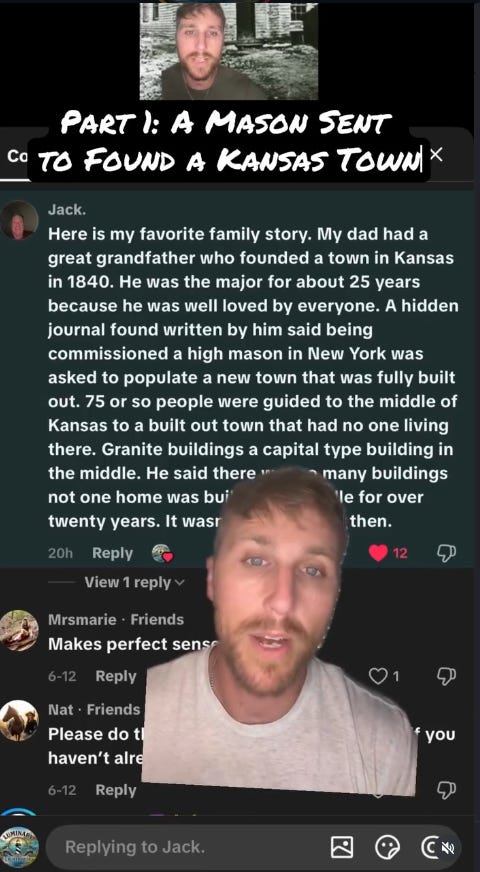
The grammar is as inconsistent as Jack’s story, as we’ll find out. Now, if I was this Logan fellow, I would jump on this comment and ask for more information. Does the hidden journal still exist? What was the ancestor’s name? What town was it? Let’s track the details given in this initial account:
Jack’s Great-Great Grandfather (his father’s great-grandfather)
Founded a “built out” town in Kansas in 1840
He was a “High Mason” in New York (No such rank exists, perhaps he meant Master Mason).
75 or so people were led to this town with so many buildings that no new houses were built for over 20 years.
These were granite buildings, and a “capital type” building was in the center of town.
This would be very compelling stuff, if it was true. Luminary Lighthouse (Logan) then invites Jack to do a livestream with him to recount his family stories, which is the video I linked above. It’s over 100 minutes long, but the parts that actually pertain to this initial story Jack commented are pretty brief, so let’s check them out in clips.
Which Granddaddy was it?
As you can see in the clip above (around 14 minutes in), we’re seeing confusion between the host and the guest about which ancestor this story is actually about. Is it his great-grandfather, or great great grandfather? When we look into the actual genealogy, this is important, because the dates of these historical Crowley’s don’t match up with the rest of the story.
Also, in this clip Jack very clearly says “my grandfather told me about his father.” That means Jack is referring to his great-grandfather. But in the original Facebook comment that got Logan’s attention in the first place, Jack wrote ““My dad had a great-grandfather who founded a town in Kansas in 1840.” So we’ve barely begun the dialogue and already Jack is contradicting his own original story. You can see why Logan is confused by how many greats they’re talking about, because he’s been told two different things.
In this video, the gentlemen assert that the town in question is Council Grove, in Morris County, which was (according to Jack) already built out, with granite buildings and a capitol style building. Later in the video, they name this “high mason” ancestor who supposedly founded the town: JJ Crowley. The first thing I did was look for any records of JJ Crowley, and found a page with information on cemeteries in Morris County, run by the county historical society.
There I found a PDF with information on Council Grove cemeteries.
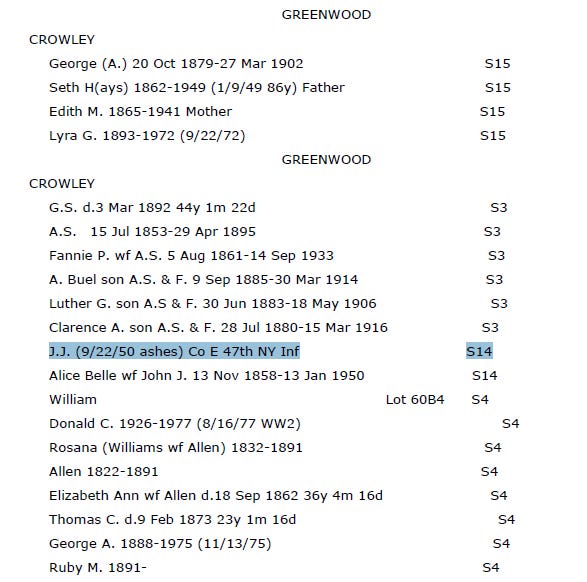
I found it interesting that one of these Crowleys was named Seth Hays Crowley, and he appears to have been named after the historical first settler to the area. Hays was the first to build there, in 1847.
From Legends of Kansas: Hays built a log cabin on the north side of the old Santa Fe Trail near the west bank of the Neosho River, close to where the Commercial House later stood. The cabin served as both a store and a dwelling, which housed Hays and his African American slave named Sarah Taylor, who was familiarly called “Aunt Sally.”
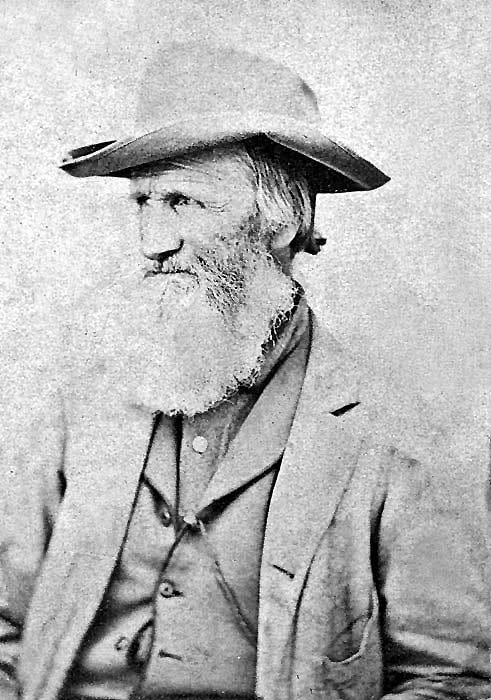
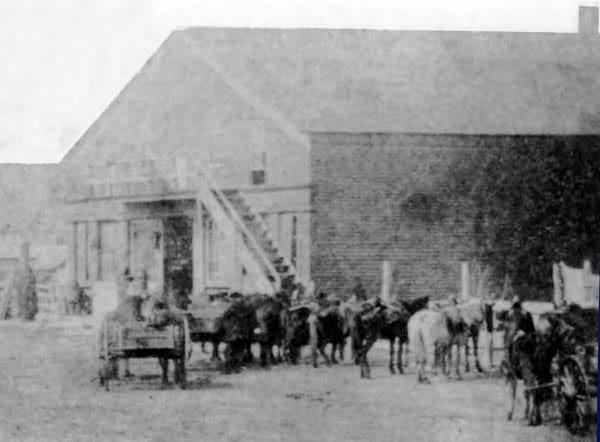
I don’t know about you, but that store doesn’t look very Tartarian to me. I am failing to see the “built out” little town here.
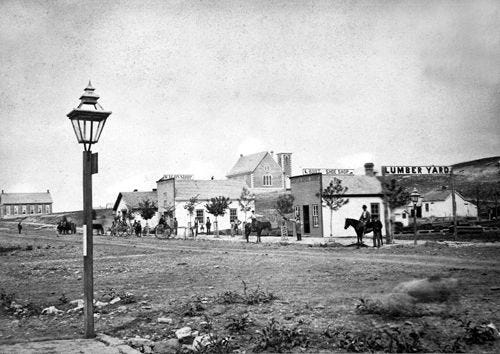
Maybe Jack’s old granddad was simply confused and thought his ancestor Seth Hays Crowley was the same as the Seth Hays who founded the town. The OG Seth Hays looks like a total legend—grandson of Daniel Boone and cousin of the remarkable mountain man Kit Carson.
You can verify for yourself whether or not anything in Council Grove today has any “old world” appearance to it. https://www.councilgrove.com/history
What we see about JJ Crowley, who is claimed by Jack to be his Great-Grandpappy, is very little from this record, except it lists him as a member of the 47th NY Infantry. That’s good luck, because the military has records on enlisted men that we can go find.
First I verified on the National Parks Service website that a John J Crowley was in that battle unit.
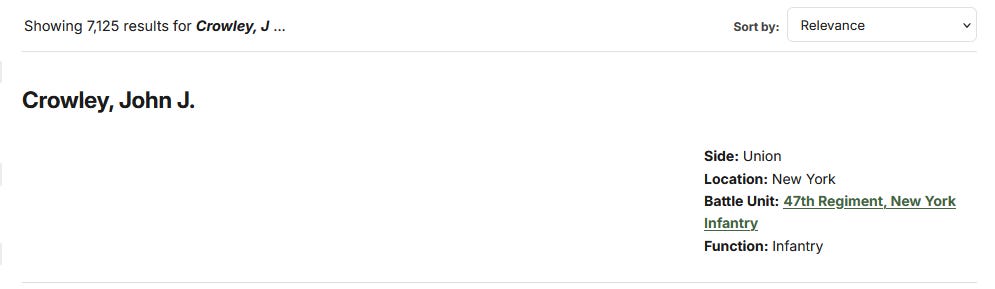
Then I went to a New York government site, https://museum.dmna.ny.gov and pulled the Unit Roster for the 47th Infantry regiment. They actually had two John Crowleys, but I think the first one is our man, because the second has the wrong middle initial.
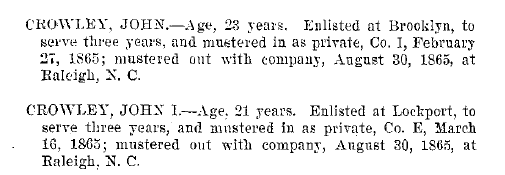
Enlisted at age 23 on Feb 27, 1865. That puts his date of birth as 1842. Remember in Jack’s original comment that got Logan talking to him, he said that his great-great-grandfather “found” the town in Kansas in 1840. Seems pretty tough to become a “high mason” and found a town, all before you’re even born!
At this point, I lost any shred of doubt that the story was false. I said as much to Logan in a direct message. He conceded that the story had “a ton of holes” but insisted “definite connection” without any other context. I then told him that I thought this Jack fella was spinning a yarn, and have not heard back from Logan since.
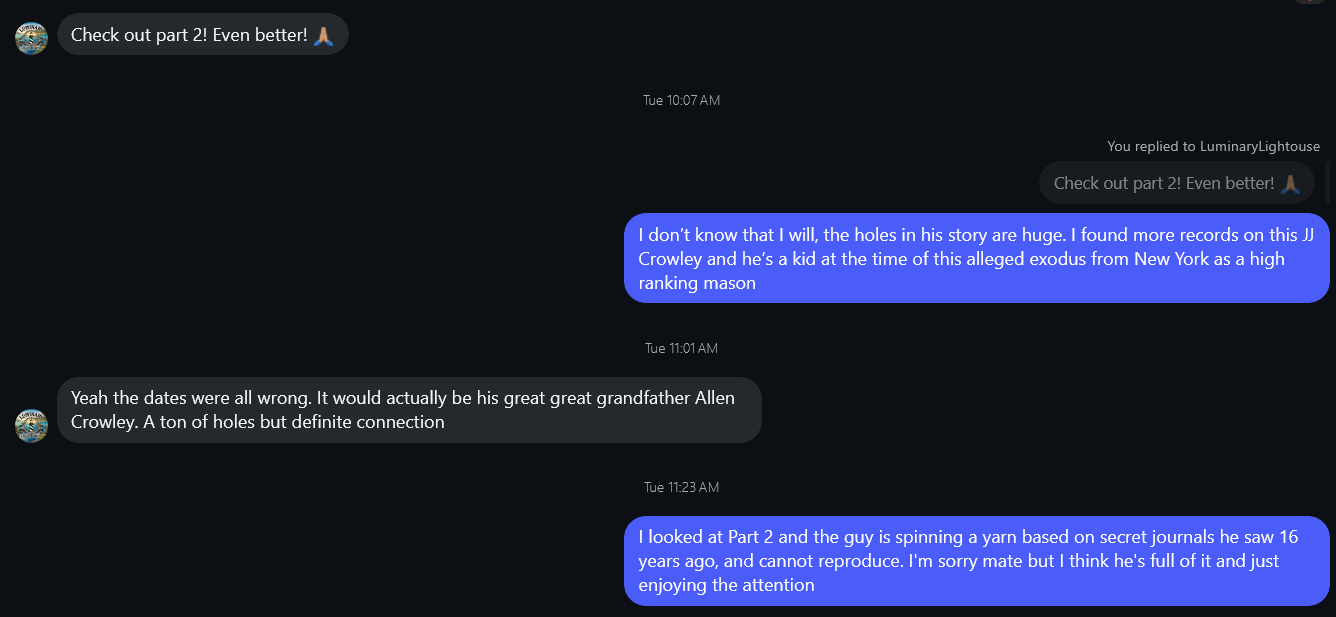
Going back to the cemetery record, Allen Crowley, mentioned by Logan here as the secret true founder of Council Grove, was born in 1822 and died in 1891. So if it was him, he’d have been 18 years old at the time of those illustrious achievements in 1840, according to Jack’s original Facebook comment.
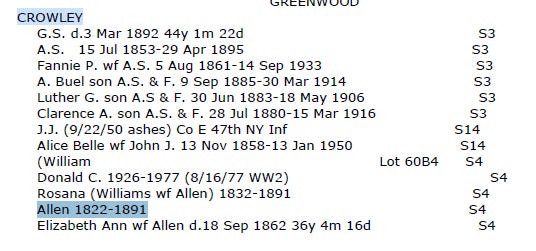
But maybe Jack just didn’t have his story straight when he left that comment. After all, he says he’s basing this knowledge off family stories he heard as a kid, which would have been many decades ago, probably the seventies. As we’ll see in a later clip, Jack changes his mind about the founding date. His exact words: “we’re speculating, 1850 to 1854…ish.” That’s a significantly different timeframe, but JJ Crowley is still only 8 to 12 years old. Allen would be 30 in this range. As I will show you, what’s actually said about Allen Crowley in the video is very brief.
This is where Logan tries to help Jack out and provide him with the only ancestor who might actually fit the “came between 1850 and 1854” claim. I found the page he’s looking at a screenshot from. It’s a digitized version of Kansas: a cyclopedia of state history from 1912. If the “60 years ago” begins at 1912, that puts Allen’s arrival at 1852. But as you can see, Logan didn’t actually read the entire paragraph. He appears to be zoomed in to the screenshot in such a way that the right hand side is cut off. Where Logan reads, “Allen Crawley, came to that old historic town of Council Grove, and thus the pioneers of the Neosho Valley,” he’s misquoting. It actually says, “and thus was one of the pioneers of the Neosho Valley. My question is, did he do this accidentally and simply not notice that the sentence he read was grammatically incorrect and likely missing a fragment? Or was it a convenient mistake that allowed him to say “it says it right there that a Crowley, Allen Crowley, was the the pioneer of the Neosho Valley.” He stutters on “the” - does he know he’s stretching the truth? Probably. Either way, Allen is not the pioneer, he’s one of them.
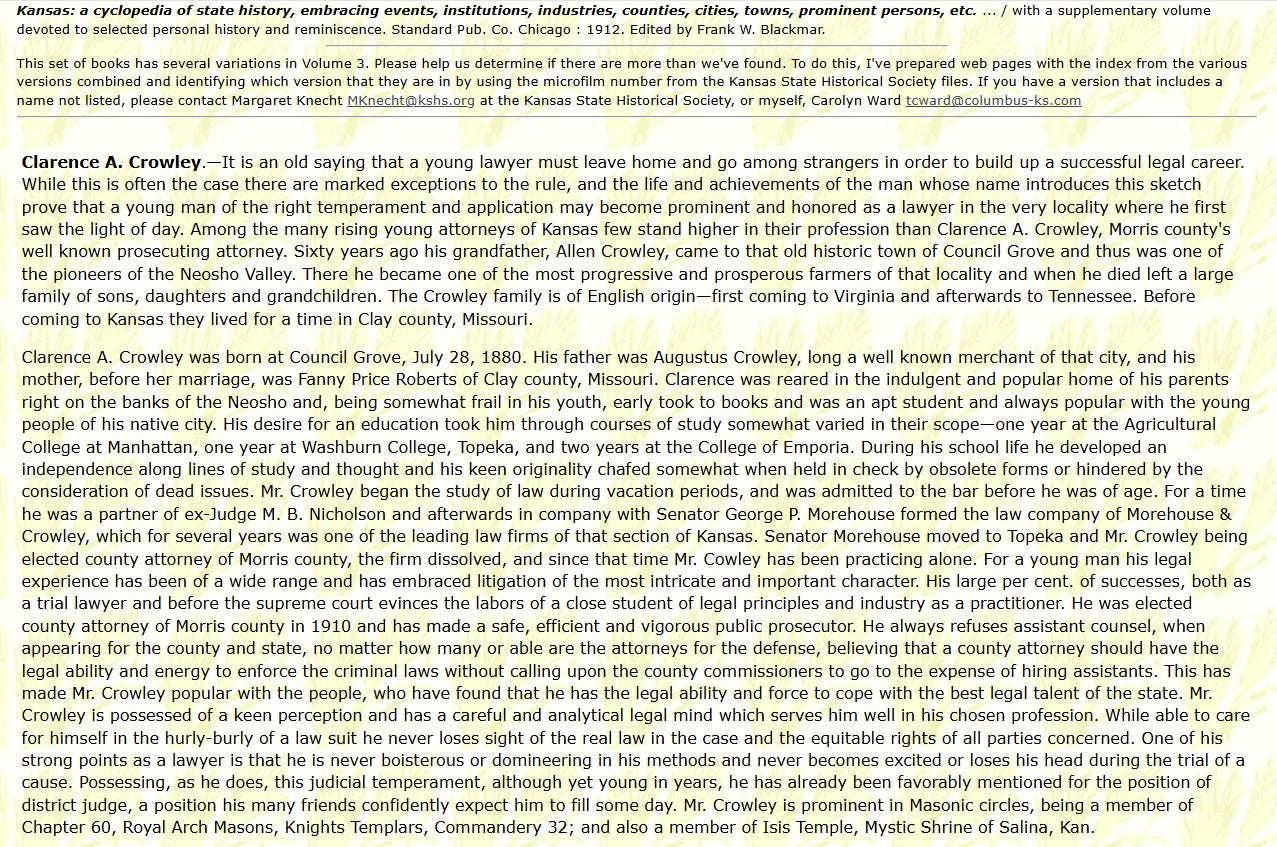
But Clarence Crowley was indeed a Mason, a Knights Templar, and a member of other orders, most likely so was his father. His initials are CC, which is 33. The funny thing about Masons and Tartaria channels is that when it suits their reset narrative, the masons are the most evil organization ever. But when we’re talking about Jack and his family, there’s no shade at the Masonry. For the record, I have nothing against Masons and I think they’re just like every other group of people: some good, some bad. The “every conspiracy = Free Masons” is one of those conspiracy culture tropes that doesn’t hold up. I won’t go into it now, but my basic view is this: sometimes Masons have been involved in conspiracies, sometimes Masonic symbolism shows up in connection to conspiracies, sure. Masonry itself isn’t the problem though, there is nothing inherently evil about the system, unless you’re a religious zealot that thinks everything besides your church is Satanic.
We’ll come back to the ancestral whodunit later when we look at more stuff they say about JJ Crowley, although we’ve already demonstrated that he couldn’t possibly have done the things that Jack claims he did, and Logan clearly knows it, which is why he tried to offer Allen Crowley as an alternate, but it didn’t stick.
The Naming of Council Grove
Here’s where Jack gives a specific location: Council Grove, Kansas. This was not specified in the original comment. Remember that in the original comment, the date given for when this ancestor “found” the town was 1840. Even being generous and granting that the date isn’t exact, numerous historical records refute the 1840 date.


The town is said to have taken its name directly from this 1825 treaty. On August 10th, an agreement was struck between the United States government and Osage chiefs, establishing the creation of the Santa Fe trail, with a guarantee that the Osage would allow travelers to pass through their territory, in exchange for an $800 payoff.
One of the U.S. commissioners at this meeting recorded the events in a journal. George Champlin Sibley wrote, “As we propose to Meet the Osage Chiefs in council Here, to negotiate a Treaty with them for the Road &c. I suggested the propriety of naming the place “Council Grove,” which was agreed to, & Capt. Cooper directed to Select a Suitable Tree, & to record this name in Strong and durable characters—which was done.” He wrote this on August 5th 1825. (See Sibley’s writings here)
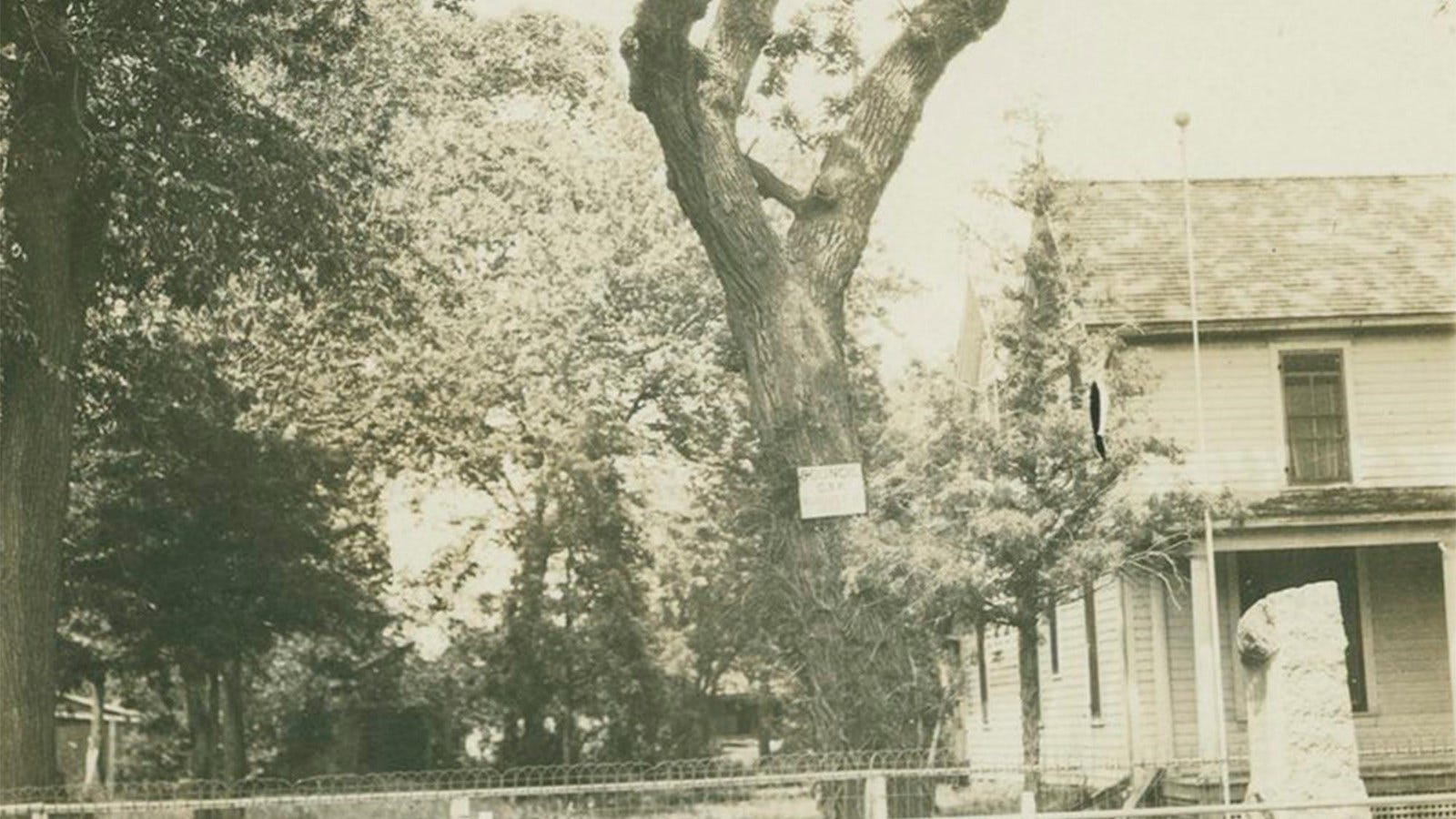
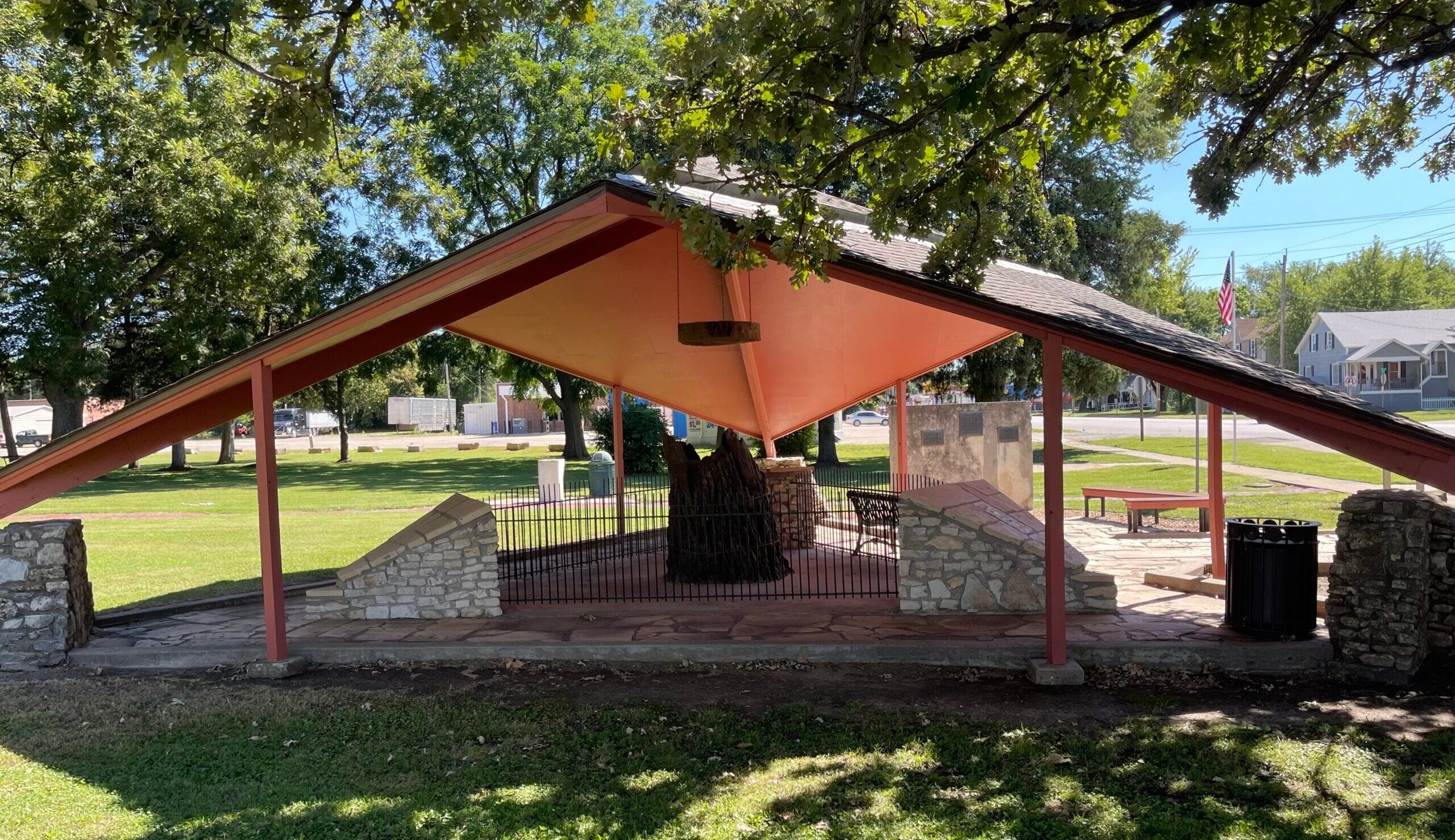
It would be awesome if that carving still existed, but the bark is said to have grown over the writing, long before photography existed. Sadly, the tree was felled by a storm in the late 50’s.
George Champlin Sibley also helped survey the Santa Fe Trail, and helped create this 1825 map. You can see below, “Council Grove” is established on this map. (Library of Congress)
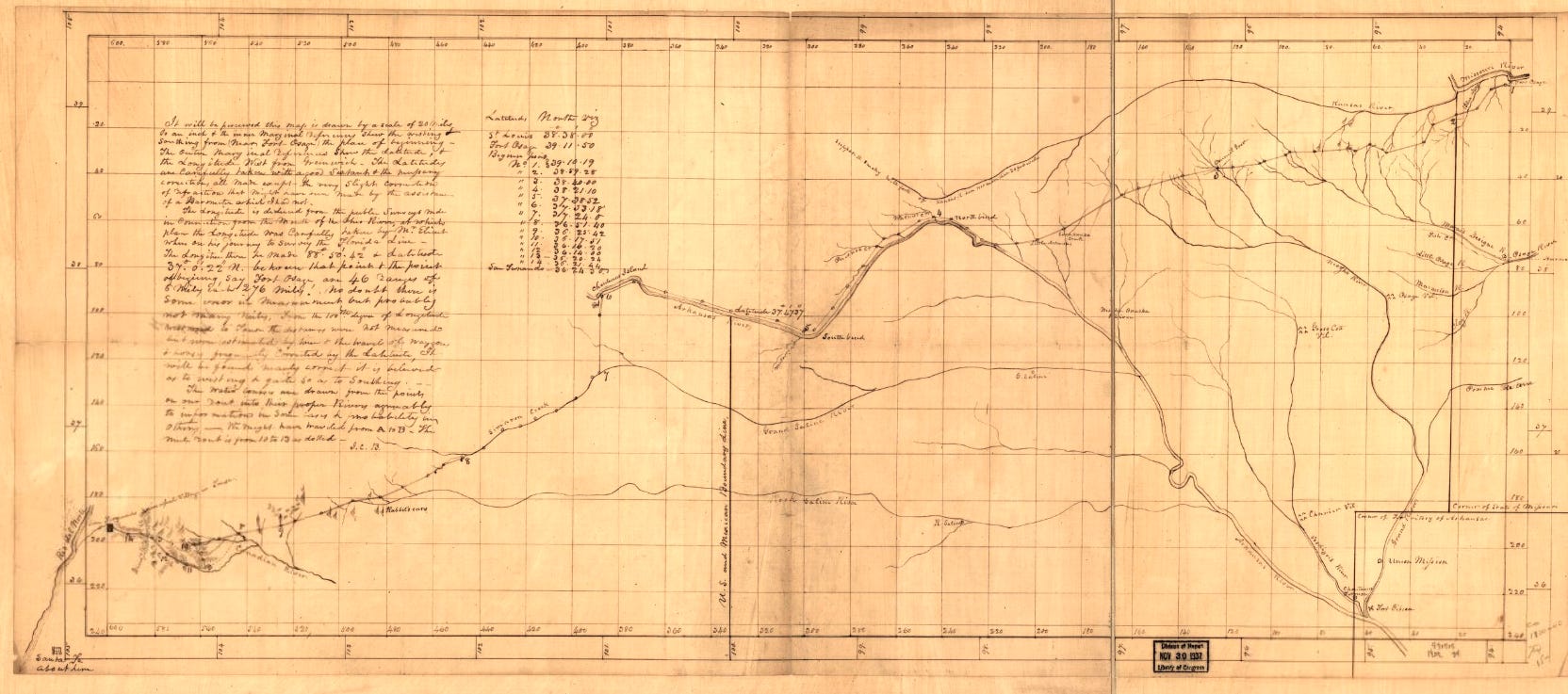
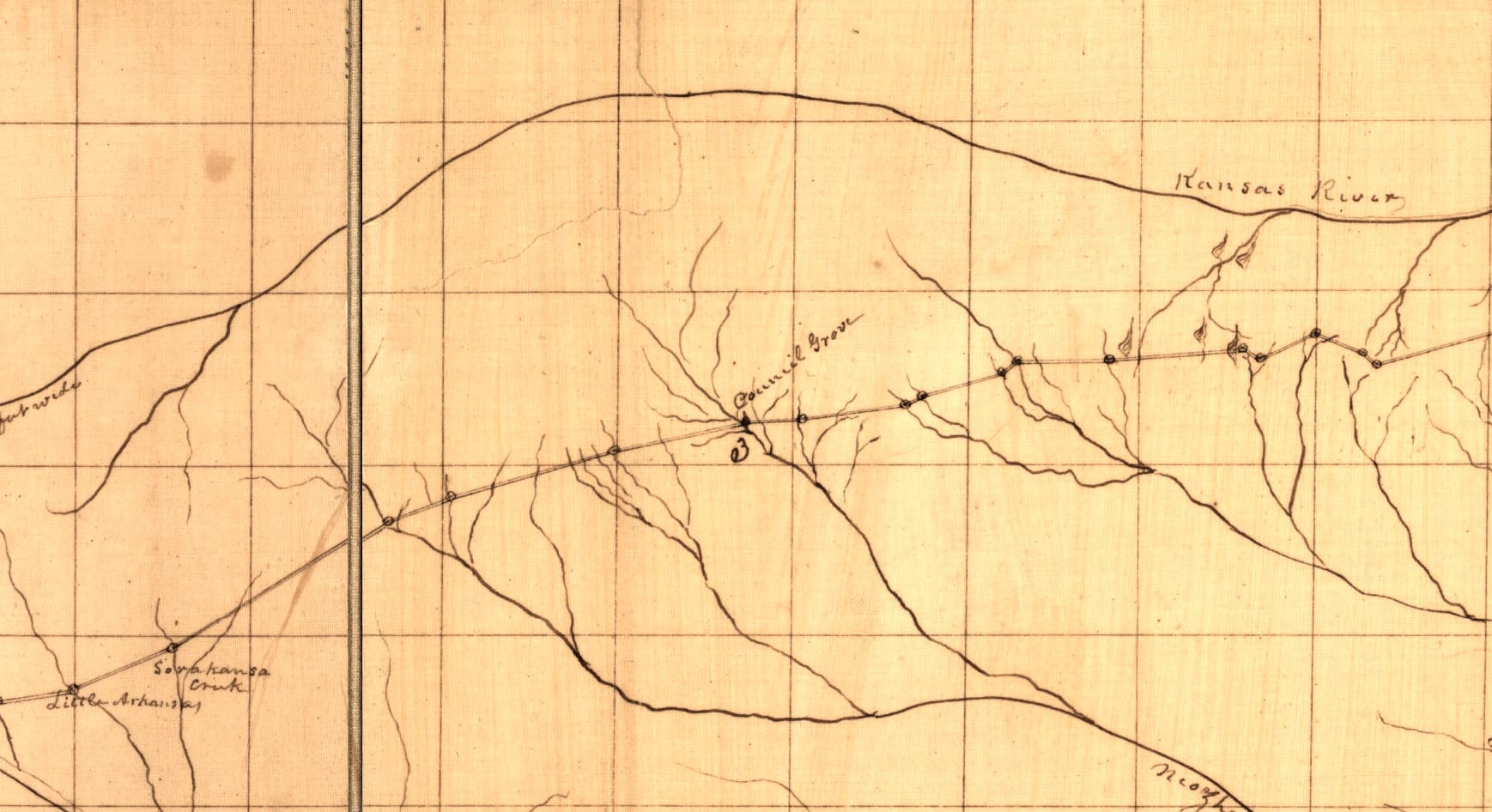
It didn’t take long for Jack’s story to appear fraudulent. As their conversation progressed, Jack and Logan propose a few Crowley’s as candidates for the naming and founding of Council Grove, but there are no Crowleys present in the actual 1825 naming of the location. Of course, the entire thing can be dismissed on its face because he provides no evidence to support his story, and that should have been the first thing Logan noticed. The livestream ought to never have happened, based on that alone. But we will look at a bit more of it, because none of it holds up.
Is it just me, or is this painful to watch? Word on the street was, “there was several cities that were already built out” along the Santa Fe Trail, not just Council Grove, KS! This is just absurd and I can’t believe Logan entertained it at all. This town has a population of about 2200 people. It’s extremely small. Remember the exact words in Jack’s original Facebook comment: “Granite buildings a capital type building in the middle.” Well, there’s no granite, and no capitol building. Maybe the local secret societies tore them down to hide the Old World? I started looking for the oldest photos I could find.
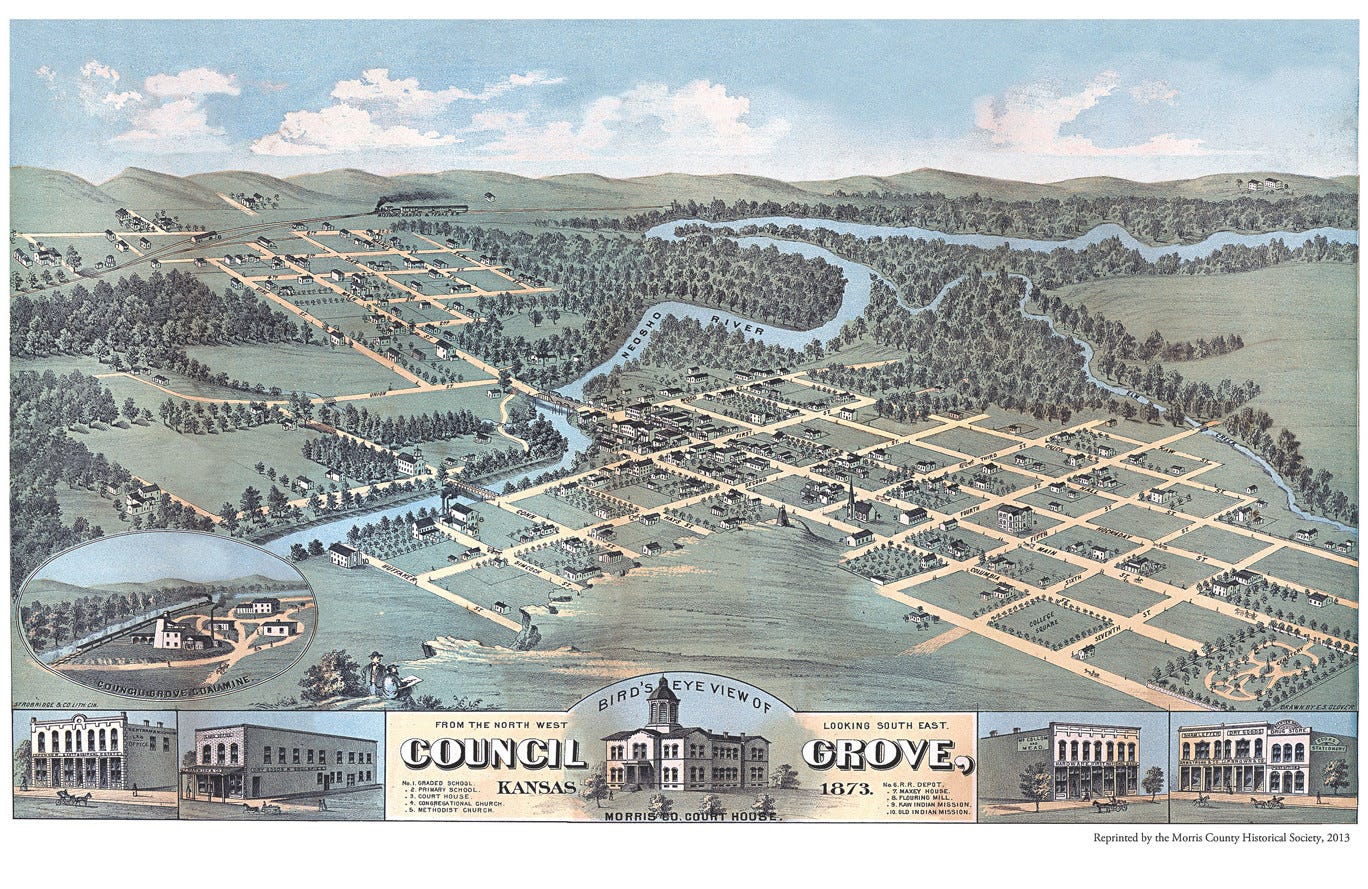
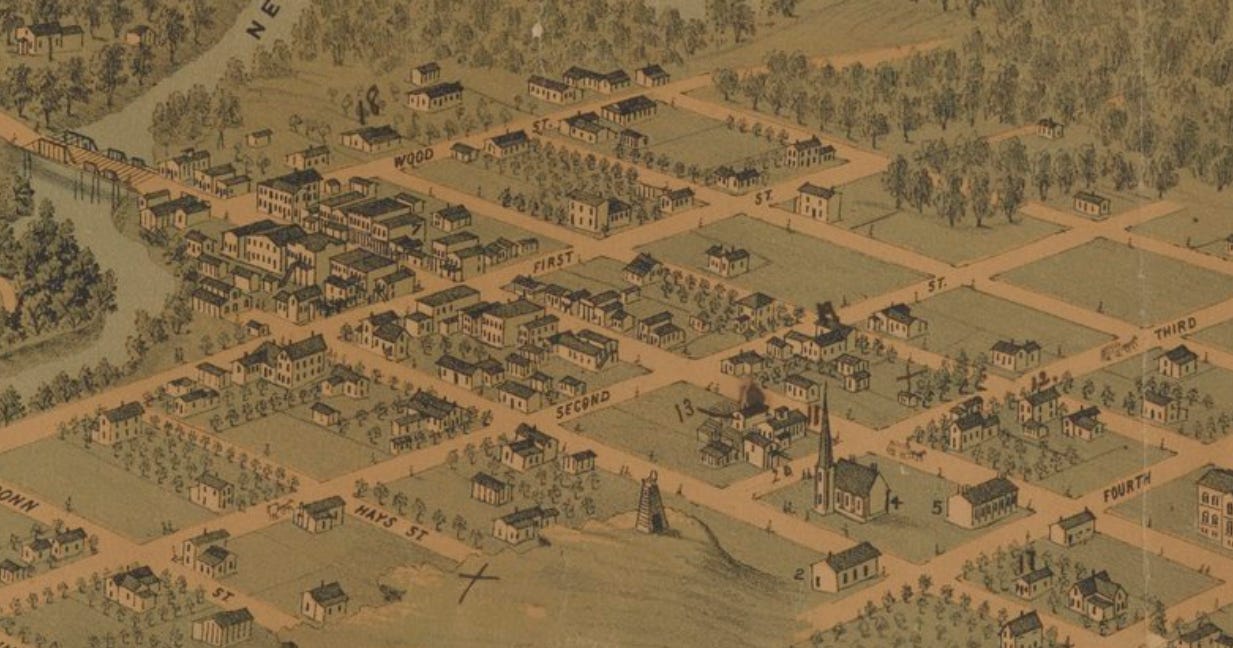
Here we see the layout of Council Grove in 1873, if this bird’s eye view drawing is to be believed. Nothing about this suggests an old world civilization that was moved into by mid 19th century settlers, unless this drawing was made to downplay the town’s grandeur, and hide the granite “capital type” building. My experience with these sorts of 18th century town layout/map drawings is that they are usually somewhat exaggerated in the other direction, making the location look better than reality.
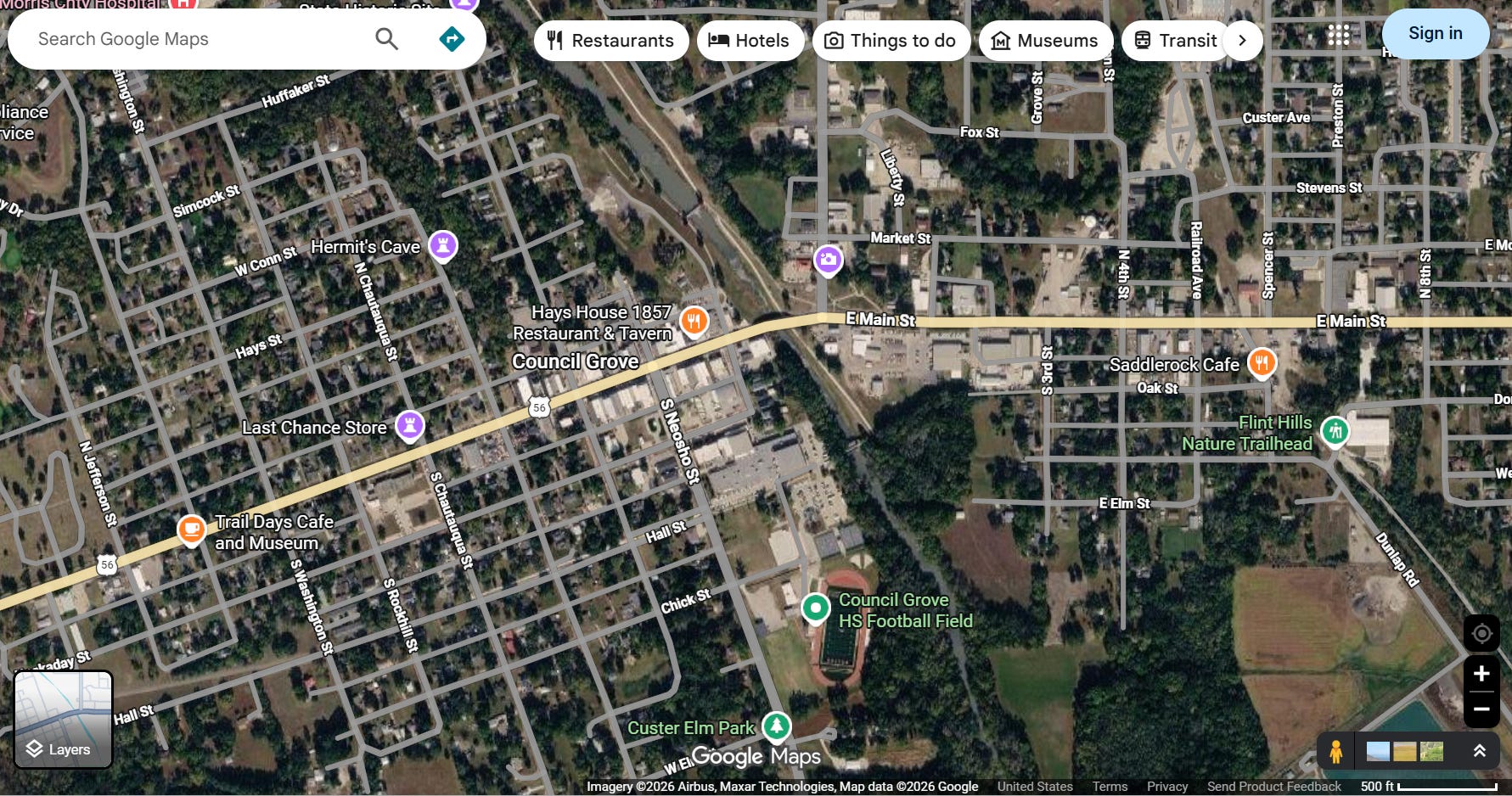
Go look at it on Google Maps yourself. The town honestly didn’t grow all that much. I looked through at street level view all down Main Street and there’s nothing special here. Below are all the old photos I could find of the town.


These are all found at kansasmemory.gov. In the order they appear in the gallery, we have:
W.F. Shamleffer and C.N. James Trading Post
This is a photograph of the W.F. Shamleffer and C.N. James Trading Post, Council Grove, Kansas. Several covered wagons are in the foreground.
Date: Between 1860 and 1870
Street scene
A photograph showing Main Street in Council Grove, Kansas. Visible in the photograph are carriages and people on horseback in front of a boot and shoe shop, lumber yard, blacksmith shop, and a wagon shop. The Congregational Church is visible in the background.
Date: Between 1870 and 1875
Street scene
A photograph showing Main Street in Council Grove, Kansas. Visible in the photograph are horses and carriages on the street in front of several businesses including a blacksmith shop, wagon shop, and boot & shoe shop.
Date: Between 1870 and 1875
Hays House
This photograph shows Hays House on Main Street in Council Grove. Horses on hitching posts and wagons are visible on the street.
Date: around 1860
Main Street
A bird’s eye view of North Main Street, Council Grove, Kansas is visible in this stereograph. Locations pictured include Mrs. J.J. Crowley’s Saddlery, C.M. Reese, Huffaker’s Hall, and several houses on the hill beyond the business district.
Date: late 1870s to 1880s
Van Camps Grocery
This photograph shows the Van Camp, Keith and Tenney, Grocery and Provisions store in Council Grove, Kansas. The business was located on the southeast corner of Main and Neosho Streets, on the Santa Fe Trail. The building was built in 1858. The men pictured are, from left to right: J. B. Flemming, Isaac Sharp, Mr. Martin, Jim Watkins, George Mashons, and G.B. Spencer. The horse team pictured belonged to Bill Watts.
Date: after 1858 (1890’s based on the photograph)
Cottage Hotel
This photograph shows the Cottage Hotel in Council Grove, Kansas, after its 1880 Queen Anne addition was built.
Date: 1950’s or 60’s based on the cars
Old Congregational Church
This photograph of the Congregational Church in Council Grove, Kansas has been extensively retouched.
Date: 1860s
Dr. Woodworth residence
This photo-postcard shows the residence of Dr. Woodworth in Council Grove, Kansas. The handwritten description states that the yard was “full of choice shrubs and bulbs! In 1880 the bulbs would persist in showing themselves every spring.”
Date: 1870s
All of this was very easy to search. Logan and Jack show none of this. Another thing they missed was a “Great Fire” of 1886 in Council Grove. You’d think they’d jump on that, because the genre loves to point out fires and say they were intentionally set to destroy the evidence of the old world. I’m telling you this because it did happen, and I don’t want to be accused of leaving it out. Calling it a “Great Fire” is only relative to the size of the town, they lost a bank, a newspaper office, and six or seven other commercial properties. There’s nothing really strange about a fire in September in Kansas that spreads to more than one wood-frame building.
What’s interesting here is how quickly they rebuilt the downtown. According to the history, they were able to reopen most of the destroyed establishments about a year later. Here’s probably the most notable building of the lot, built in 1887—the Morris County State Bank Building, now called the Council Grove National Bank.
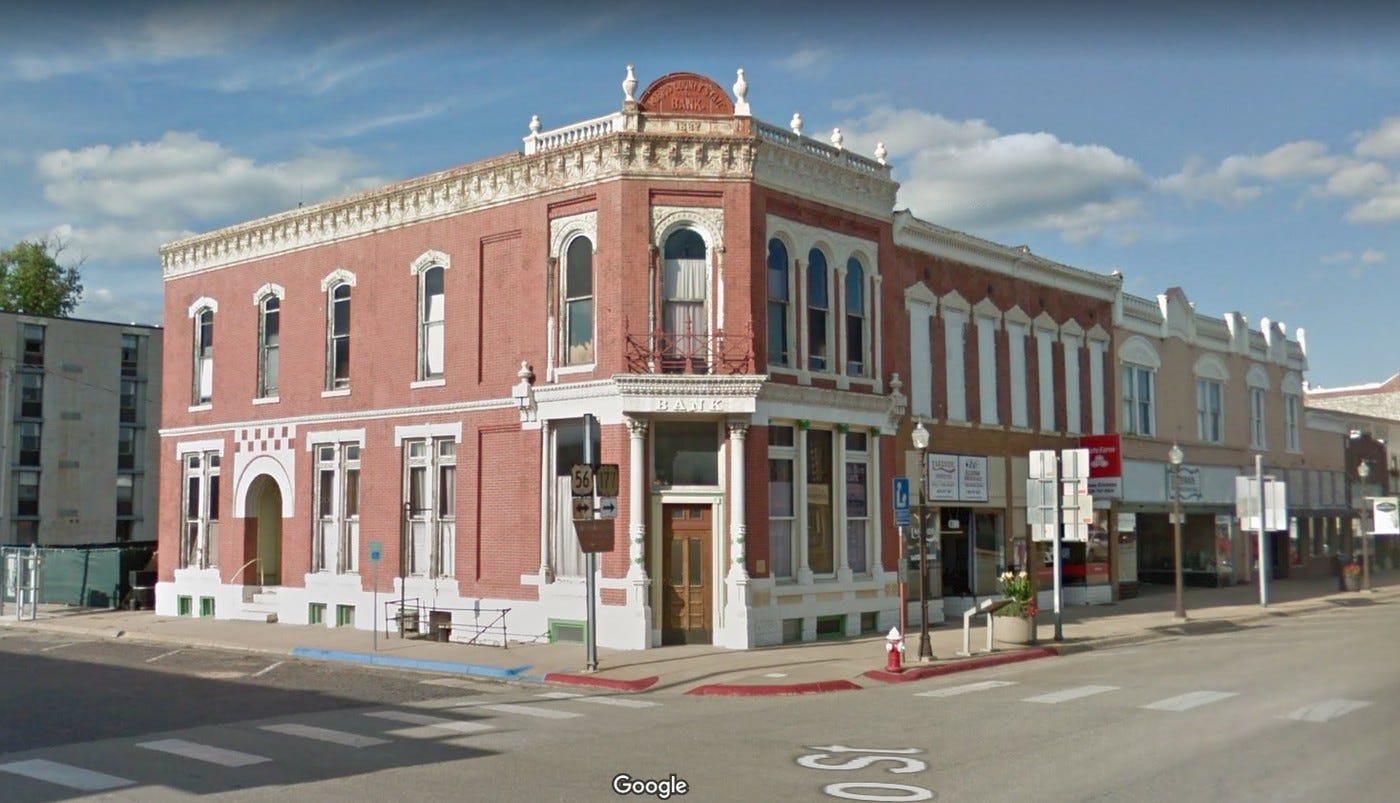
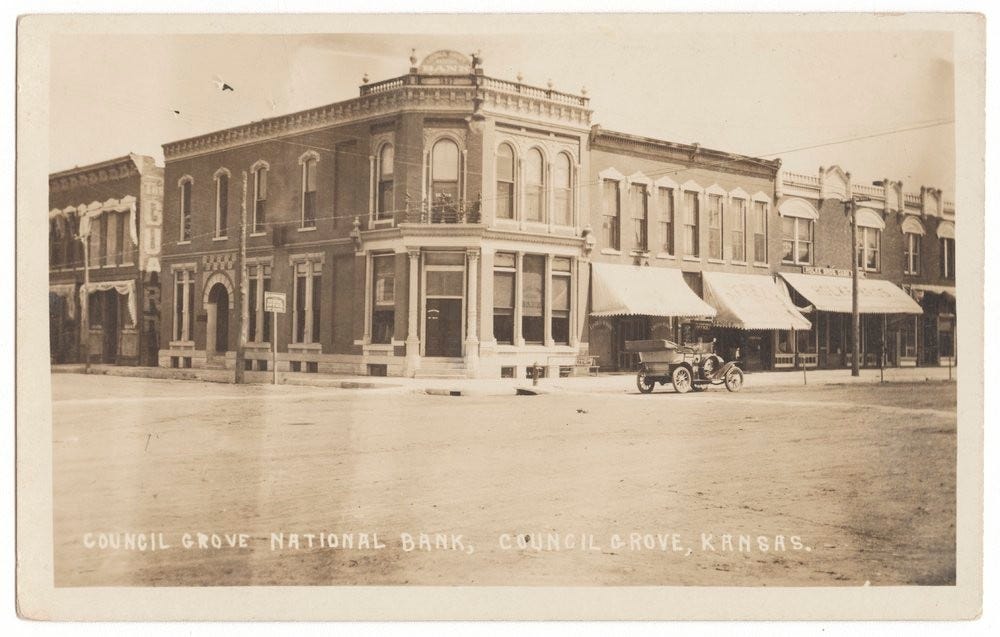
The fire served as a catalyst for a localized construction boom that lasted into the early 1890s, which tracks with the height of the Gilded Age, and Americans being generally more wealthy. The old wooden frame buildings that burned were replaced with brick and limestone ones.
The construction boom culminated with the building of the Farmers & Drovers Bank in 1893.
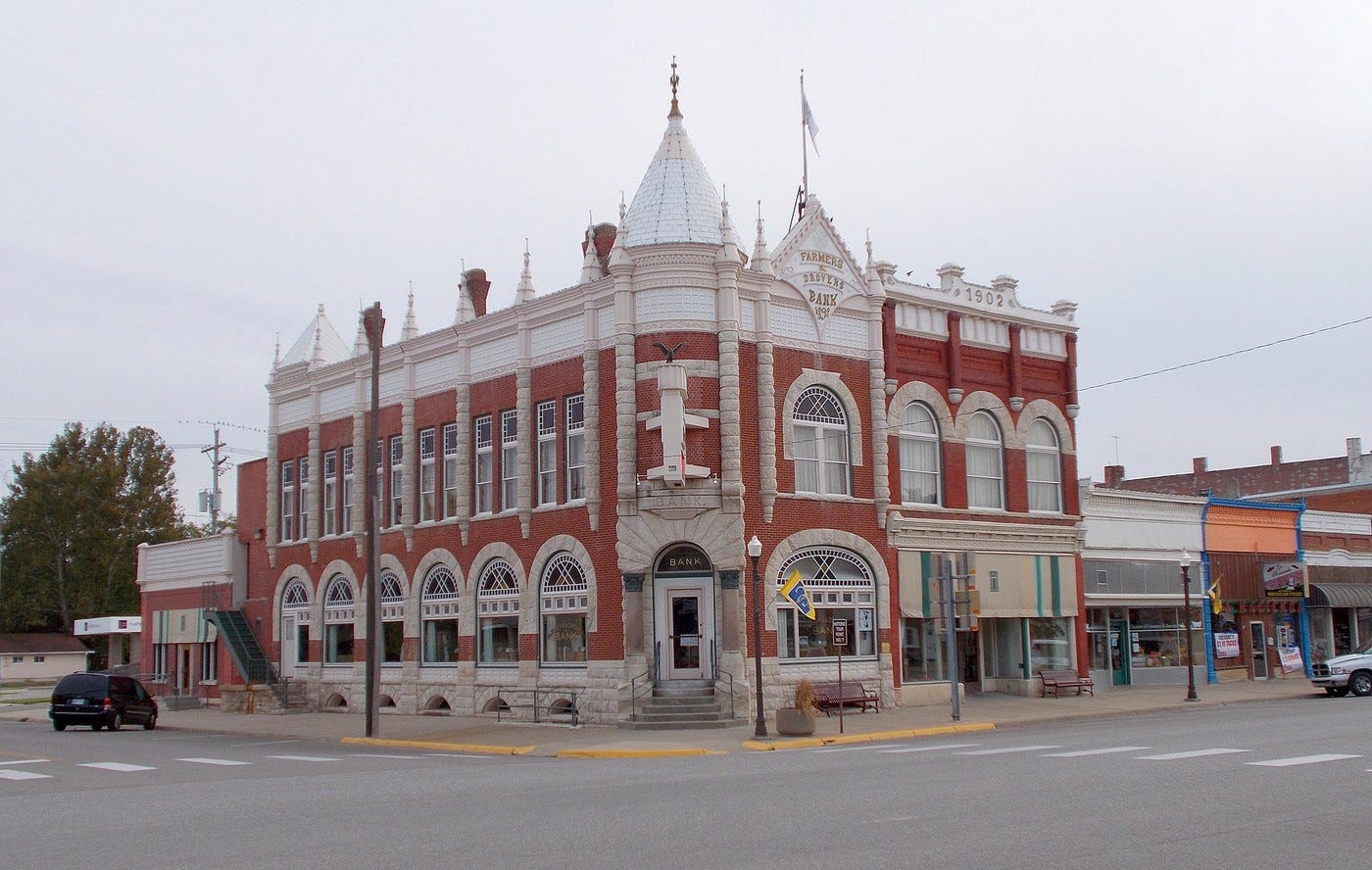
You can take a virtual tour of the historic buildings in Council Grove here: https://theclio.com/tour/1983
But if you’re looking for Old World theory support, it’ll be disappointing. Also keep in mind that Council Grove got a railroad depot as early as 1869, the famous MKT line, so all of the materials they needed could easily have been transported close to the site of the various buildings in question—the town is quite small, nothing is far away, and the railroad depot was right on Main Street.
The Council Grove Courthouse
At one point in the stream, Logan and Jack show the Morris County courthouse, which is the most impressive building in the town. The railroad I just mentioned is less than a mile down the road, the main road.
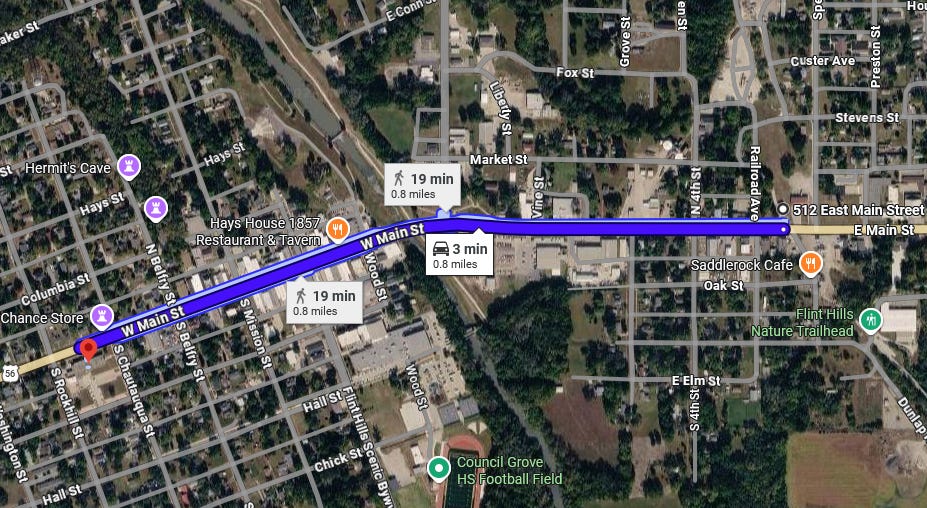
So I started looking into this courthouse. The first thing to get straight in correcting what Logan claimed is the construction date. He says it was built in the 1870s. The historical record states that it was built in 1873, but then added to in 1902.
But this is where things get interesting. For the first time in all my searching, I found what seems like a genuine anomaly. Below is the possibly the oldest photo of the courthouse.
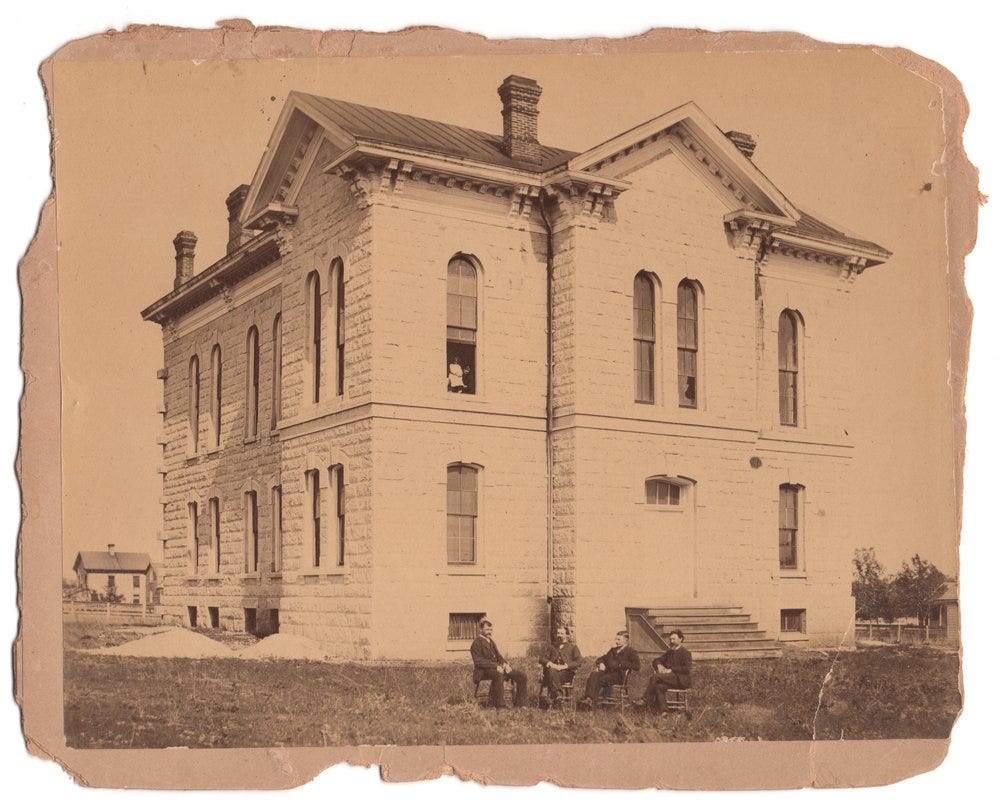
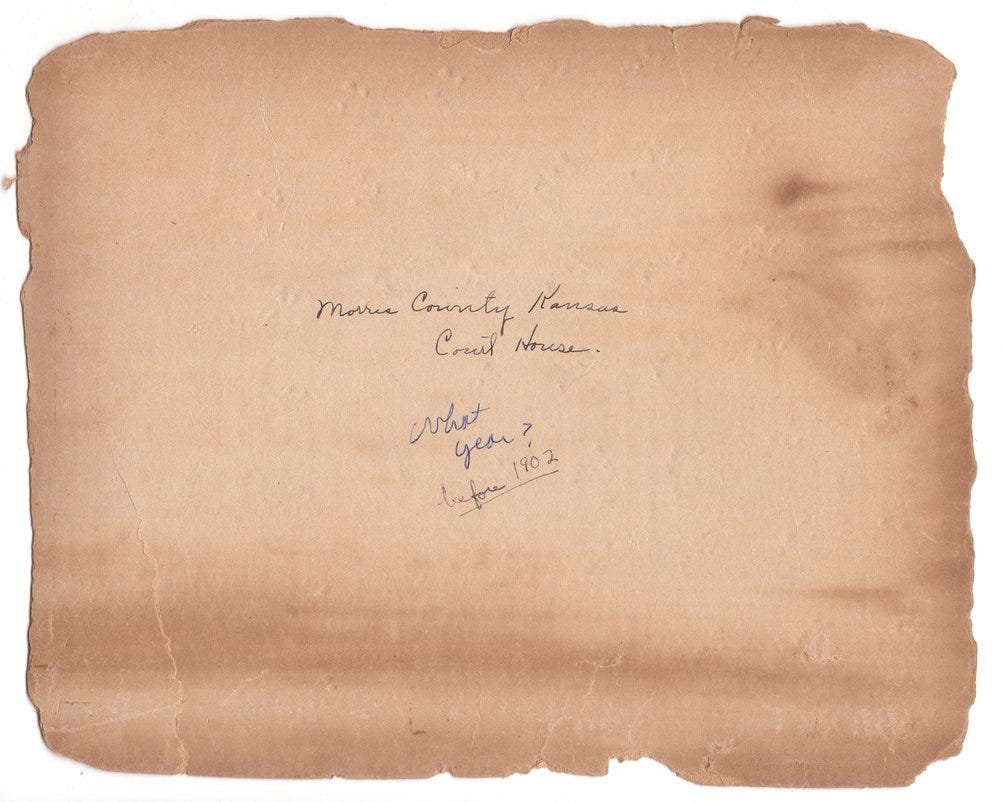
On the back, its labeled “Morris County, Kansas, Court House,” with a different pen writing “What Year?” and a third pen writing "before 1902.” Now, when we compare this photo to the later photo, which comes from a 1950’s postcard, does this look like the same building, with additions made to it?
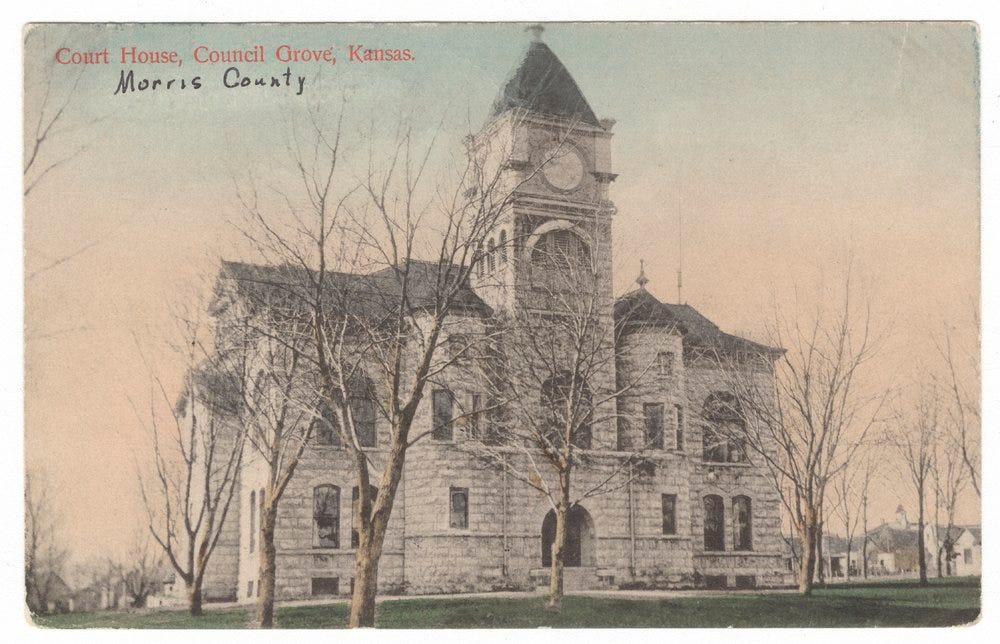
Possibly it is the same building, but it’s very hard to tell, and the additions would have to have been very significant indeed, because the first photo is much smaller.
Here are some more post card photos of the court house from the 20th century.
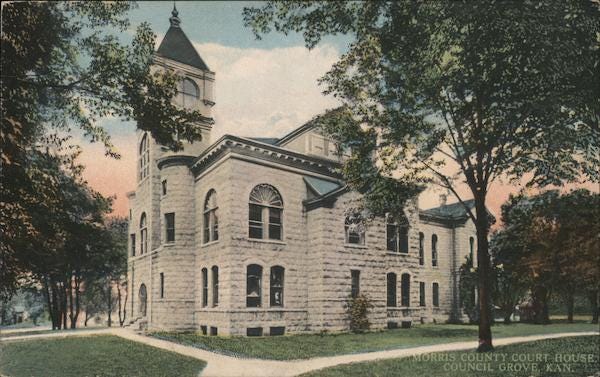
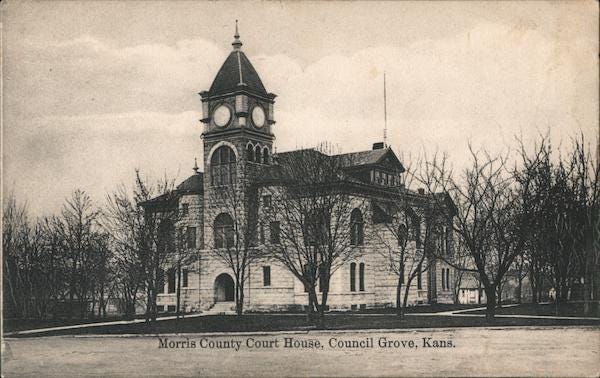
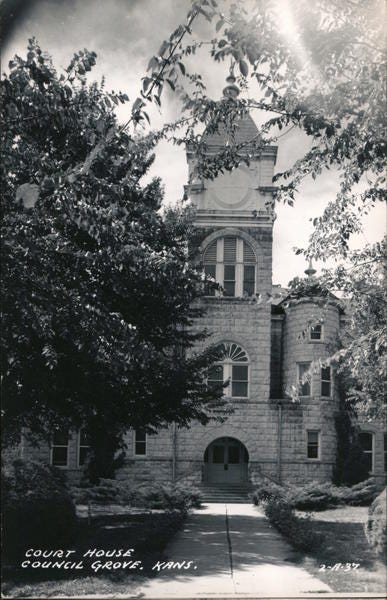
Then I remembered the 1873 bird’s eye view map of Council Grove. That’s the same year in which the courthouse was said to be built. Look at the drawing of the courthouse there. It doesn’t perfectly resemble any of the photos, neither the alleged oldest or the later 20th century ones.
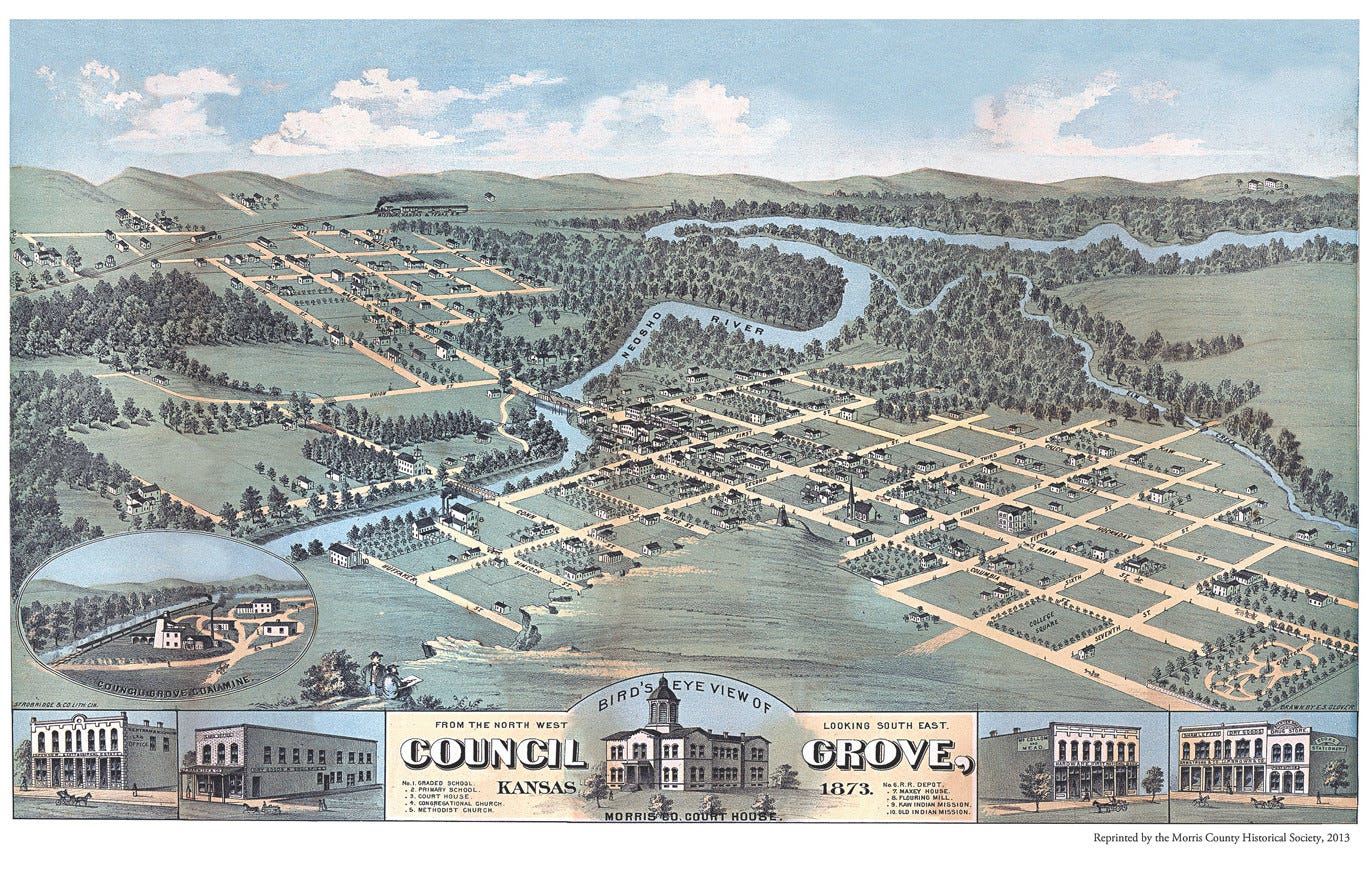
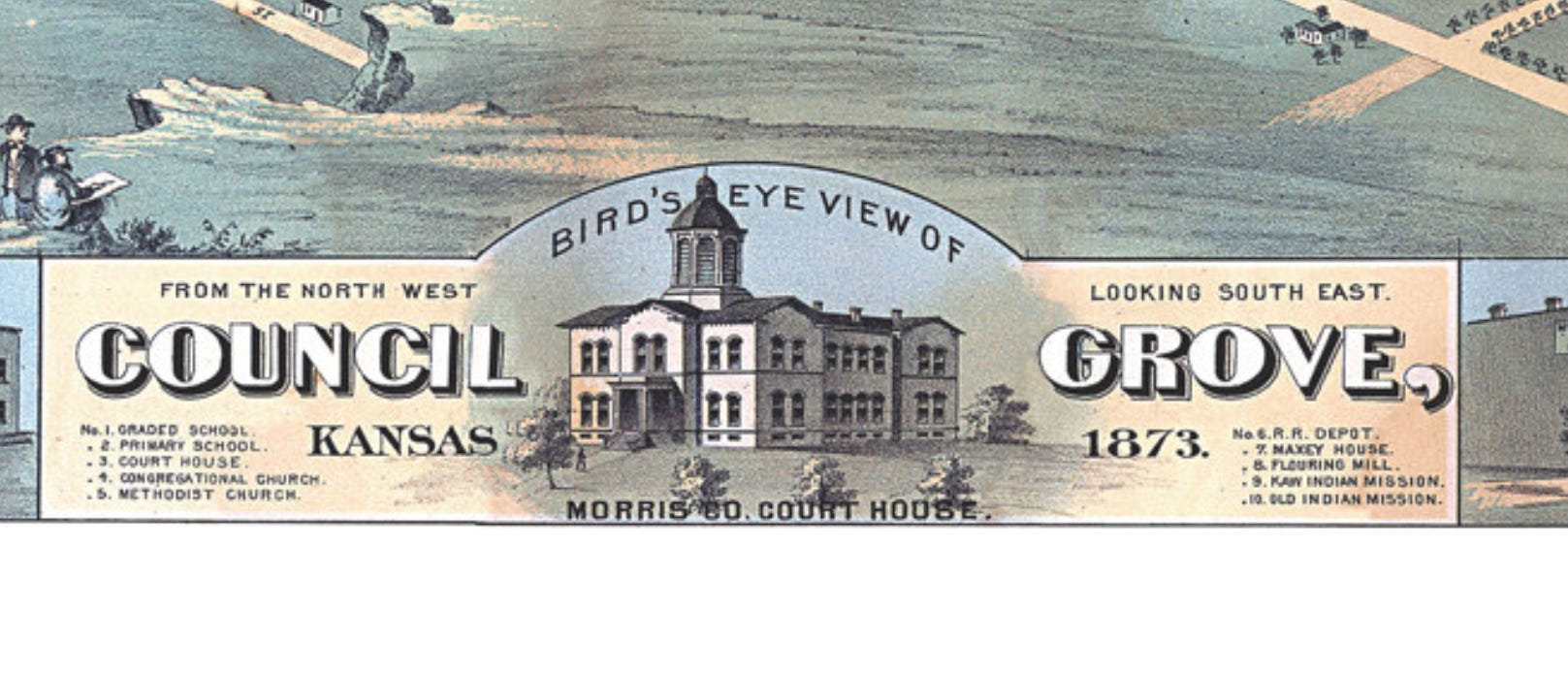
At first I was pretty surprised at this difference, but digging into it more, I realized that the imperfect resemblance of fancy buildings in a panoramic map is typical of those sorts of maps. It’s usually not in and of itself suspicious. This was a whole genre of town maps that was popular 19th century. We saw one like this in the first asylum episode when we looked at Toronto’s map. The Library of Congress describes these maps as “nonphotographic representations” and “not generally drawn to scale.” But that doesn’t account for the size of the courthouse and lack of a tower, in the older looking first photo. The difference in the drawing vs. the supposed original version of the courthouse is too drastic.
I realized there were a few possibilities. First, the photo is incorrectly labeled, and is not actually Morris Co. Courthouse, and the original courthouse did have a tower, which was later improved upon with a facelift, meaning it looked more like the 1873 panoramic map drawing before being updated later. Two, the panoramic drawing idealized the courthouse far beyond what it actually looked like, and the photos are all real, and the renovation of the courthouse changed its size and look dramatically. Three, the historical record is fabricated to hide the Old World reset! I decided to dig further to see if I could narrow down the possibilities.
I went back to The Story of Council Grove on the Santa Fe Trail. It says the court house “was built in 1873 and completed in time for a celebration Christmas night. It cost $15,000.” If this is accurate, we may have answered the problematic panorama map. If that map was published in 1873, but the courthouse wasn’t finished until the very end of the year, the drawing on the map couldn’t have been based on an actual building, at least not a finished one. Unfortunately the “front part was built in 1902” is frustratingly vague about what constitutes “front part” and what was build originally.
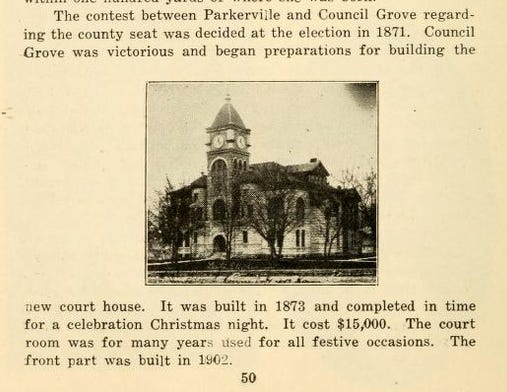
At this point, I needed to start looking at more obscure sources to figure out the courthouse mystery, if you can call it that. I signed up for a free trial at newspapers.com to start scanning through 1873 editions of the Council Grove Democrat. Below is the timeline of the court house project in that year, as reported by the local paper.
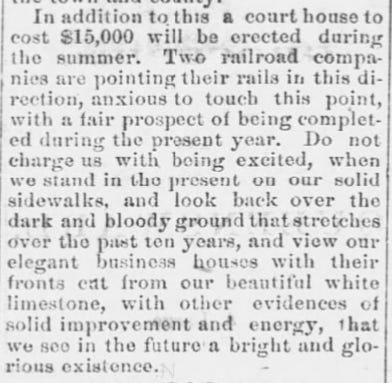
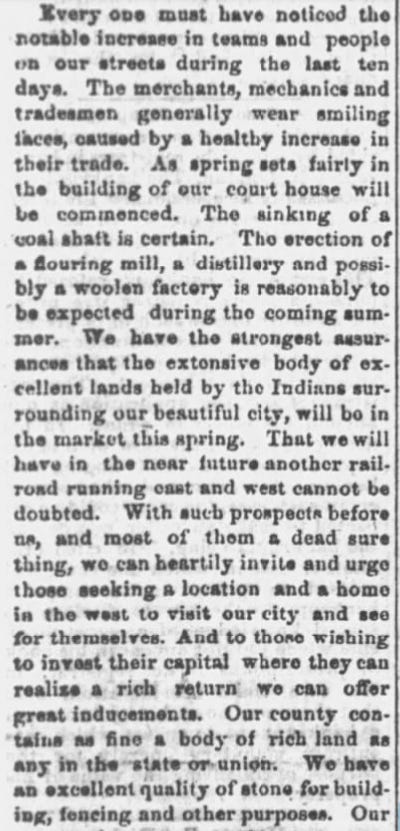
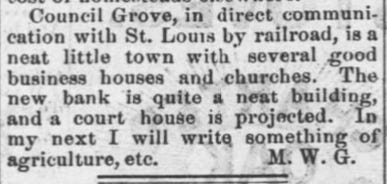
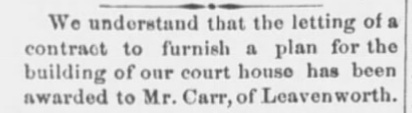
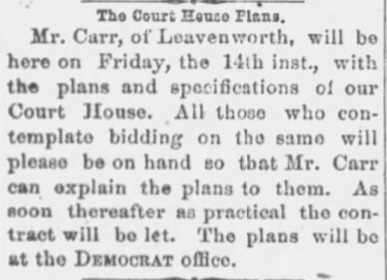
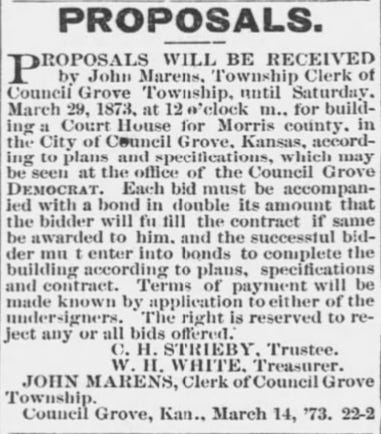
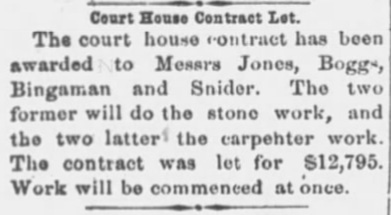
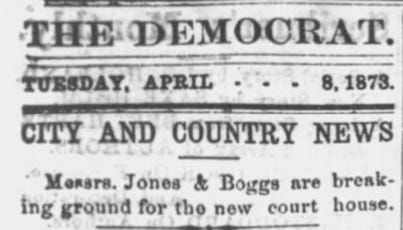
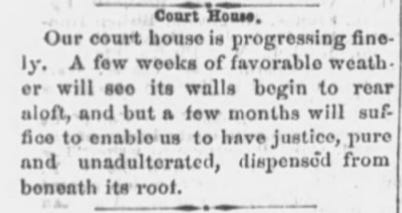
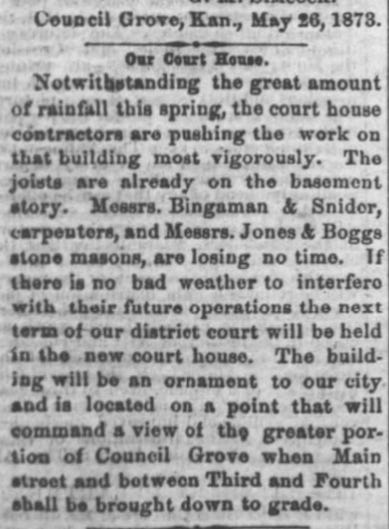
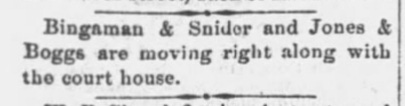
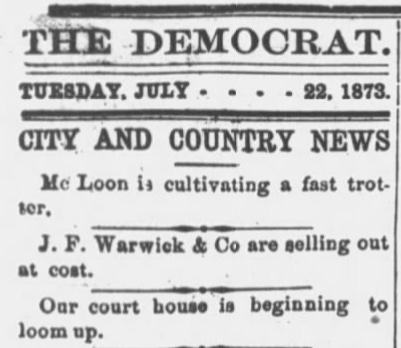
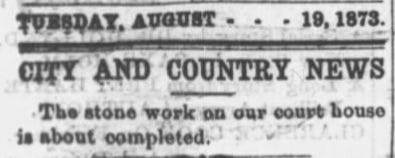
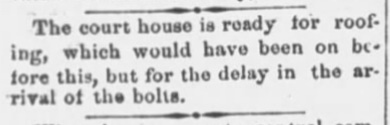
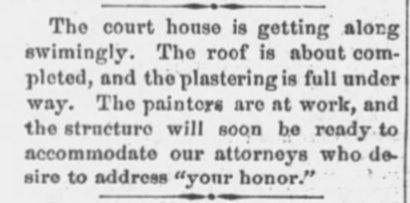

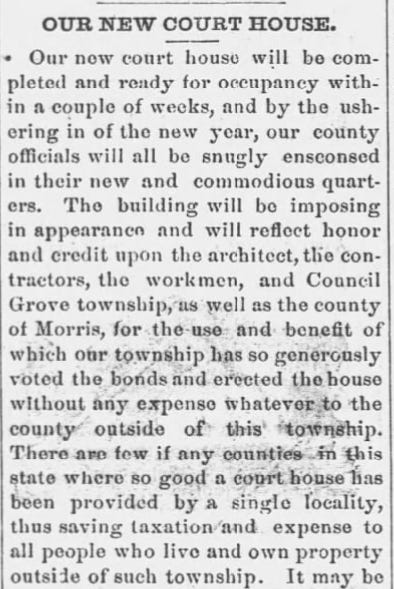
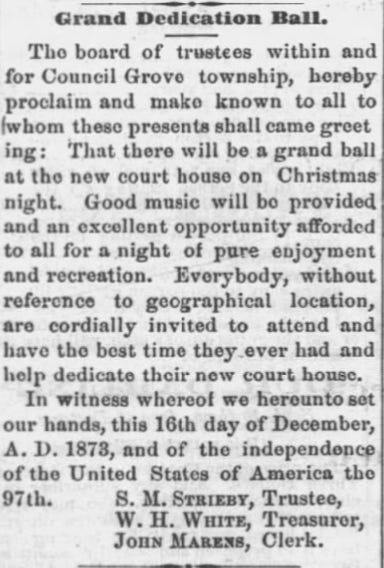
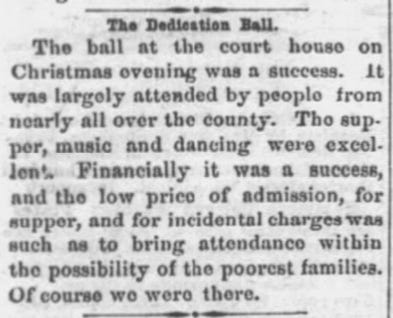
As interesting as this was, and convincing to the fact that the court house was really built in 1873, it didn’t give any information about what form the court house took. Digitized records of architect Erasmus Carr’s plans/blueprints also can’t be found online. Not strange, likely they’re in some old boxes in a county archive, and could be retrieved by contacting them. So I began searching for 1901-1902 records about the additions they made that year.
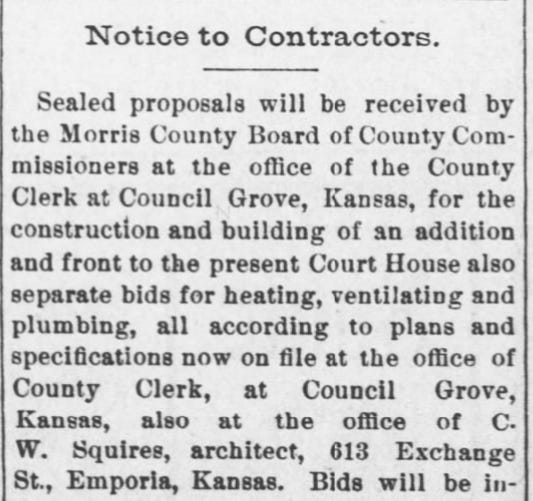
This one confirmed something I needed to know—the county history book had only said “the front part” was done in 1902, but here we read that the renovation was much more significant: heating, ventilation, plumbing, and “an addition and front” to the present Court House. So it was more than just the front, they added on to the building.
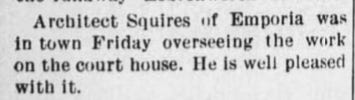
It seems by November 1901, they were well underway. The next year in July, the county commissioners began taking bids again, describing “old and new buildings” to have plumbing, steam heating, and ventilation done. It seems they didn’t select contractors the previous year for that work and instead focused on the construction of the building itself.
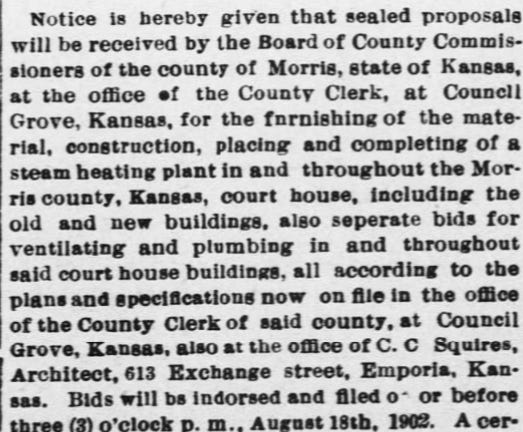

I found numerous issues that published the public accounts of Morris County’s Board of Commissioners, where many of the expenses for the project are listed out line item by line item. This was about the point that I had my fill of looking through the papers, scanning three years worth of newspapers gets tedious.
So the mystery of the courthouse may still be partially open, but I am satisfied enough to say that there’s no evidence of it being “Old World,” just an inaccurate promotional map drawing and a partial question mark on what it originally looked like—most likely the old photo we already saw of it is real.
Returning to Logan and Jack, what is remarkable about their video is how they never even scratch the surface of the court house or county’s history. It’s one of only two buildings from Council Grove that they even show in the stream. I can only chalk this up to laziness, or unwillingness. The latter makes sense, because if they really showed more of the town to their audience, the story of “built out granite buildings” and a “capital type” would instantly fall apart.
Mrs. J.J. Crowley’s Saddlery
The only other image they show of Council Grove is from this August 2016 Facebook post, where they get very excited about Mrs. J.J. Crowley’s Saddlery.
Notice here that for some reason Jack is identifying this picture as the 1860s, even though the caption on the Museum’s post says that it’s early 1900s. Then we get the wild speculation about it being the biggest and best building, so that’s why the Crowleys had it. First of all, it’s not that impressive of a building. I think this moment tells us something important about the psychology of Jack. I’ll explain.
Something I’ve witnessed in older folks is a tendency to embellish or make up things about their family history. I’ve seen this happen in my own family, particularly with relatives who are not very fulfilled in life, feel unimportant, and want to be seen as special. Being connected to a very important historical family, and getting a spotlight for it, might be a way for Jack to feel special and relevant. My father is a genealogy and history buff, and amateur archeologist. I use amateur in the sense of doing it for the love of the activity, not as a profession, but he’s been a relic hunter for decades and in our town is the pillar of that particular subculture. He knows everyone, he leads events for fellow hunters, and he has a shop where he sells the equipment. I ask him all the time about the prevalence of fraud and forgery. My dad and most of his fellow archeological hobbyists are mostly of the same generation as Jack here. My father told me that faking finds and making up family history is something he has seen countless times, apparently for the reasons I already stated: basically a desire to be special or important.
So when Jack tells us that we’re looking at the biggest and best building, even though he’s clearly 100 percent unfamiliar with the photo in question, I think that’s what’s happening, and if you watch him in full, he seems to be coming up with things on the spot to keep the party going. That’s just my take, I could be wrong, but I can’t help but speculate on the motivations of this guy—he has nothing else to gain from his fib except attention. Incredibly, Logan feeds right into it, he even goes on a tangent about how much money you’d make with a saddlery in the horse travel era.
I was looking for more info on this saddlery and found a local history book: The Story of Council Grove on the Santa Fe Trail, written in 1921 by Lalla M. Brigham, built on her father John Maloy's histories of the town from 1876, 1886, and 1891.
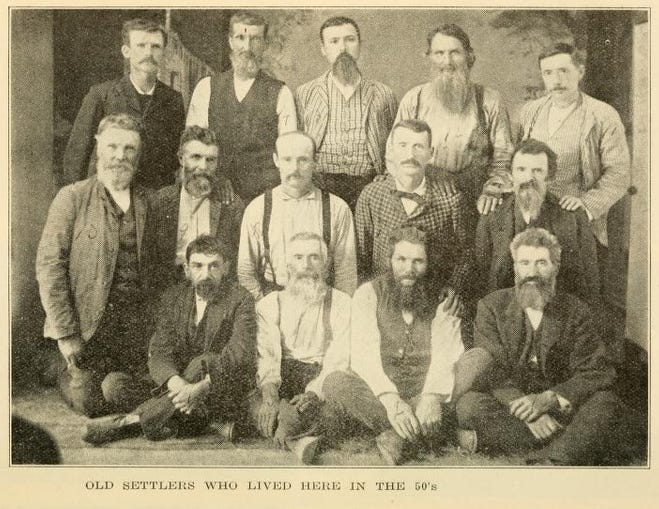
I found a few details of note in this book. First, that the Seth Hays Crowley was indeed named after the original first-pioneer of the town. And somewhere in the photo above is Allen Crowley. On page 21, this book says, “A. J. Collier and Allen Crowley were counted as old settlers when a photo was taken about 1880 of a group of men who lived here in the 50’s. Both had farming interests near town and were closely connected in business and church relations, being active in the M. E. church. South. Mr. Collier held several county offices. Mr. Crowley has one son, Seth Crowley, and one daughter, Mrs. Will Welch, living here now.”
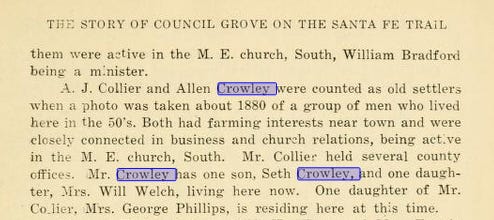
This confirms what we already found out before, that Allen Crowley came in the 50s. Now remember, the last clip I showed you, they looked at this 1900s Saddlery and Logan says these exact words: “So boom. It’s it’s got the name JJ. That’s the man. That’s the man we’re talking about.”
But that man was not a pioneer settler, he was a son of one. Elsewhere in the video, they have this to say about the ambiguous great or great great grandpappy.
This is what I mean about needing to feel special because of being connected to someone important. But ask yourself this: if Allen or JJ Crowley were “unofficial mayor” of the town, why does the book we just quoted say nothing about it? In the very paragraph that mentions Allen, another gentleman named Mr. Collier is said to have held several county offices, but nothing of the sort is said of Allen, only that he had farming interests and connections in business and church.
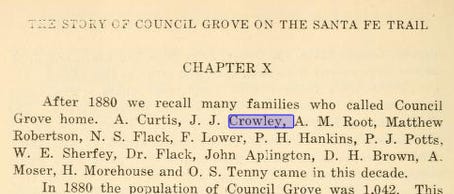
But all this time we’ve been assuming that J.J. must be the son of Allen Crowley, but that appears to be incorrect. Chapter ten of the book begins with this: “After 1880 we recall many families who called Council Grove home. A. Curtis, J. J. Crowley, A. M. Root, Matthew Robertson, N. S. Flack, F. Lower, P. H. Hankins, P. J. Potts, W. E. Sherfey, Dr. Flack, John Aplington, D. H. Brown, A. Moser, H. Morehouse and O.S. Tenny came in this decade.” If this is true, J.J. Crowley arrived in Council Grove in the 1880s, he wasn’t born there. And that totally tracks to what we found about John J. Crowley in the 47th infantry records of New York. He was from New York, fought in the Civil War, and then later moved to Kansas. These two Crowleys may not even be closely related. I believe Jack is probably descended from JJ, and there’s some kernel of truth to the old family history in the town, but it’s a very tiny kernel, that JJ Crowley moved from New York to Kansas, and maybe was a Mason.
The Verdict on Jack Crowley
To summarize what I think happened in this dialogue between Jack and Logan is this: Jack has some real ancestry in Council Grove, but he’s fuzzy on the details. Jack likes Logan’s videos and is into the Old World Reset theory. Jack either misremembers or flat out makes up a story he heard from his grandfather in the 70’s about JJ Crowley. Perhaps it’s a dementia onset thing and he really thinks he remembers this. Or he’s lying for attention. Neither option is very nice to think about, but I can’t reckon any other possibility.
Logan reads the Facebook comment from Jack, and gets excited. Like me, he’s wondered if there are any folks who actually remembered the Old World or the “found dead” structures. He jumps on the chance to talk to Jack, who keeps feeding him the fib because now he’s getting attention from a Youtube micro-celebrity and it feels good. Logan does very shallow searching into the records of the town and the Crowleys, basically just finding out that they existed. That’s apparently good enough proof for him, so he invites Jack to do a stream together. Jack tells a different version of the story on air than he did in the comments. Occasionally Logan stumbles on this fact but never addresses it, preferring instead to try and help Jack look like he’s on to something, because it supports the genre-thesis. They conflate multiple Crowleys, never show any real research or photos of Council Grove, past or modern, except the one of JJ’s saddlery and the Court House. Their raison d’être to speak fizzles out quickly, as Jack knows nothing more than his little story, and Logan has nothing else to show about Council Grove. By 30 minutes in, they’re simply rambling about Jack’s 20th century family tree, and getting excited about secret society memberships of certain forefathers, asserting that being Knights Templar means you basically run the town, and you’d never get to be in the Knights Templar unless you’re related to the founders of the town. I’m serious. Watch:
Compelling stuff, truly. This family discussion wraps up quickly, and by 40 minutes til the end of the 105 minute stream, they get into random template-based Tartaria tangents, millennial reign theology, and other stuff. It’s not my concern to debunk anything else in the video, the first 30 minutes is more than enough to discredit these guys so thoroughly, there’s no reason to grant any more attention to them. They show some impressive capitol buildings, which I intend to look at next, but we will find a different channel than Luminary Lighthouse to analyze.
The Verdict on Luminary Lighthouse
I will preface this section with a disclaimer. I don’t have any agenda against Logan personally. I don’t have any evidence he’s grifting or intentionally deceiving people. What we do have is undisputable evidence that his belief in Tartaria blinded him to being taken for a ride by Jack Crowley… not once, but twice.
Recall my DMs with him. I let him know that Jack’s story doesn’t make sense. He agreed that JJ Crowley couldn’t have been this mystical New York Mason. He says “it would actually be his great-great-grandfather Allen Crowley,” and “a ton of holes, but definite connection.”
Well, I’m not convinced that Jack’s even related to Allen Crowley. Let me show you the free, easily accessible public family tree.
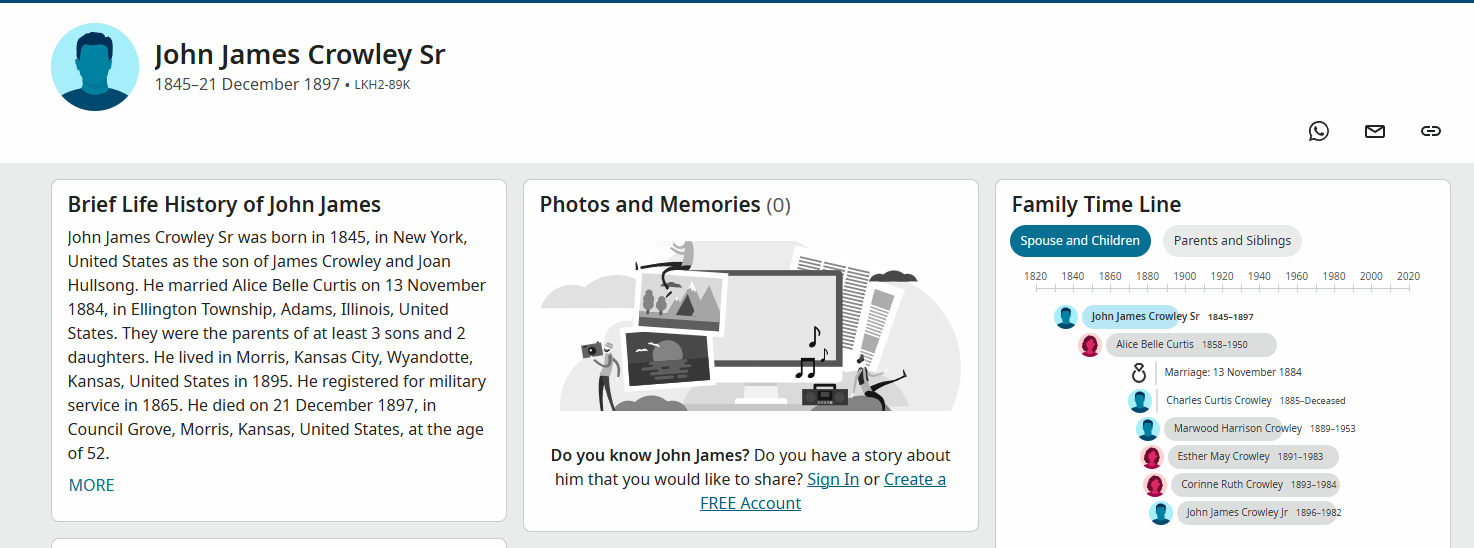
Whoops, Allen Crowley ain’t JJ’s daddy. As I had already suspected based on the fact that JJ moved to Council Grove from New York, after Allen had already been there for many years, the genealogy proves it. And you can see in the screenshot below that Logan actually checked out these people on the same public site that I just showed you disproves Allen’s connection to JJ.
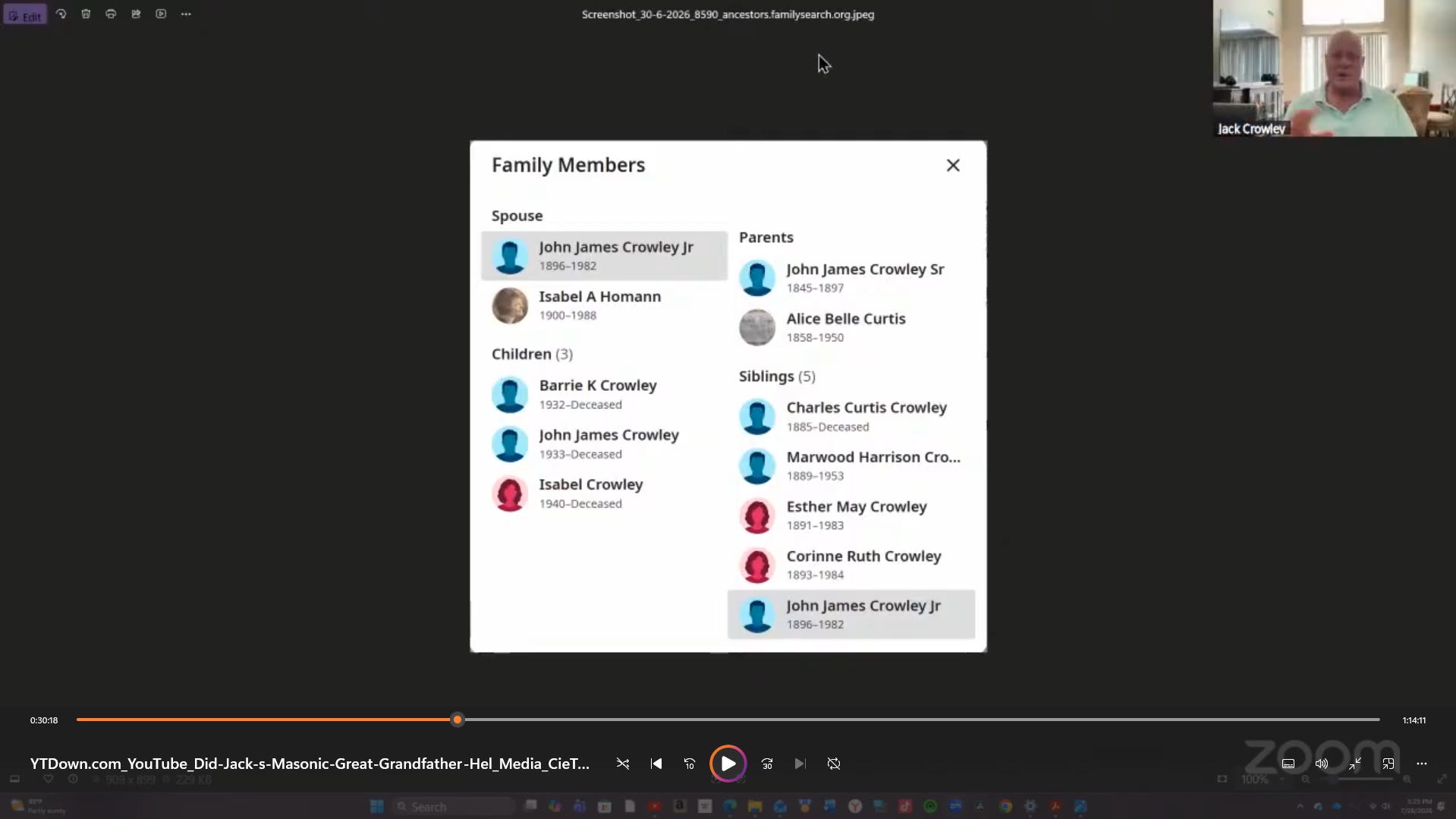
So what’s going on here with Logan? Why did he tell me “it would actually be his great-great-grandfather Allen,” when the evidence shows no connection between Jack Crowley’s family and Allen Crowley? He must know there’s something very wrong with the story, consciously or unconsciously. It’s really obvious that Jack didn’t have it all together when they spoke.
So what about where Logan tells me, “Check out part 2! Even better! (prayer hands emoji).” Is it any better? I’ll show you.
It’s called Did the Mormons REALLY Found Salt Lake City? | Jack Part 2 LIVE! MUST WATCH!!!! The subtitle “Jack’s Story Time” is the most honest part—it’s Jack telling stories for an hour. Let me tell you the story of Jack’s story-time.
This time, it’s not alleged familial oral history, it’s secondhand, from an unnamed co-worker. According to Jack, around 2012 or 2013 a Mormon co-worker showed him diaries belonging to his Mormon family, passed down through the generations. The diary’s author was a fourteen-year-old girl who was “three people behind Brigham Young” when the Mormons arrived at the Salt Lake Valley. By 1852 or 1853, she married Young herself, “before she was eighteen or nineteen.” She kept a diary every night. The coworker showed Jack three journals and read from one of them, and in it the account stated that Brigham Young looked out over the valley and saw a fully built-out granite city already standing, specifically naming the Mormon Tabernacle, the Mormon Temple, and a Capitol Building.
The overall format mirrors their first stream exactly. It’s all anecdotal based on a document that nobody but Jack has seen. Jack says the LDS Church was searching for diaries like these to seize them, and that’s why the coworker’s family kept them secret and they were never to be allowed to be shown to the world. Jack was shown them once, by a man who is now dead, over a decade ago. This is what we call unfalsifiable and it has no bearing in an actual investigation.
That being said, the buildings Jack named have plenty of documented construction history, and construction on the Capitol Building wasn’t even started until 1912. Special boy Jack also makes the claim that “five great-grandmothers back, my grandmother married Brigham Young,” which I guess he needed to do so he could feel like the story made him important. Five great’s back would be the 1700’s, so that’s nonsense too of course.
The stream starts with Logan telling Jack they’re live, because apparently they spoke for awhile before recording. Jack gets visibly worried and says “I can’t remember all the things I said.” That’s a tell, someone making stuff up might have trouble remembering what they made up, a real memory would be easy to retell.
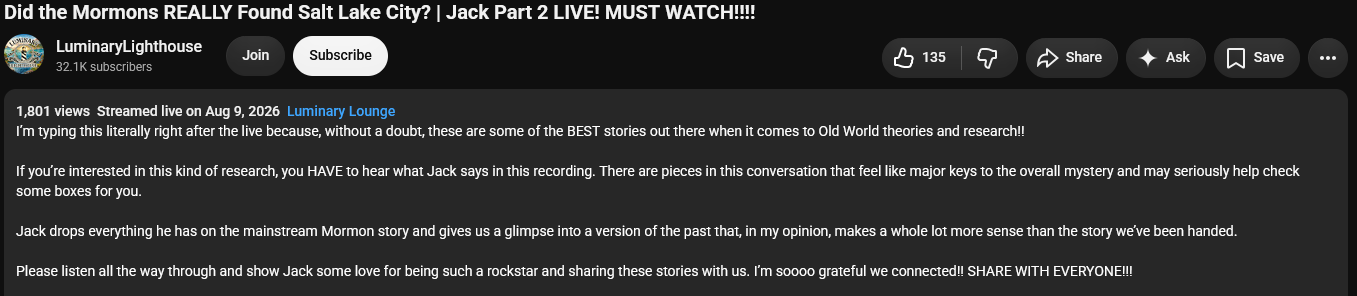
Logan describes this livestream as “some of the BEST stories out there when it comes to Old World theories and research!!” What does that say about him? I’ll let you decide. My opinion is, this is typical of the entire genre of Old World theories, and I hope the analysis we did here was a good lesson for all of us about how we can be blinded to the obvious when we are too attached to a theoretical belief.


